Best Baby Bottles for Dads Doing the Feeds (and What the Anti-Colic Claims Are Worth)
The best baby bottles for newborns, breastfed babies, gas and budget, plus what trials say about anti-colic vents, why nipple levels aren't a standard, glass vs plastic, and how to clean them.
We choose everything we recommend independently. If you buy through our links, we may earn a commission. How we make money

Our quick picks
- Best for breastfed babiesPhilips Avent Natural ResponseCheck price
A wide nipple that releases milk only when the baby drinks, Philips says.
- Best ventedDr. Brown's Options+ NarrowCheck price
An internal vent you can remove later, with a slow-flow nipple.
- Easiest to cleanComotomo Baby Bottle Gen 2Check price
Soft silicone, a very wide neck and only four parts.
In this guide
- The short answer
- Our picks at a glance
- Do anti-colic bottles work? What the trials show
- Bottles for gas and reflux
- Bottles for breastfed babies
- Nipple flow: why “Level 1” isn’t a standard
- Glass, plastic or silicone?
- Warming a bottle
- Cleaning: how often and how
- How many bottles, what size, and when to replace nipples
- FAQ
- Sources
If you’re doing the bottle feeds, here’s the most useful thing we found: the bottle matters less than the box suggests. David Hill, in an AAP book for dads, writes that he hasn’t “seen good scientific literature that supports these claims, so I can’t recommend one brand over another,” and that “More important than the type of bottle or nipple you use is how you position your baby when she eats.” So buy a small test set, learn to pace a feed, and use this guide to skip the claims that don’t hold up. Five picks follow, checked against maker pages and the CPSC recall database. We haven’t tested them ourselves.
The short answer
- No bottle is proven best. The symptom checker on the AAP’s site says “Any nipple/bottle products are fine.”
- Start small: two or three kinds of small bottle and the slowest nipple. Babies have preferences.
- Pace the feed: hold the bottle as level as you can while milk fills the nipple.
- Full-time bottles: 6 to 8 bottles covers a day at 3-to-4-hour feeds.
- Always: never prop a bottle, no bottle in bed, no feeding lying down.
Our picks at a glance
| Bottle | Material | Starting nipple | Dishwasher | Best for |
|---|---|---|---|---|
| Philips Avent Natural Response | Plastic | Slow, 0-3 months | Yes | Breastfed babies |
| Dr. Brown’s Options+ | Plastic | Level 1 | Top rack | Gassy, gulpy feeds |
| Evenflo Balance+ Wide | Plastic | Slow, 0-3 months | Top rack | Stocking up on a budget |
| Lifefactory glass | Glass with silicone sleeve | Stage 1, 0-3 months | Yes | Avoiding heated plastic |
| Comotomo Gen 2 | Silicone | Slow, 0-3 months | Top rack | Easy cleaning |
None had a CPSC recall as of November 2026.
Best for breastfed babies: Philips Avent Natural Response
A 4-ounce bottle with a wide nipple. Philips says “The nipple has a unique opening which only releases milk when the baby actively drinks,” which suits paced feeding. We picked it for that design, not because it’s proven closer to the breast; Philips says it works like a breast, and no good evidence shows that. It’s dishwasher safe, and the bottle only fits Philips Avent Natural nipples.
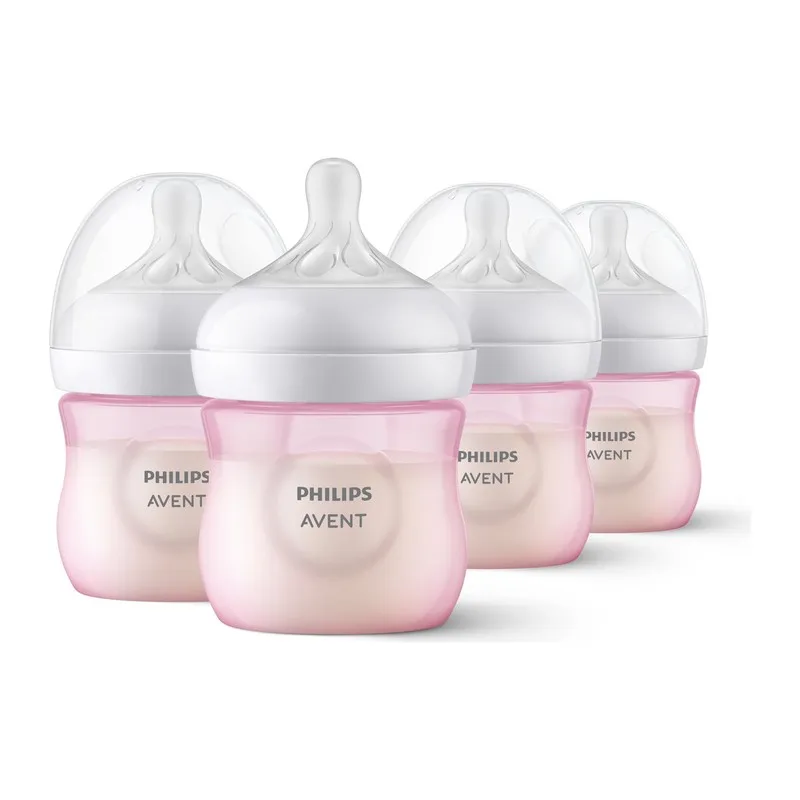
Philips Avent Natural Response Bottle, 4 oz (4-pack)
A wide-nipple 4-ounce bottle with a slow-flow nipple for 0 to 3 months. Philips says the nipple's opening only releases milk when the baby actively drinks, which suits paced feeding. Few parts: bottle, screw ring, nipple and cap.
Pros
- Nipple releases milk only when the baby drinks, Philips says
- Wide neck and few parts to wash
- Dishwasher safe
Cons
- Only fits Philips Avent Natural nipples
- Philips says to replace nipples every 3 months
Best vented: Dr. Brown’s Options+ Narrow
The classic internal-vent bottle, and the vent “can be removed as baby’s feeding develops.” It has more parts, and Dr. Brown’s says to clean the vent with its wire brush. It also says it isn’t a sealed storage container, so it can leak if you carry it assembled, and to avoid shaking formula in it, since liquid can enter the vent. Swirl instead. The maker’s “clinically proven to reduce colic” line is below. If you want it in glass, Dr. Brown’s sells a 4-ounce glass version.
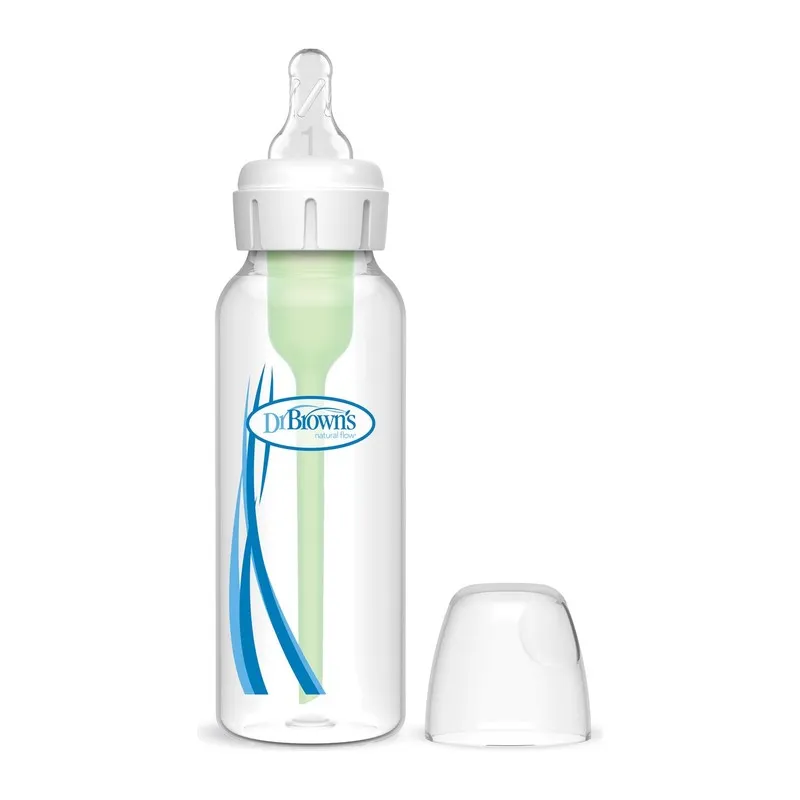
Dr. Brown's Options+ Narrow Bottle, 8 oz
A narrow bottle with an internal vent that can be removed as a baby's feeding develops, sold with a Level 1 slow-flow silicone nipple. Dr. Brown's says it's safe on the dishwasher's top rack, in electric and microwave sterilizers, and in boiling water.
Pros
- Internal vent you can take out later
- Level 1 slow-flow nipple for young babies
- Also sold in a 4-ounce size for the newborn weeks
Cons
- More parts to wash, including a vent that needs a wire brush
- Can leak if carried assembled; Dr. Brown's says it isn't a sealed storage container
- The evidence for anti-colic claims is limited, so don't buy it as a colic cure
Best budget: Evenflo Balance+ Wide Neck
A plain bottle with “Only 4 easy-to-clean parts,” sold in a 6-pack, with slow, medium and fast nipples. It’s a simple way to stock a house that uses a lot of bottles. Evenflo also sells a 5-ounce size, which suits a newborn better. Ignore the survey claims on the page.
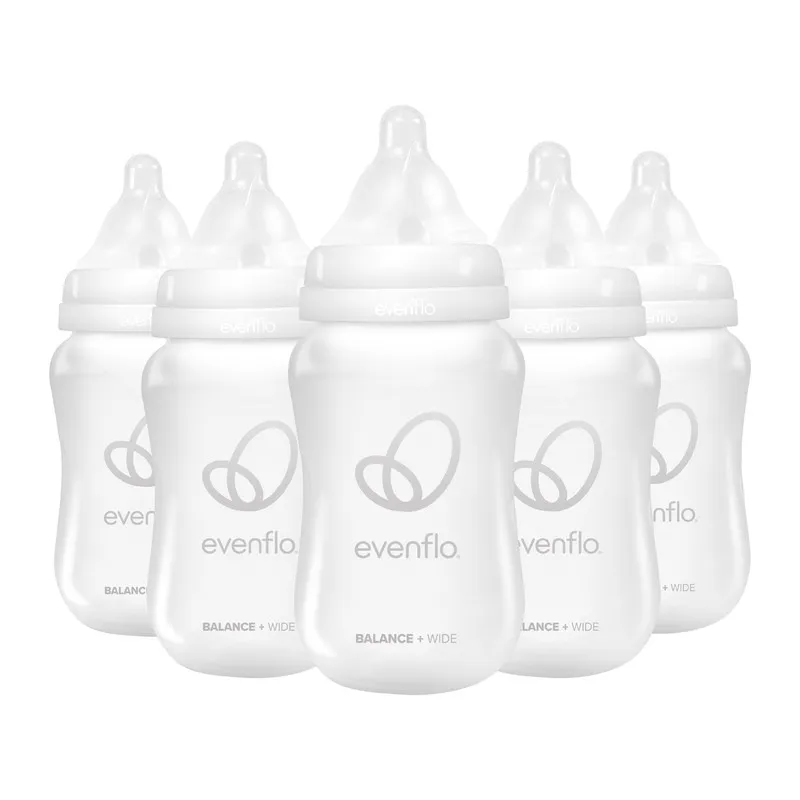
Evenflo Balance+ Wide Neck Bottles, 9 oz (6-pack)
A plain wide-neck plastic bottle sold in a 6-pack, with 4 parts to clean, a silicone slow-flow nipple included, and medium and fast nipples sold separately. Evenflo says it's top-rack dishwasher safe.
Pros
- Sold in a 6-pack, a simple way to stock a bottle-fed house
- Only 4 parts to wash
- Also comes in a smaller 5-ounce size
Cons
- Wide and standard nipples don't interchange
- Plastic: see our notes on heat and dishwashers
Best glass: Lifefactory 4 oz
Borosilicate glass in a silicone sleeve that “helps prevent breakage and provides an easier grip.” The AAP’s main caution on glass is injury if it breaks, which is why we picked one with a sleeve. It isn’t plastic-free, though: the cap and ring are polypropylene.
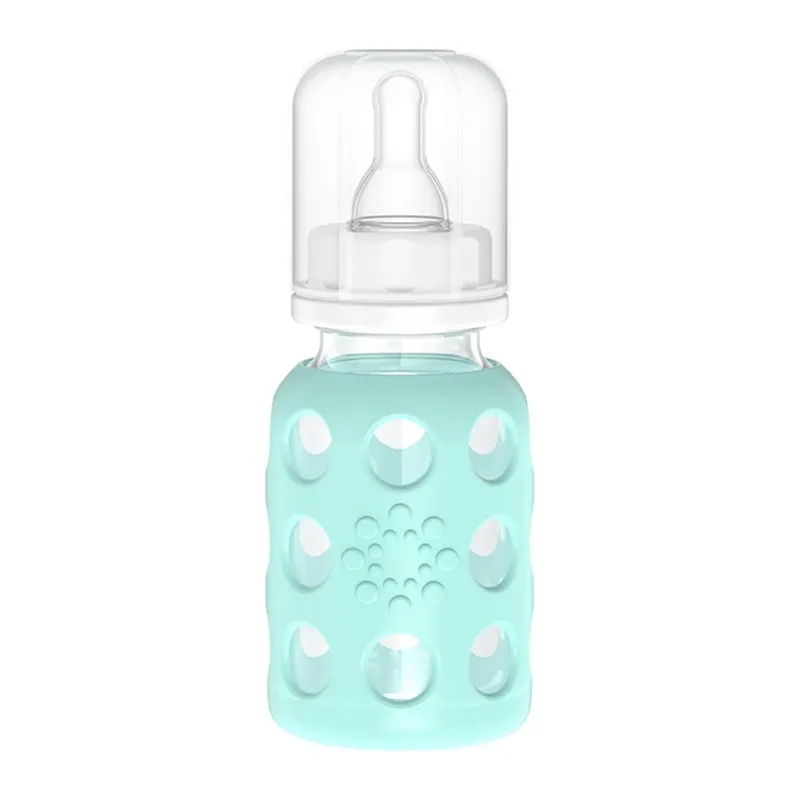
Lifefactory 4 oz Glass Baby Bottle
A borosilicate glass bottle with a protective silicone sleeve and a Stage 1 silicone nipple for 0 to 3 months. Lifefactory says it's dishwasher safe with the sleeve on, with the cap parts and nipple on the top rack.
Pros
- Silicone sleeve helps prevent breakage and adds grip
- Good if you'd rather not heat plastic
- Dishwasher safe without removing the sleeve
Cons
- Not plastic-free: the cap and ring are polypropylene
- Heavier than plastic, and glass can still break
Easiest to clean: Comotomo Gen 2
A soft silicone body, a very wide neck and four parts: cap, ring, nipple and bottle. Comotomo says you can clean it by hand without a brush; the CDC says to scrub feeding items with a clean brush, so use one anyway. Comotomo recommends replacing all parts after 6 months, which is sooner than many parents expect.
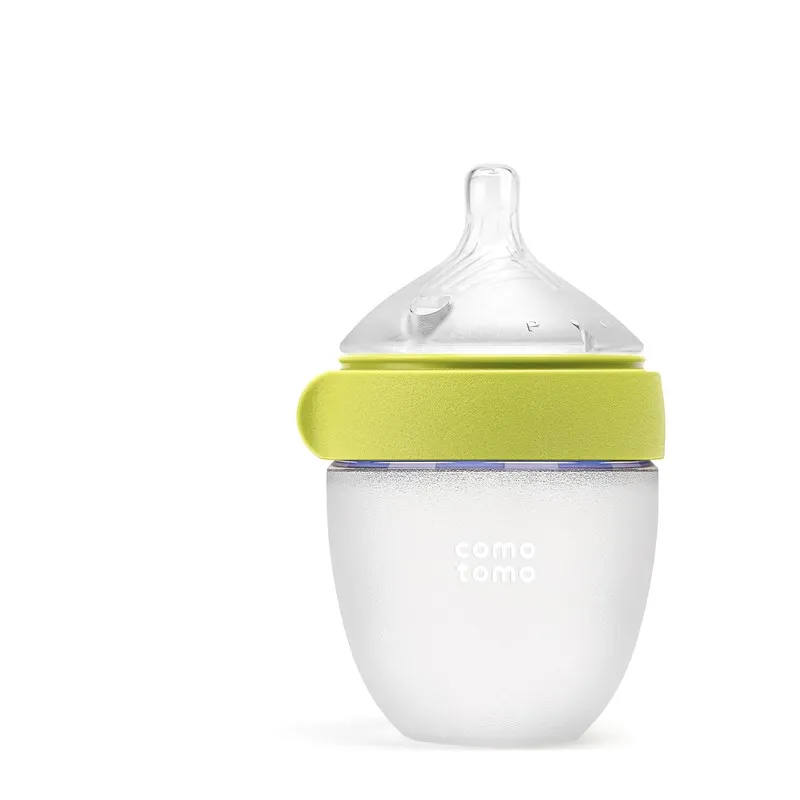
Comotomo Baby Bottle Gen 2, 5 oz
A soft silicone bottle with a very wide neck, built-in vents and only four parts: cap, ring, nipple and bottle. The 5-ounce size comes with a slow-flow nipple for 0 to 3 months. Comotomo says it's safe on the dishwasher's top rack and in sterilizers.
Pros
- Wide opening makes it easy to get a hand or brush inside
- No separate vent parts
- Soft silicone body won't shatter
Cons
- Comotomo says to replace all parts after 6 months
- Comotomo says no brush is needed, but the CDC says to scrub with one anyway
Do anti-colic bottles work? What the trials show
Boxes say “clinically proven.” Here’s what the studies we could find actually show:
| Study | Who | Result | Who paid |
|---|---|---|---|
| Liu et al., 2026 | 1,055 babies, two vent types | No significant difference on the main measure (35.5% vs 37.9%) | The bottle maker; its CEO is an author |
| Fewtrell et al., 2012 | 63 babies, Philips Avent vs Dr. Brown’s | Less fussing with Avent; no other significant difference | Philips Avent |
| Cirgin Ellett and Perkins, 2006 | 36 parents, online | Dr. Brown’s had less crying and fussing than placebo bottles | Not shown in the abstract |
| Kreitschmann et al., 2018 | 96 babies, vented vs non-vented nipples | Different sucking, but no link to colic symptoms | Not checked |
The biggest trial compared two vented designs, so it doesn’t show vents are useless. It also found less crying around feeds, but in an unplanned analysis that its authors say “warrants future confirmation.” The fair read: venting may change how a feed goes, but “clinically proven to reduce colic” overstates it. The AAP says “there is no definite explanation” for colic, and it improves as babies mature. See how to soothe a crying newborn.
Dad’s job: if feeds are gassy and gulpy, fix the pace, the angle and the burping first. Then try a vented bottle.
Bottles for gas and reflux
We found no bottle trial for reflux. The AAP’s advice is mostly about the feed: smaller amounts more often, and the symptom checker adds keeping feeds under 20 minutes and holding your baby at a slant. A different bottle is only a “consider.” The AAP says to hold the bottle so “milk completely covers the nipple; that way your baby isn’t swallowing air.” That fits with pacing: keep the nipple full, and don’t tilt the bottle any more than that. A nipple hole that’s too small can also make babies take in air.
Always call if your baby vomits forcefully after every feed, or there’s blood in the vomit.
Bottles for breastfed babies
“Closest to breastfeeding” is a maker’s line, not a finding. A 2015 review called the evidence on nipple confusion “limited and inconsistent,” and said the difficulty is “establishing causality.” What the AAP’s advice says to do is more practical:
- When: the symptom checker on the AAP’s site says to offer a bottle of pumped milk at about 4 weeks if nursing is going well, once a day. It warns that if you wait too long, “such as 8 weeks,” many babies reject it.
- Who: “If you are breastfeeding, your baby may be more willing to take a bottle from someone other than you,” the CDC says.
- Where: the AAP suggests somewhere other than where the baby usually nurses.
- If it isn’t working: stop if your baby gets frustrated, and try tomorrow. After a few days, try a different nipple.
Pace the feed. Hold the bottle level, with the nipple just full, so your baby controls the flow rather than gravity. In a small study of 29 mothers, paced feeding slowed feeds, with no significant difference in how much babies drank. Our night feeds guide has the step-by-step.
Dad’s job: this one’s yours. First bottles go better from you, in a different room.
Nipple flow: why “Level 1” isn’t a standard
Start with the slowest nipple. Nemours says “Some babies may be content throughout infancy to use the same kind and size of nipple,” and Nationwide Children’s says “There is no need to move up a level based on age.”
Labels don’t compare across brands. In a lab test of 26 nipple types, flow ranged from 1.68 to 85.34 mL per minute, and the authors said “The name of the nipple does not provide clear information about the flow rate.” A follow-up found “Packing information did not accurately reflect the flow rates of bottle nipples.”
So watch your baby instead:
- Too fast: gulping, catch-up breaths, milk leaking from the mouth, pulling away.
- Too slow: taking longer to finish, fast sucking with few swallows, a collapsing nipple, getting fussy.
Glass, plastic or silicone?
| Material | Good | Watch out for |
|---|---|---|
| Plastic | Light, cheap, won’t break | Heat and scratches |
| Glass | The body is plastic-free | Can break; heavier |
| Silicone | Soft, won’t shatter | Costs more |
BPA: ignore “BPA-free” on the box. Federal rules have barred polycarbonate baby bottles since 2012, and the FDA based that on the industry abandoning the use, not on a safety finding. Just throw out any old polycarbonate hand-me-downs.
Microplastics: a 2020 Nature Food study found high microplastic release from polypropylene bottles, especially with hot water and sterilizing. A later lab test of seven bottles suggested some of that may have been additives rather than plastic. The FDA says current evidence “does not demonstrate” a risk at levels found in food, though that’s about food in general. The AAP’s general advice is to avoid microwaving in plastic and to use glass or stainless steel when possible. No study shows babies do better on one material.
Warming a bottle
You don’t have to. The CDC says “Infant formula does not need to be warmed before feeding,” and “Breast milk does not need to be warmed.” If your baby prefers it warm, hold the bottle under warm running water, and test a few drops on your wrist. Never use a microwave: it creates hot spots that can burn your baby’s mouth. The AAP says no stovetop either.
Cleaning: how often and how
“Clean baby bottles after every feeding,” the CDC says. A rinse isn’t enough, and don’t top up a used bottle.
In the dishwasher: the CDC says hot water and a heated drying or sanitizing setting help kill more germs, and that then “a separate sanitizing step is not necessary.” Put small parts in a closed basket or mesh bag.
By hand: use a basin, not the sink, and a brush used only for feeding items. Squeeze water through the nipple holes, and air-dry. Don’t rub dry with a dish towel.
Sanitize daily if your baby is under 2 months, was born early or has a weakened immune system, the CDC says. Boil for 5 minutes, use a steam system, or follow the CDC’s bleach method.
One conflict: the AAP’s general advice on plastics is to hand-wash them, because heat can release chemicals, while the CDC favors a hot dishwasher for germs. Both are current. For a young baby, we’d follow the CDC; glass or silicone sidesteps the question.
Dad’s job: own the bottle shift. A basin and brush for nothing else, and a mesh bag for small parts.
How many bottles, what size, and when to replace nipples
- How many: Nemours says 6 to 8 bottles lasts a day at 3-to-4-hour feeds. For one bottle a day alongside nursing, 2 or 3 is plenty (our rule of thumb).
- What size: start with 4 ounces. The AAP says feeds reach 3 to 4 ounces by the end of month one and 6 to 8 by 6 months, so you’ll want bigger bottles later. See how much formula by age.
- Nipples: Nemours says to replace them about every 2 months, and Philips every 3 months. Replace them right away if they’re sticky, swollen, cracked or tear in a pull test, since worn nipples can be a choking hazard.
- Recalls: check the CPSC before buying. Boon NURSH’s 8-ounce 3-pack sold at Walmart was recalled in June 2026 for a choking hazard.
Rules for every bottle: never prop it (“This can increase your baby’s risk of choking, ear infections, and tooth decay,” the CDC says), never put your baby to bed with one, don’t feed lying flat, and don’t push them to finish.
FAQ
What is the best baby bottle for a newborn?
No bottle is proven best. Choose a small bottle with the slowest nipple, and expect to try a couple of kinds.
What bottle is best for a breastfed baby?
No trial shows one is closest to the breast. Use a slow nipple, pace the feed, and let someone other than the nursing parent offer it, at about 4 weeks if nursing is going well.
Do anti-colic bottles really work?
The evidence is limited. The largest trial found no significant difference between two vent types on its main measure, though crying around feeds was lower in an unplanned analysis, and the bottle maker funded it.
Are glass bottles safer than plastic?
BPA is out of US baby bottles. The AAP suggests glass or stainless steel where possible and warns about breakage. The FDA says a risk from microplastics in food hasn’t been demonstrated. No study shows babies do better on one material.
Can baby bottles go in the dishwasher?
Yes, if the maker says so; top rack for most. The CDC says hot water and heated drying also replaces a separate sanitizing step.
How often should I replace bottle nipples?
About every 2 to 3 months, depending on the source, and right away if they’re sticky, swollen, cracked or tear in a pull test.
How do I warm a bottle?
You don’t have to. If your baby prefers it warm, use warm running water, never a microwave, and test a few drops on your wrist.
Sources
- American Academy of Pediatrics (HealthyChildren.org): Bottle feeding: how it’s done (from Dad to Dad, 2012), Introducing the bottle, Why babies spit up, Colic, Baby bottles and BPA, Food additives, How long can bottles sit out?, Amount and schedule of formula feedings and symptom checkers (Schmitt Pediatric Guidelines) for bottle feeding, breastfeeding and reflux
- CDC: Bottle feeding, Cleaning and sanitizing feeding items, Handling breast milk and Formula preparation and storage
- FDA: Bisphenol A, Microplastics in foods, the 2012 BPA rule and 21 CFR 177.1580
- Hospitals and agencies: Nemours KidsHealth Starting formula and Storing formula; Nationwide Children’s Choosing a bottle flow rate; Arizona Department of Health Services Paced bottle feeding
- Studies (PubMed): Liu et al. 2026, Fewtrell et al. 2012, Cirgin Ellett and Perkins 2006, Kreitschmann et al. 2018, Zimmerman and Thompson 2015, Ventura et al. 2025, Pados et al. 2016, Pados et al. 2019, Li et al. 2020 and Gerhard et al. 2022
- CPSC: Boon NURSH recall
- Product pages: Philips Avent Natural Response, Dr. Brown’s Options+ and FAQ, Evenflo Balance+, Lifefactory, Comotomo