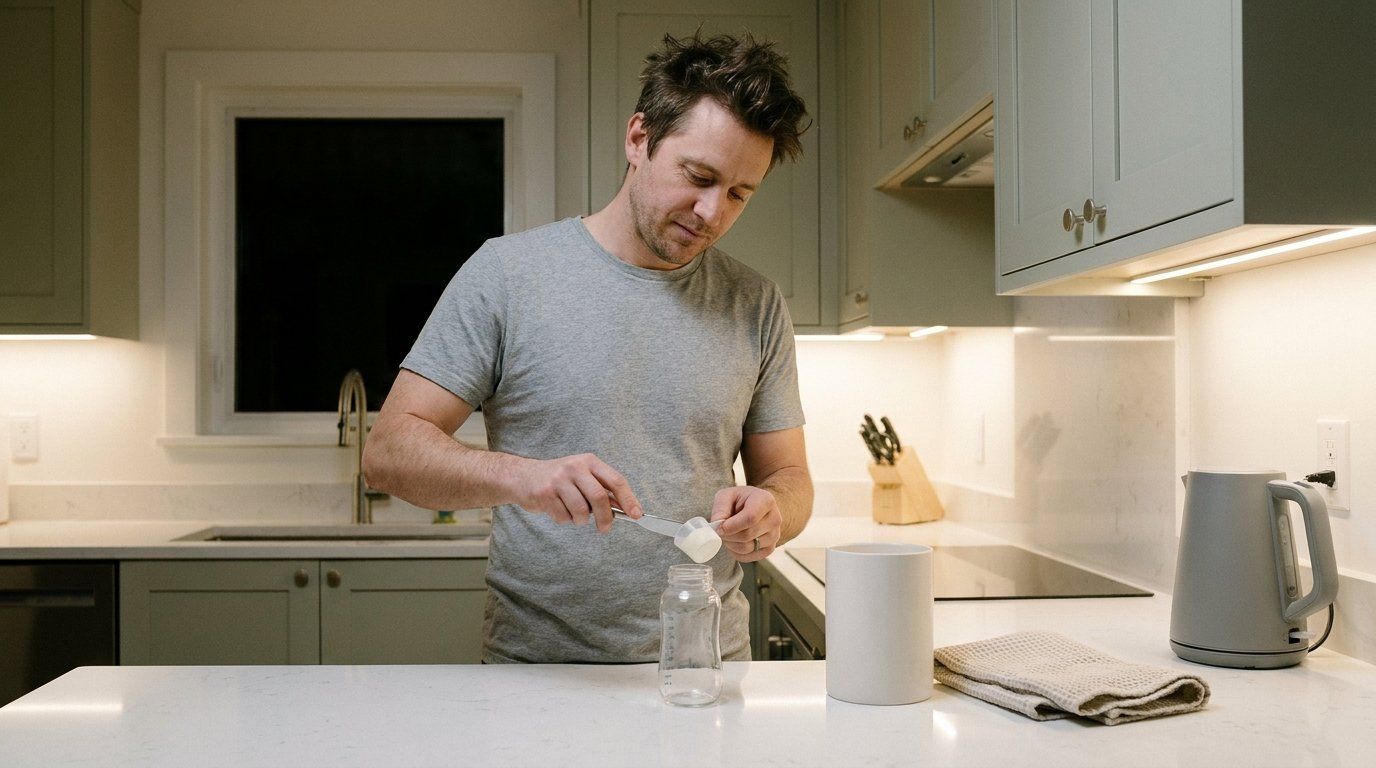
How to Burp a Baby: 3 Positions and What to Do When They Won't Burp
How to burp a baby, step by step: the three positions the AAP recommends, how often to burp during bottle and breast feeds, what to do when your baby won't burp or falls asleep, and spit-up vs vomiting.
We choose everything we recommend independently. If you buy through our links, we may earn a commission. How we make money

In this guide
Burping is the most-repeated move of the newborn months, and it’s a great dad job: the AAP says swallowed air bothers both breastfed and bottle-fed babies, but “it’s seen more often with the bottle,” which is often the feed you’re doing. Here’s how to do it in each of the three positions, how often, what to do when nothing comes up, and when spit-up is a reason to call the doctor.
A note before you start: this is general guidance, not medical advice for your baby. If your baby was born early or has a feeding or breathing condition, ask your pediatrician what’s right for them.
The short answer
- Three positions: on your shoulder, sitting on your lap, or face down across your lap.
- How often: every 2 to 3 ounces from a bottle, or when switching breasts.
- No burp after a few minutes? Keep feeding. Not every feed produces one.
- After the feed: burp again and hold the baby upright for 10 to 15 minutes.
- Fell asleep? Back to sleep, flat on the back, in the crib or bassinet.
- Call the doctor for green or bloody spit-up, forceful vomiting in a young baby, or signs of dehydration.
Have a cloth ready
Put a cloth or bib on your shoulder or under the baby’s chin first, because something usually comes up with the air.

Burt's Bees Baby Organic Burp Cloths, 5 Pack
Plain, flat burp cloths in 100% organic cotton, two layers thick with a three-panel design that folds easily over a shoulder. No snaps or ties. Five in a pack, machine washable, so there's always a clean one by the feeding chair.
Pros
- Two-ply cotton soaks up spit-up
- No snaps or ties, just a flat cloth
- Five in a pack for night feeds
Cons
- Plain white shows stains
- A cloth for awake time only: keep it out of the crib
How to burp a baby: the 3 positions
The AAP describes three positions. Try all three and see which works best for your baby.
1. Over your shoulder. “Hold the baby upright with their head on your shoulder to support their head and back. Gently pat their back with your other hand.” This is the easiest one for a dad with a newborn, since your shoulder is a stable shelf.
2. Sitting on your lap. “Sit the baby on your lap. Support their chest and head with one hand while patting their back with your other hand.” Nemours KidsHealth adds a key detail: grip the baby’s chin, not the throat.
3. Face down across your lap. “Lay the baby on your lap with their back up. Support their head so that it is higher than their chest, and gently pat or rotate your hand on their back.”
How to pat: cup your hand. KidsHealth says a cupped hand “is gentler on the baby than a flat palm.” Gentle rubbing in circles works too, and some babies like a slow rock in a rocking chair while you do it.
Dad’s job: learn all three. When one stops working at 3 a.m., switch to another before you give up.
How often to burp
The AAP’s rule: if bottle feeding, “burp them after every 2 to 3 ounces (60–90 ml). If nursing, burp them when they switch breasts. Some breastfed babies don’t swallow very much air, so they may not need to burp.”
Burp more often, every ounce of a bottle or every 5 minutes of nursing, KidsHealth says, if your baby is gassy, spits up a lot, has reflux or seems fussy during the feed.
The AAP also suggests burping frequently even when the baby seems fine: “The pause and the change of position alone will slow gulping and reduce the amount of swallowed air.” If the baby gets fussy mid-feed, stop and burp rather than letting them feed and fuss at once, since fussing means more swallowed air.
Less air in, less to burp out
The best burp is the one you don’t need:
- Feed before the baby is frantic. The AAP says the best way to reduce spit-up “is to feed your baby before they get very hungry.”
- Keep the nipple full. The AAP says to hold the bottle “so that milk completely covers the nipple,” and not to bottle-feed a baby lying flat on their back.
- Watch the flow. Gulping, catch-up breaths, milk leaking from the mouth or a baby pulling away from the bottle mean the flow is too fast, an Arizona WIC paced-feeding guide says. Paced bottle feeding (holding the bottle more level) slows it down; see night feeds for dads.
- Don’t overpay for “anti-gas” bottles. An AAP pediatrician writes that he hasn’t seen good scientific evidence for claims that special bottles prevent gas, though trying a different bottle is reasonable if your baby gulps air.
What to do when your baby won’t burp
The AAP is reassuring: “If your baby still hasn’t burped after several minutes, continue feeding and don’t worry; no baby burps every time.”
Try this order:
- Switch positions. KidsHealth suggests changing position and trying for another few minutes.
- Then move on. Some sources suggest even less: one AAP-hosted guide says to burp for less than a minute and stop even if nothing comes up, and Allina Health says “Not all babies need to burp.”
- Always burp at the end of the feed, then hold the baby upright.
As babies get older, they swallow less air, and not burping usually means they’ve learned to eat without gulping, KidsHealth says.
Does burping help colic? Not necessarily. In a randomized trial of 71 healthy newborns in India, burping didn’t significantly reduce colic, and babies who were burped spat up more. For crying that won’t stop, see how to soothe a crying newborn.
How to burp a sleeping baby
Babies often fall asleep mid-bottle. You can usually burp them gently in the shoulder position without fully waking them, and KidsHealth notes that picking up a baby who wakes from gas to burp them may help them back to sleep.
The safety rules don’t change:
- Back to sleep, flat. The AAP says “Even babies with gastroesophageal reflux disease (GERD) should sleep flat on their backs,” and that babies won’t choke on their backs because their airway and gag reflex protect them.
- No couch. If you might doze off during a night feed, don’t do it on a couch or armchair; the AAP says the risk of sleep-related death is “up to 67 times higher” when babies sleep with someone on a couch or soft chair. If you do fall asleep while feeding, the AAP says to put the baby on their back in their bassinet or crib as soon as you wake up.
- No wedges or inclined sleepers. The AAP says a semi-inclined position doesn’t help reflux and can make it worse, and that wedges and raising the head of the crib aren’t effective or safe. Inclined sleepers over 10 degrees have been banned by federal rule since November 2022.
More in safe sleep for newborns and how to get baby to sleep in a bassinet.
After the feed: upright time
The AAP says to burp again at the end of the feed and keep the baby “in an upright position for 10 to 15 minutes so they don’t spit up.” For a baby who spits up a lot, the AAP suggests at least 20 minutes, and for reflux, the first half-hour or so, always closely supervised. Keep play calm for a while after, and don’t fasten the diaper too tight, which puts pressure on the stomach.
Holding the baby upright on your chest is ideal dad time, as long as you’re awake. A car seat, swing or bouncer isn’t a safe place for the baby to sleep, the AAP says.
Hiccups
The AAP says most babies hiccup from time to time and it “bothers parents more than the infant.” If hiccups start during a feed, change position, try a burp or help the baby relax. If they don’t stop in 5 to 10 minutes, try feeding for a few more minutes, which usually stops them.
Burping on a car trip
There’s no special rule for burping in the car, but the car seat rules decide it: the AAP says the harness should stay snug “at all times while riding in the car,” and to never breastfeed in a moving car. So pull over to feed and burp. The AAP suggests a break every 2 to 3 hours on a day trip. See how to install an infant car seat.
Spit-up vs vomiting: when to call the doctor
For the full picture, including reflux and what actually reduces spit-up, see spit up vs reflux.
Spit-up is normal. An AAP-hosted symptom guide says normal spitting up “occurs in half of babies” and doesn’t cause crying or colic. The AAP says reflux usually starts at 2 to 3 weeks, peaks at 4 to 5 months and is gone by 9 to 12 months for most full-term babies. Spitting up is “the easy flow of stomach contents out of the mouth, frequently with a burp”; vomiting is forceful.
Call your pediatrician right away (or get urgent care) if:
- The spit-up is green (bile) or has blood in it.
- Your baby chokes on milk and turns blue or goes limp.
- A baby under 12 weeks starts forceful or projectile vomiting.
- There are signs of dehydration: fewer than six wet diapers a day, no urine in more than 8 hours, dark urine, a very dry mouth or a sunken soft spot.
Call during office hours if your baby refuses feeds, cries and arches their back during feeds, isn’t gaining weight, or the spit-up is getting worse or more forceful. Don’t add cereal or anything else to the bottle unless your pediatrician tells you to, the AAP says.
FAQ
How do you burp a newborn?
Hold the baby upright with their head on your shoulder, or sit them on your lap supporting the chest and chin, or lay them face down across your lap with the head higher than the chest. Then gently pat or rub their back with a cupped hand.
How often should you burp a baby?
The AAP says every 2 to 3 ounces when bottle feeding, and when switching breasts when nursing. Burp more often if your baby is gassy, spits up a lot or has reflux.
What if my baby won’t burp?
Try another position for a few minutes. If nothing comes up, keep feeding: the AAP says no baby burps every time. Some babies, especially breastfed ones, don’t swallow much air and may not need to burp.
Do you have to burp a baby if they fall asleep?
Try a gentle burp on your shoulder; many babies burp without waking. If nothing comes up, lay them down on their back in their crib or bassinet, flat, which the AAP says is safe even for babies with reflux.
How long should a baby stay upright after a feed?
The AAP says 10 to 15 minutes after most feeds, and longer, about 20 to 30 minutes, if your baby spits up a lot or has reflux. Stay awake and watch the baby during that time.
Is it normal for a baby to spit up after burping?
Yes. Spit-up often comes with a burp and happens in about half of babies. Call your doctor for green or bloody spit-up, forceful vomiting, signs of dehydration or poor weight gain.
Sources
- Burping, Hiccups, and Spitting Up, Why Babies Spit Up, GERD and Reflux, Bottle Feeding: How It’s Done, Reflux (Spitting Up) symptom checker, Vomiting Without Diarrhea symptom checker, Dehydration, How to Keep Your Sleeping Baby Safe, Safe sleep tips for sleep-deprived parents, What is the safest sleep solution for my baby with reflux?, Inclined Sleepers and Other Baby Registry Items to Avoid, Colic and Is it safe for my baby to travel in a car seat for hours at a time?, American Academy of Pediatrics (HealthyChildren.org)
- Burping your baby, Nemours KidsHealth; How to burp your baby, Allina Health
- Paced bottle feeding, Arizona Department of Health Services (WIC)
- Safety Standard for Infant Sleep Products: inclined sleepers, 16 CFR 1310, Code of Federal Regulations
- Kaur R, Bharti B, Saini SK. A randomized controlled trial of burping for the prevention of colic and regurgitation in healthy infants. Child Care Health Dev, 2015.
- Organic Burp Cloths, 5 Pack, Burt’s Bees Baby