Babyproofing Checklist for Dads: Room by Room, Before Your Baby Crawls
A room-by-room babyproofing checklist for dads: when to start, anchoring furniture and TVs, the right gate for the top of the stairs, water heater, windows, outlets, batteries, and the gear we'd buy.
We choose everything we recommend independently. If you buy through our links, we may earn a commission. How we make money
Our quick picks
- Top of the stairsCardinal Gates Stairway Special SS-30Check price
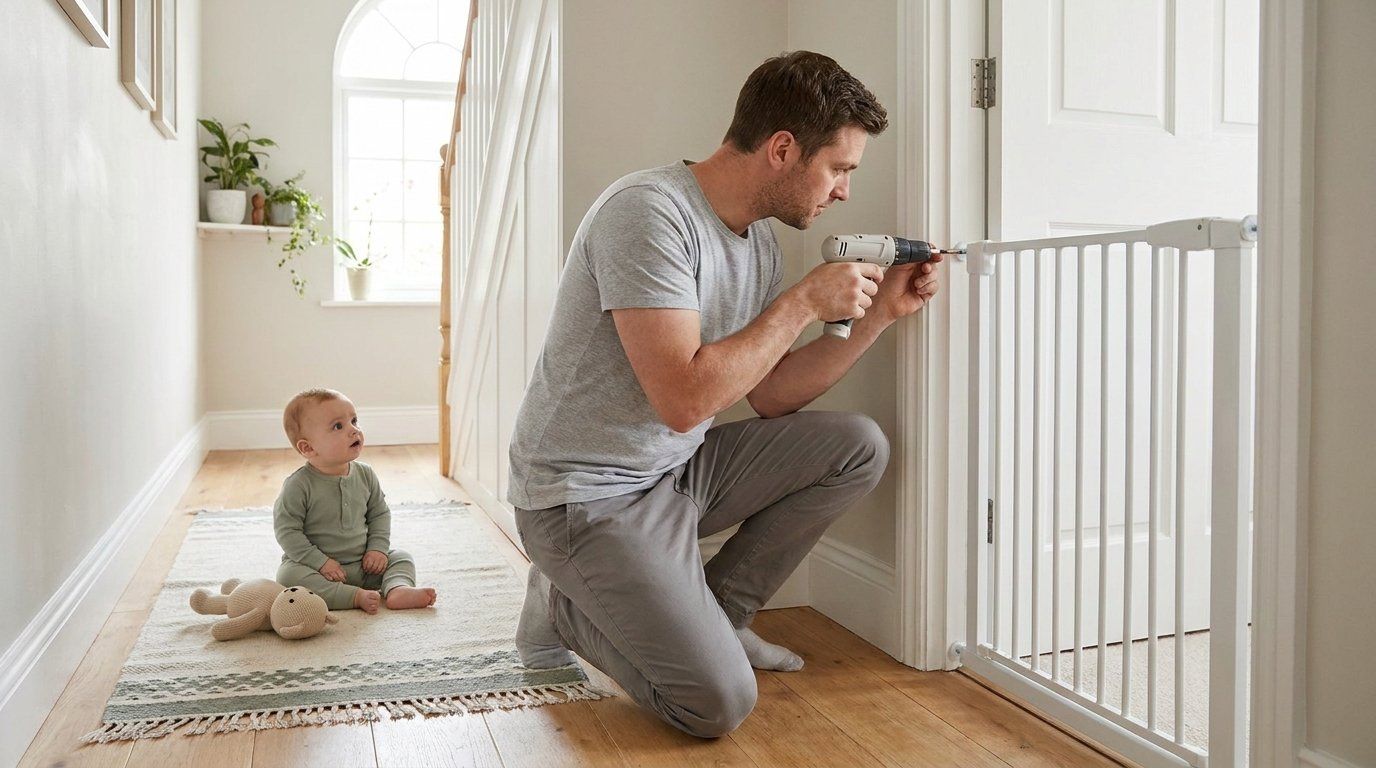
Screws to the wall, JPMA certified per Cardinal, with a stop bracket so it can't swing out over the stairs.
- DoorwaysKidCo Auto Close GatewayCheck price
Pressure-mounted and closes itself. Never at the top of stairs.
- Anchor the TVHangman TV Anti-Tip KitCheck price
All-steel cables and brackets that go into the studs.
In this guide
- When to start babyproofing
- The floor sweep (every room)
- Furniture and TVs: anchor everything that can tip
- Stairs and gates: the top is not the bottom
- Kitchen
- Bathroom and water
- Laundry room
- Nursery and bedrooms
- Windows and blind cords
- Outlets and cords
- Smoke and CO alarms
- Button batteries, magnets and poisons: what to do if…
- FAQ
- Sources
Your baby is about to start moving, which means you’re about to spend a Saturday with a stud finder. Good. The AAP says “Before or as soon as your child begins crawling or walking,” you should get harmful things out of reach and locked up. This checklist goes room by room, starting with the jobs that prevent the worst injuries.
One honest caveat from the CPSC: “no device is completely childproof; determined toddlers have been known to overcome or disable them.” Babyproofing buys you time. It doesn’t replace watching.
How we made this list: we checked the products on the makers’ sites and against the CPSC recall database. We haven’t tested them ourselves.
When to start babyproofing
The AAP puts crawling at “usually mastered between seven and ten months,” but babies vary, and crawling isn’t even on the CDC’s current milestone lists (see baby milestones by month). Some babies scoot or roll their way into trouble first.
Our practical answer: get the big jobs done by about 6 months, then add the rest as your baby gets moving.
The big jobs:
- Anchor furniture and TVs.
- Install the top-of-stairs gate.
- Turn the water heater down to 120°F.
- Deal with blind cords.
- Check smoke and CO alarms.
Dad’s job: do a crawl-through. “The best way to check is to get down at your child’s level and see what’s there,” the AAP says. Every room, on your hands and knees.
The floor sweep (every room)
Look for what fits in a mouth:
- Button batteries, in remotes, key fobs, scales and greeting cards. More on these below.
- Magnets, including small fridge magnets. The AAP says skip them.
- Coins and small parts.
- Medicines and vitamins left on nightstands and counters. The CPSC says even child-resistant packaging should be locked away.
Furniture and TVs: anchor everything that can tip
The CPSC estimates US emergency rooms treated an average of 17,800 tip-over injuries a year from 2020 to 2022, and 44% were children, “meaning a child is treated every 53 minutes.” The AAP says 77% of tip-over deaths from 2000 to 2019 involved kids under 6.
- Into a stud. “Secure all furniture and mirrors with anti-tip devices,” the AAP says, even if you have to move the furniture to reach a stud.
- Metal, not plastic. “Plastic can become brittle over time and break, causing anchors to fail,” the AAP says, and knock-off anchors sold online are a problem. In 2026 the CPSC warned about KareKlub plastic kits sold on Amazon, and 4our Kiddies recalled 253,500 plastic kits after at least 150 reports of breakage.
- Check the standard. The CPSC says to use tip restraints that comply with ASTM F3096-23.
- New dressers too. A federal stability standard for dressers took effect in September 2023, but older furniture isn’t covered. The CPSC says new dressers come with anti-tip kits, so install them right away.
- TVs: “Televisions that are not wall mounted should still be anchored to the wall,” the CPSC says. “Never place a TV on top of a dresser,” the AAP adds. If you truly can’t anchor, use a sturdy, low base and push the TV back.
- The stove needs its anti-tip bracket installed.
- Renting? The AAP says talk to your landlord.
If furniture ever falls on your child, the AAP says to see the pediatrician or go to the ER right away.
Dad’s job: stud finder, metal anchors, and every dresser, bookcase and TV this weekend. Start with the nursery: the AAP says about half of fatal tip-overs happen in bedrooms.
Anchor the TV: Hangman TV Anti-Tip Kit
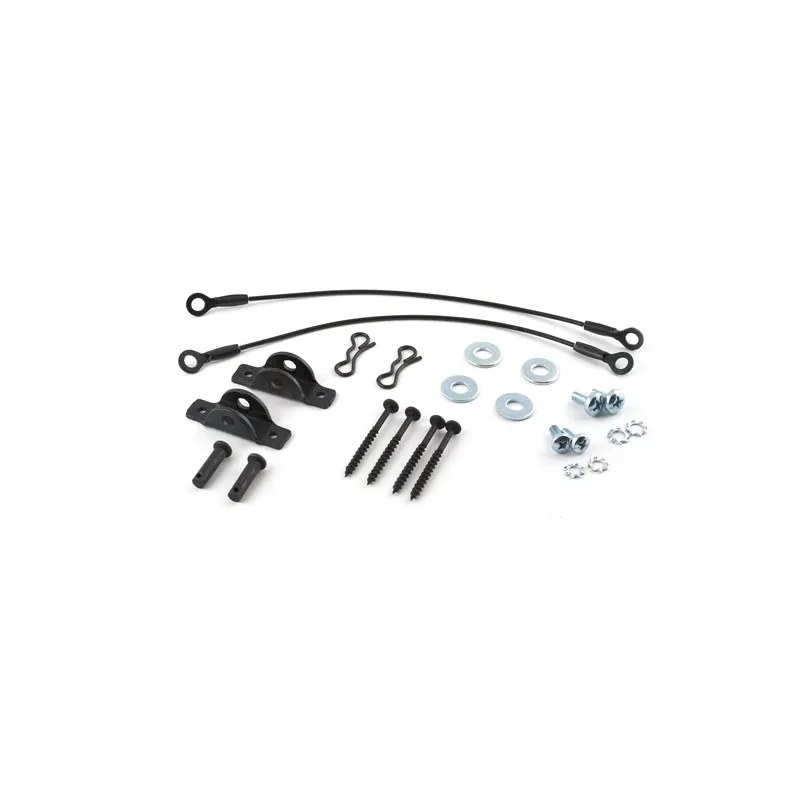
Two 13-inch steel cables and wall brackets that go into studs. Hangman says it’s all-steel and made in the USA, with a child-resistant clip. It doesn’t state an ASTM rating. For dressers, Hangman’s matching furniture kit is the TK-400. Whatever you buy for dressers, look for ASTM F3096-23 on the package and pick metal.
Hangman TV Anti-Tip Kit TV400
An all-steel TV anchor kit with two 13-inch aircraft-grade steel cables and heavy-duty wall brackets that go into studs, Hangman says. It's made in the USA and uses a child-resistant clip to adjust the cables.
Pros
- All-steel, not plastic straps
- Brackets go into studs
- Made in USA, Hangman says
Cons
- The maker states no ASTM rating
- Hangman's own store showed it sold out when we checked
Stairs and gates: the top is not the bottom
Here’s the rule that matters most. “For the top of stairs, only use gates that screw to the wall,” the CPSC says. A pressure-mounted gate can be pushed out, and at the top of the stairs that means a fall.
- Gate both ends. “Place sturdy gates at the top and bottom of your staircase,” the AAP says, and keep them closed.
- Into studs. The AAP says to use gates firmly mounted to the home’s studs.
- Skip accordion gates. The AAP says they can trap an arm or a neck. The CPSC says replace old V-shaped gates too.
- No pet gates. “Pet gates should never be used as a child safety gate,” the CPSC says.
- Buy a known brand. Gates have had to meet a federal standard since July 2021, and recent recalls have mostly been retractable and pressure gates sold online where a child’s torso could fit under the gate.
- Pressure gates are for doorways and hallways. Use one at the bottom of the stairs only if the maker’s instructions allow it.
- At the grandparents’ house too. The AAP says the same gate rule applies.
No stud where you need one? Many top-of-stairs gates offer angle mounting or banister kits. Check the maker’s options before reaching for a pressure gate.
Dad’s job: measure the opening, find the studs, install the gate, then test the latch a dozen times.
Top of the stairs: Cardinal Gates Stairway Special SS-30
A hardware-mounted aluminum gate that fits openings 27 to 42.5 inches wide. Cardinal says it’s JPMA certified, and an optional stop bracket keeps it from opening out over the stairs. It can mount at angles up to 30 degrees “for easy stud alignment on drywall.” Banister kits are sold separately.
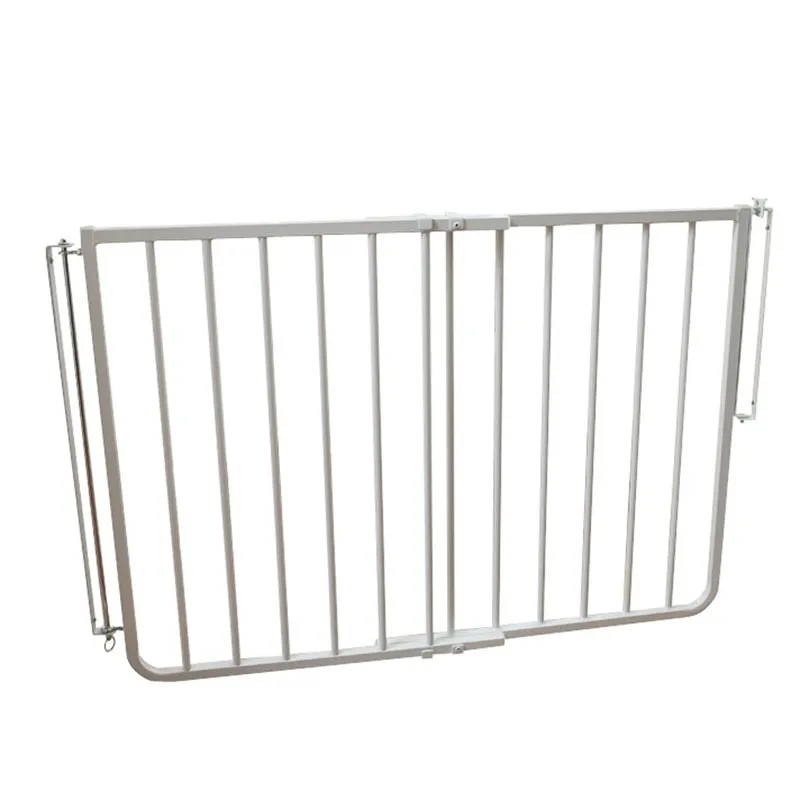
Cardinal Gates Stairway Special SS-30
A hardware-mounted aluminum gate for the top of the stairs. Cardinal says it fits openings 27 to 42.5 inches wide, is 29.5 inches tall, can be mounted at angles up to 30 degrees to hit studs, and is JPMA certified.
Pros
- Screws to the wall, which the CPSC requires at the top of stairs
- Optional stop bracket so it can't swing out over the stairs
- Angle mounting helps you hit a stud
Cons
- Banister and drywall kits are sold separately
- Takes a drill and an hour, not five minutes
Doorways: KidCo Auto Close Gateway
A pressure-mounted gate that closes and latches itself after you walk through, KidCo says. Its own manual says “Never use gate at top of stairs,” and it’s meant for 6 to 24 months. Extensions fit openings up to 47.5 inches.
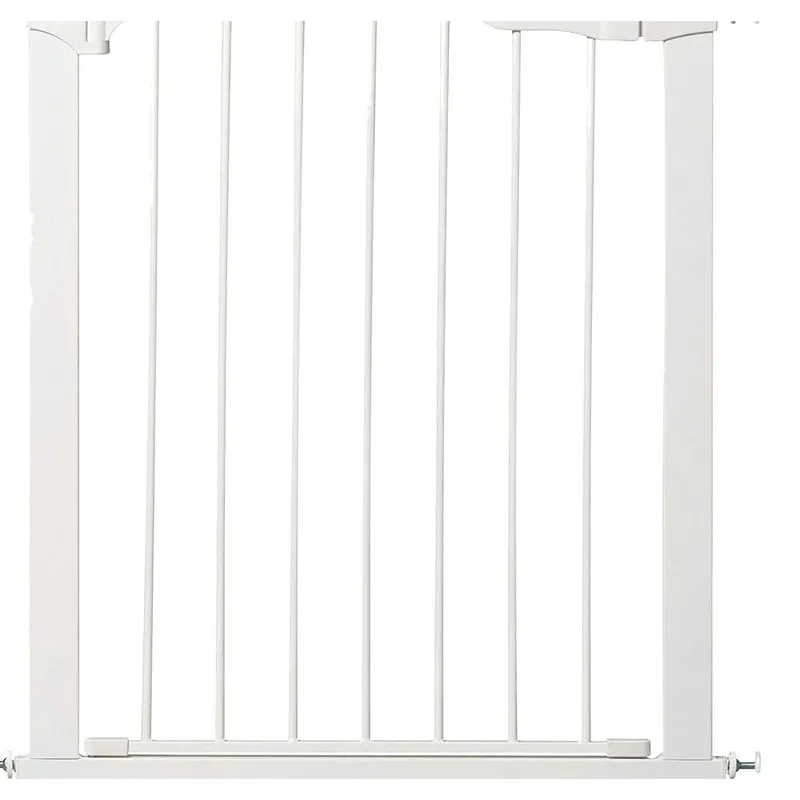
KidCo Auto Close Gateway G1100
A pressure-mounted gate for doorways and hallways that closes and locks itself after you walk through, KidCo says. Its manual says it's for 6 to 24 months and never for the top of stairs. Extensions fit openings up to 47.5 inches.
Pros
- Closes and latches on its own
- No drilling
- Extensions for wider openings
Cons
- Never at the top of stairs, per KidCo's own manual
- Pressure gates can loosen, so check the fit often
Kitchen
- Cleaners up high, or in a locked cabinet. The AAP warns that any latch can fail or be defeated, so up and away is safest.
- Pot handles turned toward the back of the stove.
- Knob covers, and block access to the stove where you can.
- No small fridge magnets.
Cabinet locks: KidCo Magnet Lock Set
Four hidden magnetic locks plus a key, mounted with adhesive, so no drilling. Each has a disengage feature for when you don’t need it. Keep the key up high.
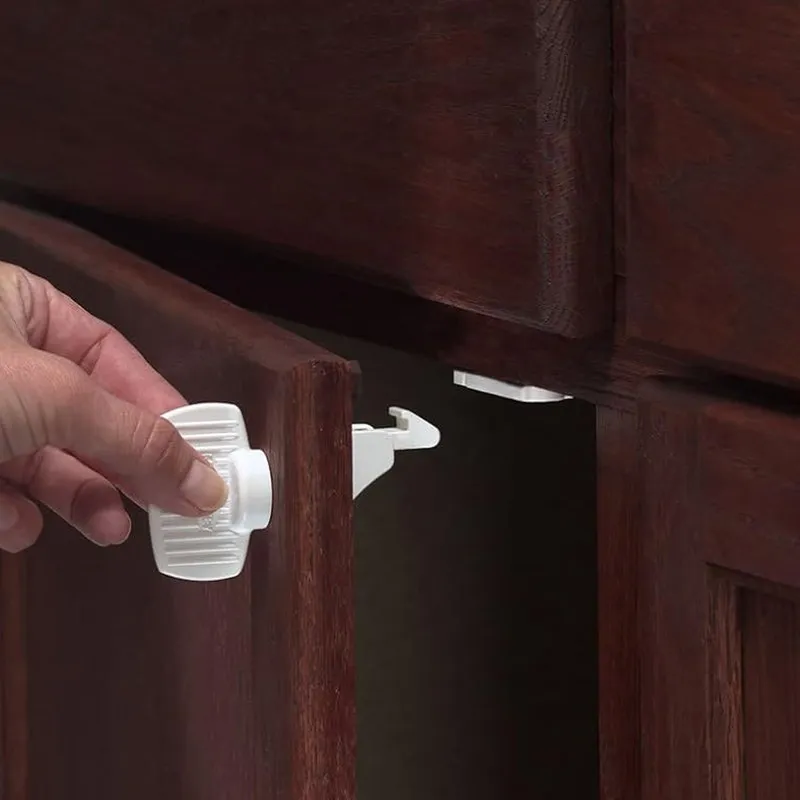
KidCo Magnet Lock Set S3365
Four hidden magnetic cabinet and drawer locks plus a key. KidCo says they mount with strong adhesive, so no drilling, and each has a disengage feature for when you don't need it. Keep the key up high.
Pros
- Invisible from outside the cabinet
- No drilling
- Disengage feature for adult-only days
Cons
- Lose the key and you're stuck
- The AAP says any latch can fail, so dangerous stuff still goes up high
Bathroom and water
Babies “can drown in as little as just 1 or 2 inches of water,” the AAP says, and most indoor child drownings happen in bathtubs. The CDC says drowning kills more children ages 1 to 4 than anything else.
- Water heater: the AAP says the hottest water at the faucet should be no more than 120°F. Hot tap water is the top cause of burns in babies and young children.
- Toilet lid locks.
- A latch on the bathroom door at adult height, the AAP suggests.
- Pull the tub drain plug when it’s not in use.
- Never leave your baby in the bath, even for a second. See how to bathe a newborn.
Dad’s job: check the water heater dial, then run the hot tap and test it with a thermometer.
Laundry room
“It is best to use traditional liquid or powder laundry detergents instead of detergent packets until all children who live in or visit your home are at least 6 years old,” the AAP says. In January and February 2024 alone, poison centers got 1,423 reports of kids 5 and under exposed to laundry pods. Keep everything up high.
Nursery and bedrooms
- Anchor the dresser first.
- Crib away from windows, the AAP says, and away from blind cords.
- No strings or cords dangling in or near the crib, the AAP adds.
The full sleep rules are in safe sleep for newborns.
Windows and blind cords
The CPSC says about nine children under 5 die each year from strangling in window covering cords, and that cordless window coverings “are the safest option.”
- Go cordless. The CPSC says retrofit kits don’t fix the dangling pull cord on many blinds. If you can’t replace them yet, the AAP says to attach cords to floor mounts that hold them taut.
- Window stops at 4 inches. The CPSC says about 5,600 kids 12 and under were treated in ERs in 2024 after falling from windows. Install stops so windows open no more than 4 inches.
- Screens don’t stop falls. Open windows from the top when you can.
- Window guards above the first floor, the AAP says, but keep at least one window per room usable for a fire escape, the CPSC adds.
Outlets and cords
Check your outlets first. If they’re the tamper-resistant type, you may not need plugs.
If you use covers, the CPSC says make sure they “cannot be easily removed by children and are large enough so that children cannot choke on them.” When you replace outlets, use the tamper-resistant type. If your baby keeps going for one outlet, the AAP says block it with furniture.
Smoke and CO alarms
- Smoke alarms in every bedroom, outside each sleeping area and on every level, the U.S. Fire Administration says. Test monthly and replace every 10 years. Interconnected alarms all sound together.
- CO alarms outside bedrooms, the CPSC says, “even if the home does not have any fuel-burning appliances.”
Button batteries, magnets and poisons: what to do if…
Save this number now: Poison Help, 1-800-222-1222. It’s free and open around the clock.
- Button battery swallowed, or you think it was: go to the ER immediately. The CPSC says they can burn through a child’s throat in as little as two hours, and the AAP says even a missing battery is enough suspicion. Call the National Battery Ingestion Hotline (800-498-8666) on the way. A federal rule now requires battery doors on new products to need a tool or two hand movements to open, so for older devices, the AAP suggests taping the compartment shut.
- Magnets swallowed: when two or more are swallowed, they can attract inside the body. Get medical care right away.
- Poison: call Poison Help. If your child is unconscious, not breathing or having seizures, call 911.
FAQ
When should I start babyproofing?
The AAP says before or as soon as your baby crawls or walks. Crawling usually comes between 7 and 10 months, but it varies, so do the anchors, top-of-stairs gate and water heater before your baby moves on their own.
Can I use a pressure-mounted gate at the top of the stairs?
No. The CPSC says only gates that screw to the wall at the top of stairs. KidCo’s own pressure-gate manual says never use it at the top of stairs.
Are plastic outlet plugs safe?
Only if they’re too big to choke on and hard for kids to remove. If your outlets are tamper-resistant, you may not need plugs.
Do I really need to anchor a new dresser?
Yes. New dressers come with anti-tip kits, and the CPSC says to install them right away. Older dressers aren’t covered by the new stability standard, so anchor those too.
What temperature should the water heater be?
120°F or lower at the faucet, the AAP and CPSC say.
What do I do if my baby swallows a button battery?
Go to the ER immediately, even if you only suspect it. Call the National Battery Ingestion Hotline, 800-498-8666, on the way.
Are laundry pods OK with a baby in the house?
The AAP says to use liquid or powder detergent until all children in or visiting your home are at least 6.
Sources
- American Academy of Pediatrics (HealthyChildren.org): Childproofing your home, Home safety, Movement, 8 to 12 months, Furniture and TV tip-overs, Kitchen safety, Bathroom safety, Infant water safety, Water safety and young children, Laundry room safety, Poison prevention, Baby’s room, Safety at 1 to 2 years, Grandparents, Button batteries
- CPSC: Childproofing your home, Anchor It, 2026 tip-over data, Dresser standard, KareKlub warning, 4our Kiddies recall, Gate standard, BabyBond gate recall, Window cords, Window falls, Button batteries and Reese’s Law, Magnets
- CDC: Drowning facts and risk factors; U.S. Fire Administration: Smoke alarms; America’s Poison Centers: Poison Help
- Product pages: Cardinal Gates Stairway Special, KidCo Auto Close Gateway and user guide, Hangman TV kit, KidCo Magnet Lock Set