Best Baby Thermometer: What a New Dad Actually Needs (Rectal, Forehead, Ear)
The best baby thermometers by age: why rectal comes first for newborns, when forehead and ear thermometers are OK, what the research says about no-touch models, how to clean them, and our 4 picks.
We choose everything we recommend independently. If you buy through our links, we may earn a commission. How we make money

Our quick picks
- Best for newbornsFrida Baby Quick-Read RectalCheck price
Made for rectal use, with a stopper, a 10-second read and a backlit screen.
- Best foreheadExergen TemporalScanner TAT-2000C+Check price
The forehead type the AAP allows at any age, with a silent mode.
- Best ear (6 months+)Braun ThermoScan 7Check price
Quick ear readings with a positioning light, for older babies and toddlers.
In this guide
You don’t need a fancy thermometer. You need the right type for your baby’s age, used the right way. The AAP ranks the options plainly: “Rectal (in the anus) temperatures are the most accurate. Forehead temperatures are the next most accurate. Oral and ear temperatures are accurate if done properly. Armpit temperatures are the least accurate.” This guide covers which one to use at which age, what studies say about forehead, ear and no-touch models, and four picks, checked against maker pages and the CPSC and FDA recall databases.
For what to do with the number, see our guide to baby fever and when to call the doctor.
The short answer
- Under 3 months: rectal, with a digital stick thermometer.
- Buy it before the birth and label it “rectal” so it never ends up in a mouth.
- A forehead (temporal artery) thermometer is a good second for quick checks, at any age.
- Ear thermometers: 6 months and up only.
- Skip mercury thermometers, forehead strips, pacifier thermometers and phone apps.
- Tell the doctor which method you used.
Which thermometer at which age
| Age | Best | Also OK | Not yet |
|---|---|---|---|
| Under 3 months | Rectal | Forehead or armpit to screen, then confirm rectally | Ear, mouth |
| 3 to 6 months | Rectal | Forehead, armpit | Ear, mouth |
| 6 months to 3 years | Rectal | Forehead, ear, armpit | Mouth |
| 4 years and up | Mouth | Forehead, ear, armpit |
The table follows the age guide from Children’s Mercy Kansas City and the AAP, which says oral readings aren’t recommended “until a child is age 4 or older.” The AAP adds that a rectal reading “is the most reliable and accurate for infants, especially babies under 3 months old.” That matters because, for a baby that young, a reading of 100.4°F (38°C) or higher means calling the pediatrician right away.
Dad’s job: buy the stick thermometer before the birth, put it in the diaper caddy, and write “RECTAL” on it. The AAP says to label it so it “is not accidentally used in the mouth.”
Our picks
Best for newborns: Frida Baby Quick-Read Digital Rectal Thermometer
Made for rectal use only, with a flexible tip and a stopper that keeps it from going in too far, a 10-second read, a backlit screen for night checks and memory for the last 10 readings, Frida says. One note: Frida’s page says the AAP recommends rectal-only checks for the first year. We couldn’t find that on the AAP’s pages; the AAP says rectal is best, especially under 3 months, and allows forehead thermometers at any age. Use petroleum jelly as the lubricant, as the AAP suggests.
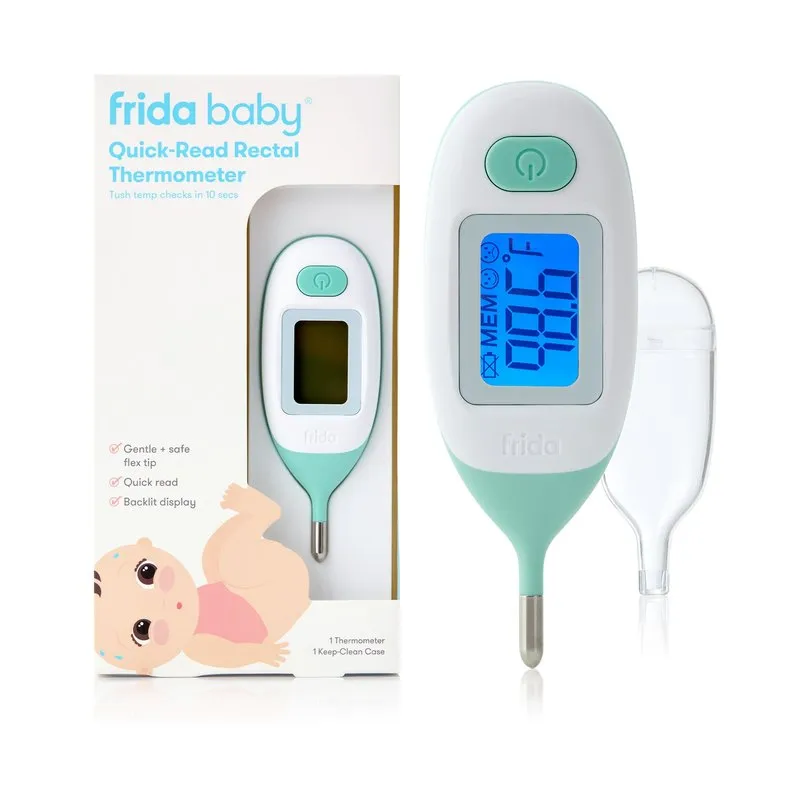
Frida Baby Quick-Read Digital Rectal Thermometer
A digital rectal thermometer with a 10-second read, a backlit display for night checks and memory for the last 10 readings. A flexible tip and stopper keep it from going in too far.
Pros
- Rectal: the most accurate way to check a baby, per the AAP
- Backlit screen for 3 a.m. checks
- Flexible tip with a stopper
Cons
- Label it for rectal use only, so it never ends up in a mouth
Best simple stick: Vicks SpeedRead (V912)
A plain digital stick for “Oral, rectal or underarm use,” with 8-second readings and a waterproof body, Vicks says. It’s a good second thermometer: one stays labeled for rectal use, the other handles armpit screening now and mouth readings later. The red-yellow-green display is a guide, not medical advice. Under 3 months, any rectal reading of 100.4°F or more is a call to the doctor, whatever color it shows.
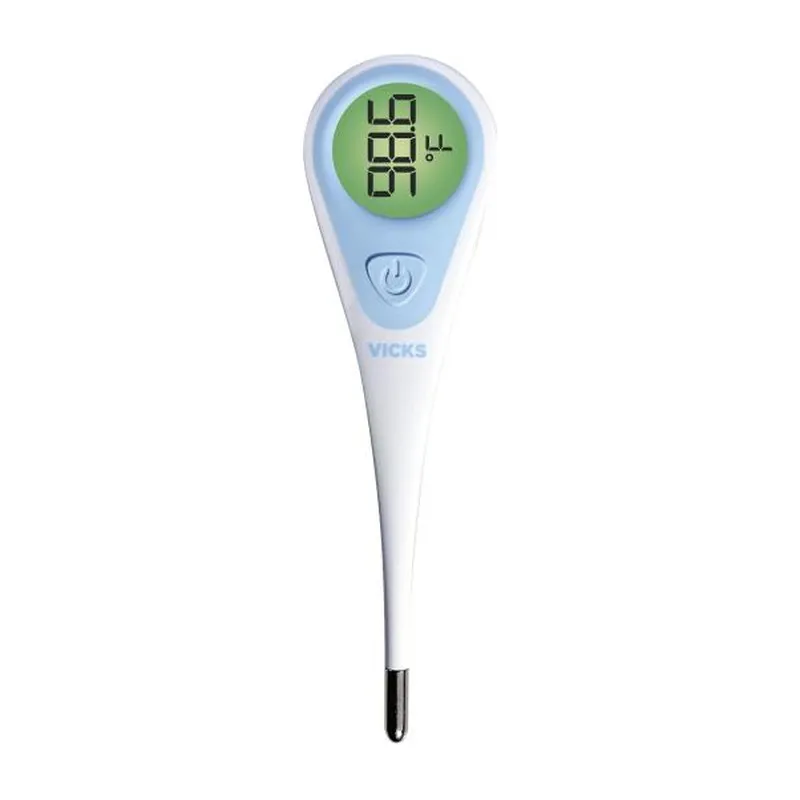
Vicks SpeedRead Digital Thermometer (V912)
A plain digital stick thermometer for oral, rectal or underarm use, with 8-second readings, a stated accuracy of +/- 0.2°F and a waterproof body for easy cleaning.
Pros
- One simple stick for rectal now, armpit screening, and oral from age 4
- 8-second readings
- Waterproof, so it's easy to clean
Cons
- Pick one for rectal use only and label it; buy a second for armpit or mouth
- The color display is a guide, not medical advice: under 3 months, 100.4°F rectal means call the doctor
Best forehead: Exergen TemporalScanner TAT-2000C+
You slide it across the forehead. Exergen lists a soft-glow display for dark rooms, a silent mode “for taking temperatures while someone is sleeping” and memory for the last 8 readings. Children’s Hospital Colorado notes this touch-the-forehead type is “the one most used in hospitals and doctors’ offices.” Exergen also says its technology is “proven accurate by more than 100 published clinical studies,” but one infant study on its own list found “limited sensitivity” for picking up rectal fevers in babies. So use it for quick checks, and confirm rectally when it counts.
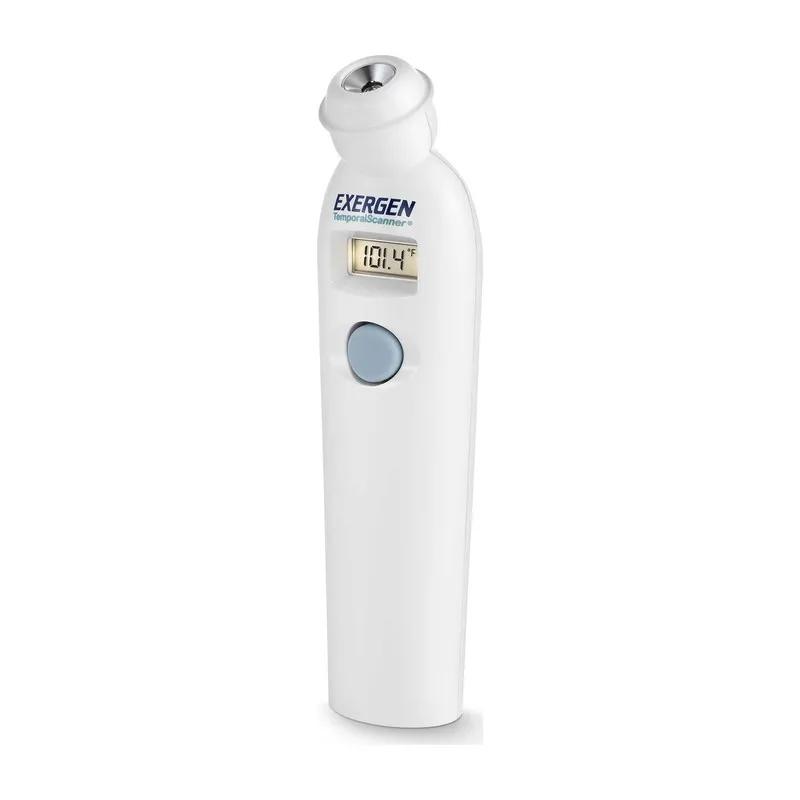
Exergen TemporalScanner TAT-2000C+
A temporal artery (forehead) thermometer you slide across the forehead. It has a soft-glow display for dark rooms, a silent mode for sleeping kids and a memory for the last 8 readings.
Pros
- The AAP says forehead thermometers can be used at any age
- Silent mode and soft-glow display for checking a sleeping baby
- Memory for the last 8 readings
Cons
- Studies find forehead readings miss some fevers in young babies: under 3 months, confirm rectally
- Let it sit in the room for 30 minutes if it's been somewhere cold, and wait a minute between scans
Best ear (6 months and up): Braun ThermoScan 7
An ear thermometer with a light and a beep to confirm it’s positioned correctly, and Age Precision color guidance. The box includes a protective case, 21 lens filters and 2 AA batteries, Braun says. Braun claims it’s as accurate as rectal readings in newborns. The AAP disagrees: ear thermometers are “Not reliable for younger babies, whose ear canals are too narrow,” so we treat it as a thermometer for 6 months and up.
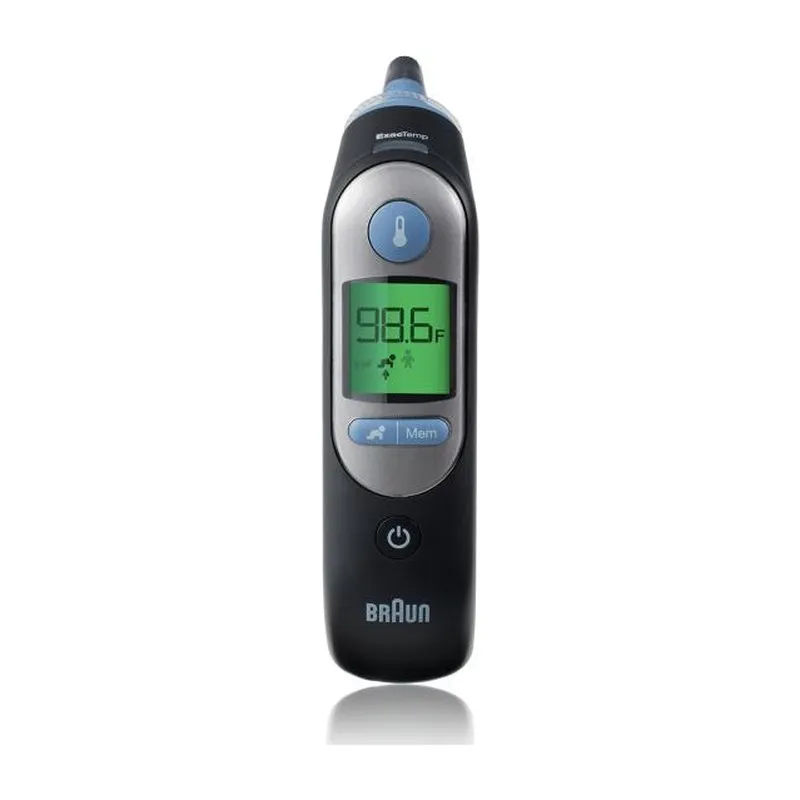
Braun ThermoScan 7 Ear Thermometer (IRT6520)
An ear thermometer with a light and a beep to confirm it's positioned correctly, and Age Precision color guidance. It comes with a protective case, 21 lens filters and 2 AA batteries.
Pros
- Quick reading for a squirmy older baby or toddler
- Light and beep confirm the probe is in the right position
- Lens filters keep the probe clean between kids
Cons
- The AAP says ear thermometers aren't reliable under 6 months
- Uses disposable lens filters, so you'll need to restock
Under 3 months: rectal, without panicking
The AAP’s steps:
- Put a little petroleum jelly on the tip and on your baby’s bottom.
- Lay your baby belly down across your lap, or on their back with legs pulled up to the chest.
- Turn it on and slide it in gently, about 1/2 inch for babies under 6 months. “There should not be any resistance. If there is, stop.”
- Hold your baby and the thermometer still until it beeps.
Two tips from Children’s Mercy: avoid taking a temperature “right after a bath or if they were under blankets or in multiple layers (or swaddled, if an infant),” and “Stay with your child while you take their temperature.” Children’s Hospital Colorado adds that rectal readings shouldn’t be taken in young children with leukemia or other cancers; ask your doctor.
Dad’s job: practice once on a calm day, so the first time isn’t at 3 a.m. with a hot, screaming baby.
Forehead thermometers: good for screening, check rectally when it counts
The AAP says temporal artery thermometers “can be used on children of any age,” and ranks forehead readings second only to rectal. Studies are more mixed, especially for young babies:
- In a Boston emergency department study of 304 infants under 1, a temporal artery thermometer had “limited sensitivity” for catching rectal fevers, though it beat ear thermometers and babies tolerated it better than rectal.
- A Johns Hopkins study found the temple thermometer worked as a screen for babies 3 to 24 months, but “The findings do not support use of temple temperatures to screen young infants.” Parents did as well as nurses.
- A 2016 review of 37 studies (adults and children) concluded temporal thermometers are “not sufficiently accurate to replace” rectal readings.
The research is older and mostly used professional models, not the exact ones we picked. The practical rule: a forehead reading is fine for a quick check, but if your baby is under 3 months or seems sick, confirm with a rectal reading.
Technique matters. Children’s Mercy notes each brand “slightly different instructions,” so read the insert. The AAP says direct sun and cold “after being outside may affect reading.”
No-touch thermometers: safe, but easy to use wrong
Infrared no-touch thermometers are not dangerous. The AAP says social media claims about danger “are false”; the thermometer gathers the heat coming off the person and doesn’t beam anything in. Accuracy is the issue. The AAP says readings “can be affected by clothing, drafts, direct sunlight and cold air,” and the FDA warns that improper use “may lead to inaccurate measurements.” The FDA’s tips: use them in a draft-free spot, out of direct sun; let the thermometer sit in the room for 10 to 30 minutes first; and check the distance, which “is specific to each NCIT.”
In a Michigan emergency department study of 200 children ages 1 month to 4 years, a no-touch thermometer tended to over-read healthy kids and under-read feverish ones. A UK study found one no-touch model caught only 12.5% of fevers. Brands differ, but that’s why we don’t make a no-touch thermometer a pick for newborns.
If you want one for checking a sleeping toddler, follow the manual’s distance exactly, and confirm a high or worrying reading with another method.
Ear thermometers: after 6 months
The AAP says to avoid ear thermometers under 6 months, “since their ear canals are too small to allow an accurate reading.” After that, they’re quick. The AAP’s technique: for a child over 1, pull the ear back and up, then “aim the tip of the ear probe between the opposite eye and ear.” On a cold day, wait 15 minutes after coming indoors. Children’s Hospital Colorado says earwax and ear tubes don’t stop a correct reading.
Reviews of ear thermometers in children have been critical. A UK-led review of 44 studies concluded that ear temperature “is not a good approximation of rectal temperature,” and a follow-up estimated ear thermometers would miss fever in “three or four out of every 10 febrile children.” Those reviews cover older devices; still, for a decision that matters, rectal wins.
Cleaning and storage
- Before and after every use. The AAP says to disinfect thermometers “with disinfecting soap and water or disinfecting alcohol swab,” and to follow the package instructions.
- Don’t dunk the infrared ones. The FDA says most no-touch thermometers “should never be immersed in water or other liquids.” Exergen’s manual says the same for its scanner.
- Keep them apart. Once a thermometer is rectal, it stays rectal.
Skip these
- Mercury thermometers. The AAP says not to use them and to remove any you have. The EPA says if the liquid is any color other than silver, it isn’t mercury. If one breaks, never vacuum it or pour it down a drain, and keep kids away. For disposal, the EPA says to call your local health department, waste authority or fire department.
- Forehead strips, pacifier thermometers and phone apps. The AAP calls strips and pacifier thermometers less accurate, and Children’s Mercy lists strips, pacifier thermometers and “smartphone temperature apps” as not recommended.
- Your hand. The AAP says feeling the forehead “is quick but not very exact.”
About “FDA approved”: home thermometers aren’t FDA approved. FDA approval is generally for the highest-risk devices, like heart valves. Most thermometers were “cleared,” and since June 2025 the FDA has exempted most spot-check thermometers from that step altogether. So “FDA approved” on a box isn’t a buying test. Buy a known brand with clear instructions.
FAQ
What is the best type of thermometer for a newborn?
A digital thermometer used rectally. The AAP says rectal gives the best reading, especially for babies under 3 months.
Are forehead thermometers accurate for babies?
The AAP ranks forehead readings second only to rectal and says they can be used at any age. Studies find they miss some fevers in young infants, so confirm rectally when it counts, especially under 3 months.
When can I use an ear thermometer on my baby?
From 6 months. Younger babies’ ear canals are too narrow for an accurate reading.
Are no-touch thermometers safe for babies?
Yes. They read the heat coming off your baby and don’t beam anything in. Accuracy is the issue: drafts, sun, hats and distance all change the reading, so follow the instructions exactly.
How do I clean a baby thermometer?
Before and after each use, with soap and water or an alcohol swab, following the package instructions. Don’t put infrared thermometers in water.
Can I use the same thermometer for rectal and oral temperatures?
No. Label it so it’s only ever used in one place. Oral readings aren’t recommended until age 4 anyway.
What should I do with an old mercury thermometer?
Get it out of the house, but not in the trash. Ask your local health department, waste authority or fire department how to dispose of it. If one breaks, don’t vacuum it, and keep children away.
Sources
- American Academy of Pediatrics (HealthyChildren.org): How to Take a Child’s Temperature, Fever and Your Baby and Are infrared thermometers safe?
- Children’s Mercy Kansas City (Nemours KidsHealth): How to Take Your Child’s Temperature; Children’s Hospital Colorado: How to take a temperature
- U.S. Food and Drug Administration: Non-contact infrared thermometers, Is it really FDA approved? and the June 2025 thermometer exemption (Federal Register)
- U.S. Environmental Protection Agency: Mercury thermometers and What to do if a mercury thermometer breaks
- Studies (PubMed): Greenes and Fleisher 2001, Siberry et al. 2002, Callanan 2003, Geijer et al. 2016, Fortuna et al. 2010, Van den Bruel et al. 2020, Craig et al. 2002 and Dodd et al. 2006
- Product pages: Frida Baby Quick-Read, Vicks SpeedRead, Exergen TAT-2000C+ and clinical studies list, Braun ThermoScan 7