How to Soothe a Crying Newborn: A Dad's Guide
Why newborns cry so much, the checklist to run first, the soothing moves that work, when crying means call the doctor, and what to do when you hit your limit.
We choose everything we recommend independently. If you buy through our links, we may earn a commission. How we make money
In this guide
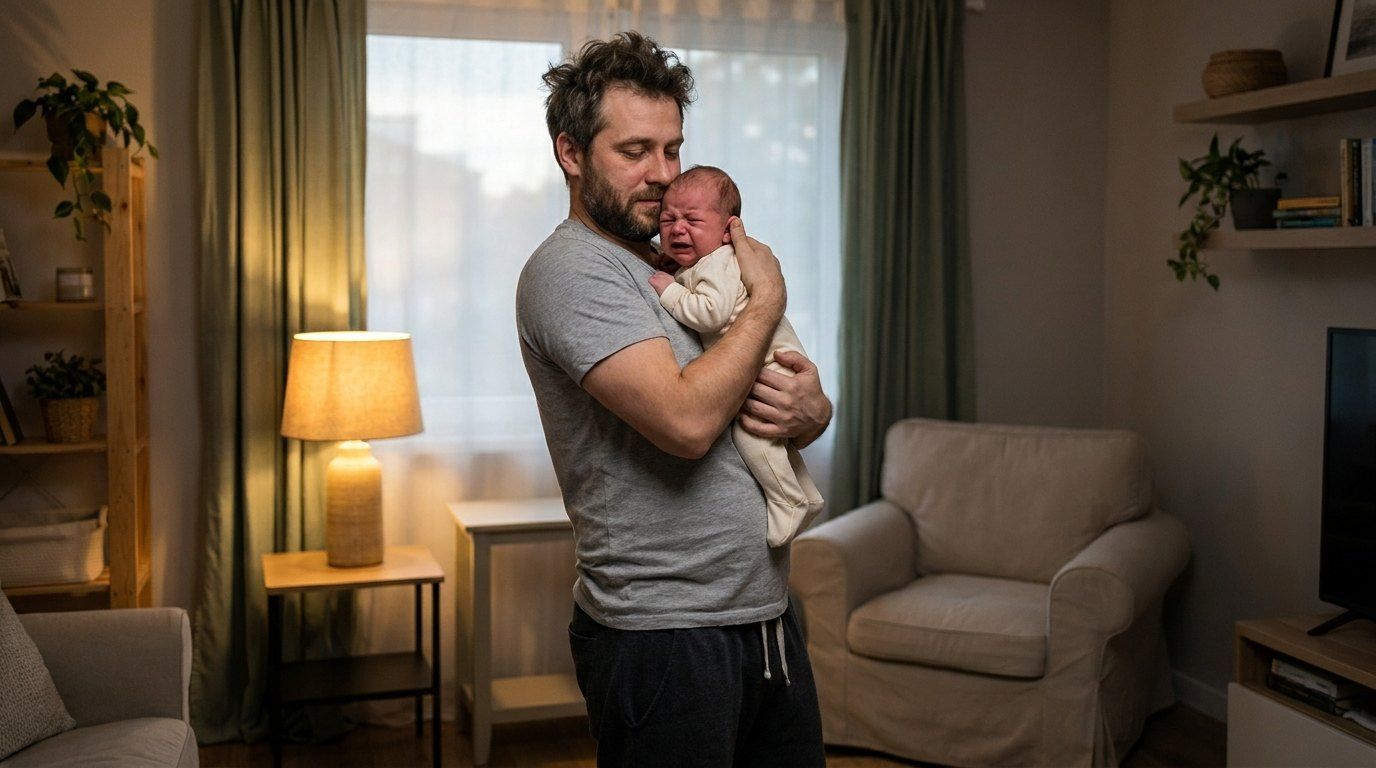
Learning how to soothe a crying newborn is the first real test most dads face. It’s 2 a.m., you’ve fed, changed and burped, and the crying keeps going. Here’s what helps: it’s almost always normal, it gets better, and there’s a short list of things that work. This guide covers why newborns cry, what to try in what order, when crying is a reason to call the doctor, and what to do when you’re the one who needs a break.
A note before you start: this is general information, not medical advice. If something seems wrong, call your pediatrician.
The short answer
- Is this much crying normal? Usually, yes. The American Academy of Pediatrics (AAP) says newborns routinely cry 1 to 4 hours a day.
- What to check first: hunger, a wet or dirty diaper, too hot or too cold, a burp, or too much going on around them.
- What soothes: rocking, walking, safe swaddling, white noise, a pacifier, holding the baby skin-to-skin, a stroller walk or a drive.
- Call the pediatrician now for a fever of 100.4°F or higher under 3 months, nonstop crying for more than 2 hours, vomiting, or a baby who seems unwell.
- At your limit? Put the baby on their back in the crib, leave the room for 10 to 15 minutes, and call someone. Never shake a baby.
Why newborns cry so much
Crying is how a newborn says everything: hungry, cold, wet, tired, overwhelmed. Some of it has no reason you can find at all.
How much is normal. A 2017 review of 28 studies with more than 8,600 babies found that babies fuss and cry about 2 hours a day on average in the first 6 weeks, dropping to about an hour a day by 10 to 12 weeks. The AAP says fussing peaks at about 3 hours a day around 6 weeks, then drops to 1 or 2 hours by 3 to 4 months.
It often gets worse in the evening. The National Center on Shaken Baby Syndrome sums up this stage as the Period of PURPLE Crying: crying that peaks around month 2, comes and goes unexpectedly, resists soothing, can look like the baby is in pain, can last for hours, and is often worse in the late afternoon and evening. The “Period” part is the good news: it has a beginning and an end, usually by 4 to 5 months.
You can’t spoil a newborn. The AAP says you cannot spoil a young baby with attention. Pick them up.
Step 1: run the checklist
The AAP’s advice is to meet the most pressing need first. If the baby is cold, hungry and wet, warm them up, change the diaper, then feed. Go down the list:
- Hungry?
- Wet or dirty diaper?
- Too hot or too cold? The AAP’s rule of thumb: dress the baby in about the same layers you’re wearing.
- Needs a burp? The AAP lists burping to release trapped air among its soothing steps.
- Overstimulated? Too many visitors, lights or noise. Try a dark, quiet room.
- Something pinching? If the cry suddenly sounds shrieking or panicked, the AAP suggests checking for a hair wrapped tightly around a finger or toe, or clothing that’s too tight.
Step 2: try motion, sound and closeness
If the baby is fed, dry and comfortable and still crying, these are the techniques the AAP and the CDC suggest. Try one at a time for a few minutes before switching; babies often need a bit of time to settle.
- Hold them close and move. Rock, sway or walk with the baby in your arms. The AAP says calming motions remind babies of the movement they felt in the womb.
- Skin-to-skin. The CDC suggests holding the baby against your bare skin. This is a great dad job: take your shirt off, baby in just a diaper, on your chest. See our guide to skin-to-skin for dads.
- Swaddle. Wrap the baby snugly in a large, thin blanket (see the safety rules below).
- Shush or play white noise. Steady background sound, like a fan or a white noise machine, can help. Keep the volume low and the machine away from the baby.
- Offer a pacifier.
- Go for a walk or a drive. The CDC suggests a stroller walk or a drive in the car if you can. Keep the baby buckled in properly.
- Tummy across your lap. The AAP suggests laying the baby tummy-down across your knees and rubbing their back. If they fall asleep, move them to their crib on their back.
- Try a warm bath or softly singing and talking.
The AAP also mentions the sound and vibration of a vacuum or dryer, with one firm rule: never put the baby on top of a washer or dryer.
What about the “5 S’s”? You’ll see them everywhere: swaddle, side or stomach position, shush, swing and suck. They come from pediatrician Harvey Karp’s book The Happiest Baby on the Block, which an AAP symptom guide recommends to parents. The side and stomach positions are only for calming a baby who is awake in your arms. For sleep, a baby always goes down on their back.
Swaddling safely
From the AAP:
- Back only. A swaddled baby should always be placed on their back and watched so they don’t roll over.
- Stop at the first signs of rolling. The AAP says to stop swaddling as soon as your baby shows any sign of trying to roll over, which can happen as early as 2 months.
- Snug at the chest, loose at the hips. Leave room for two or three fingers between the baby’s chest and the swaddle, and let the legs bend up and out.
- No weighted swaddles, and watch for overheating: sweating, damp hair or flushed cheeks.
A loose blanket that comes unwrapped can cover the baby’s face, so for sleep, many parents use a wearable swaddle or sleep sack instead.
Gear that can help
None of this is required. These two are worth having when the crying gets long.

Ergobaby Omni Classic
Ergobaby's current four-position, newborn-ready carrier for babies from 7 to 45 pounds. Ergobaby sizes it from petite to 4XL and offers strap options for parents with narrower or wider shoulders; its waistbelt extender adds about 6 inches.
Pros
- Strap options for wide shoulders
- Newborn-ready, no infant insert
- Extender adds about 6 inches
Cons
- Ergobaby doesn't publish the waist range in inches
A carrier lets you keep the baby close and moving, which the AAP lists among its soothing ideas, with your hands free. Follow the TICKS rule for safe babywearing, explained in our guide to baby carriers for big and tall dads.

Yogasleep Hushh 2 Portable Sound Machine
A pocket-size white noise machine with 6 sounds, a timer and up to 34 hours of battery on one USB-C charge, according to Yogasleep. Small enough for the diaper bag.
Pros
- Up to 34 hours of battery
- USB-C charging
- Fits in a diaper bag
Cons
- Keep it away from the baby's ears and out of the crib
A pocket white noise machine for the nursery, the car or a walk. A 2014 study in Pediatrics found some infant sleep machines were loud enough at full volume to risk babies’ hearing, so keep it across the room, never in the crib, and the volume low.
Is it colic?
About one in five babies develops colic, according to the AAP, usually starting between the second and fourth week. A common definition is crying for more than 3 hours a day, more than 3 days a week, in a healthy baby. Colicky crying is often worst in the early evening and usually stops by 3 to 4 months, though the AAP says it can last until 6 months.
Nobody knows exactly what causes it. The AAP says most often the baby is simply unusually sensitive to stimulation. Food sensitivity is less common: the AAP says it causes less than 5% of colicky crying.
What helps, and what doesn’t:
- Gas drops and gripe water: the AAP says research has never shown these products to work, and a Cochrane review found no evidence for simethicone.
- Probiotic drops (L. reuteri): a 2018 analysis of four trials found they reduced crying in breastfed babies with colic, but not in formula-fed babies. Several of the authors had ties to the maker. Ask your pediatrician before trying them.
- Feeding changes: the AAP says that, with your pediatrician’s advice, a breastfeeding mom can try cutting out dairy or caffeine one at a time for about two weeks, and formula-fed babies may try a hypoallergenic formula. Don’t overfeed, and try a slower-flow nipple.
When crying means call the doctor
Call your pediatrician right away, or get care now, if:
- Fever in a baby under 3 months. The AAP says a rectal temperature of 100.4°F (38°C) or higher means calling the pediatrician immediately, even with no other symptoms. Don’t give fever medicine before the baby is seen.
- Nonstop crying for more than 2 hours.
- Vomiting, or the baby is drinking very little.
- The baby cries when touched or moved, or might have been injured.
- The soft spot on the head is bulging, or the groin or scrotum is swollen.
- A sudden change in how the baby cries or behaves, according to MedlinePlus.
- The baby is hard to wake or not alert when awake: go to the ER. Not moving or very weak: call 911.
The AAP’s symptom guide also says to call within 24 hours if you’re worn out from all the crying, and right away if you’re afraid someone might hurt or shake the baby. That’s a medical reason to call, not a failure.
When you’re the one at your limit
This is the most important part of this guide.
Prolonged crying wears down every parent. The CDC says abusive head trauma, often called shaken baby syndrome, often happens when a parent or caregiver gets angry or frustrated because a baby won’t stop crying. It’s a leading cause of child abuse deaths in children under five, and the CDC says up to one in four babies who suffer it die. Research on the timing of shaken baby cases found they rise and fall with the normal crying curve, peaking a few weeks after crying does.
This is a dad issue, too. A 1995 study of 151 babies at one US hospital found that men outnumbered women more than two to one among the people who hurt them, and fathers were the largest single group. That’s one older study, but it’s why this section is here. Most dads would never imagine doing it. The point of a plan is that you don’t have to rely on willpower at 3 a.m.
The plan, from the AAP and CDC:
- Put the baby down safely. On their back in the crib or playpen, with no blankets or stuffed animals.
- Walk out of the room. Take a deep breath and count to 10. Let the baby cry alone for 10 to 15 minutes. The PURPLE program says letting a baby cry will not hurt them.
- Check on them every 10 to 15 minutes, but don’t pick them up until you’re calm.
- Call someone. Your partner, a friend, a relative, a neighbor or your pediatrician.
- Tag out. Agree with your partner in advance on a signal that means “take over now,” no questions asked.
Never shake, throw, hit or jerk a baby, even playfully. The AAP says shaking can cause blindness, brain damage or death. And make sure everyone who looks after your baby, including grandparents and sitters, knows the plan.
Where to call:
- Childhelp National Child Abuse Hotline: call 1-800-422-4453 (1-800-4-A-CHILD), or text “GO” to the same number. Childhelp calls it a safe, nonjudgmental space for anyone worried about child abuse, and it’s not a reporting line.
- Postpartum Support International HelpLine: 1-800-944-4773 if the crying is wearing you down for weeks. PSI has support specifically for dads.
- 988 Suicide and Crisis Lifeline: call or text 988 if you’re in crisis.
- Emergency: call 911.
Look after yourself
Long stretches of crying are hard on dads’ mental health. A 2021 study found that fathers of babies with colic had higher scores for stress, depression and anxiety than fathers of babies without colic. Depression in new dads is common: reviews put it around 1 in 10. If you’ve felt flat, irritable or angry most days for two weeks or more, see our guide to postpartum depression in dads.
Practical help: split the night into shifts so each of you gets one stretch of real sleep. See night feeds for dads for how to set that up.
FAQ
How do you calm a crying newborn fast?
Check the basics first: hunger, diaper, temperature, a burp. Then hold the baby close and move: rock, sway or walk. Swaddling, white noise, a pacifier or skin-to-skin often help. Give each one a few minutes before trying the next.
How long is it normal for a newborn to cry?
The AAP says newborns routinely cry 1 to 4 hours a day. A review of 28 studies found about 2 hours a day in the first 6 weeks, dropping to about an hour by 10 to 12 weeks.
When should I worry about my newborn crying?
Call the pediatrician right away for a fever of 100.4°F or higher in a baby under 3 months, nonstop crying for more than 2 hours, vomiting, poor feeding, a baby who cries when touched, or any sudden change in how the baby cries or acts.
Is it OK to let a newborn cry?
If the baby is fed, changed and safe on their back in the crib, it’s OK to step away for 10 to 15 minutes when you need to calm down. The AAP recommends exactly this when you feel overwhelmed. Check on them regularly.
What is the PURPLE crying period?
A name from the National Center on Shaken Baby Syndrome for the normal stage when babies cry the most: it peaks around month 2, often comes in the evening and resists soothing, and usually ends by 4 to 5 months.
Does gas make babies cry?
Probably less than people think. An AAP symptom guide says gas passing through normal intestines doesn’t cause pain or crying, and the AAP says gas drops have never been shown to work. Burping during and after feeds is still worth doing.
Sources
- Responding to Your Baby’s Cries, Colic, Calming a Fussy Baby, Swaddling: Is it Safe?, Fever and Your Baby, Abusive Head Trauma: Shaken Baby Syndrome and Crying Baby: Before 3 Months Old, American Academy of Pediatrics (HealthyChildren.org)
- About Abusive Head Trauma, Centers for Disease Control and Prevention
- Colic and crying: self-care, MedlinePlus (National Library of Medicine)
- The Period of PURPLE Crying, National Center on Shaken Baby Syndrome
- Systematic Review and Meta-Analysis: Fussing and Crying Durations and Prevalence of Colic in Infants, Wolke et al., The Journal of Pediatrics, 2017
- Pain-relieving agents for infantile colic, Biagioli et al., Cochrane Database of Systematic Reviews, 2016
- Lactobacillus reuteri to Treat Infant Colic: A Meta-analysis, Sung et al., Pediatrics, 2018
- Age-related incidence curve of hospitalized Shaken Baby Syndrome cases: convergent evidence for crying as a trigger to shaking, Barr et al., Child Abuse and Neglect, 2006
- Abusive head trauma: the relationship of perpetrators to their victims, Starling et al., Pediatrics, 1995
- Distress in fathers of babies with infant colic, de Kruijff et al., Acta Paediatrica, 2021
- Infant sleep machines and hazardous sound pressure levels, Hugh et al., Pediatrics, 2014
- Childhelp National Child Abuse Hotline, Help for Dads, Postpartum Support International, and 988 Suicide and Crisis Lifeline