How Much Formula by Age: Chart, Weight Rule and When to Stop the Bottle
How much formula a baby needs by age and weight: a chart from newborn to 12 months, the 2.5 ounces per pound rule, the 32-ounce limit, hunger and fullness cues, and mixing and bottle rules for dads.
We choose everything we recommend independently. If you buy through our links, we may earn a commission. How we make money
In this guide
- The short answer
- Formula chart by age
- How much formula by weight
- The first week
- Hungry or full? Reading your baby
- Can you overfeed a formula baby?
- When solids start: 6 months and the 8-month question
- Is my baby getting enough?
- Spit-up or overfed?
- How to mix formula (never dilute it)
- What water to use
- How long a bottle lasts
- Combo feeding and vitamin D
- No water before 6 months
- Switching brands, imports and recalls
- When to call the pediatrician
- FAQ
- Sources
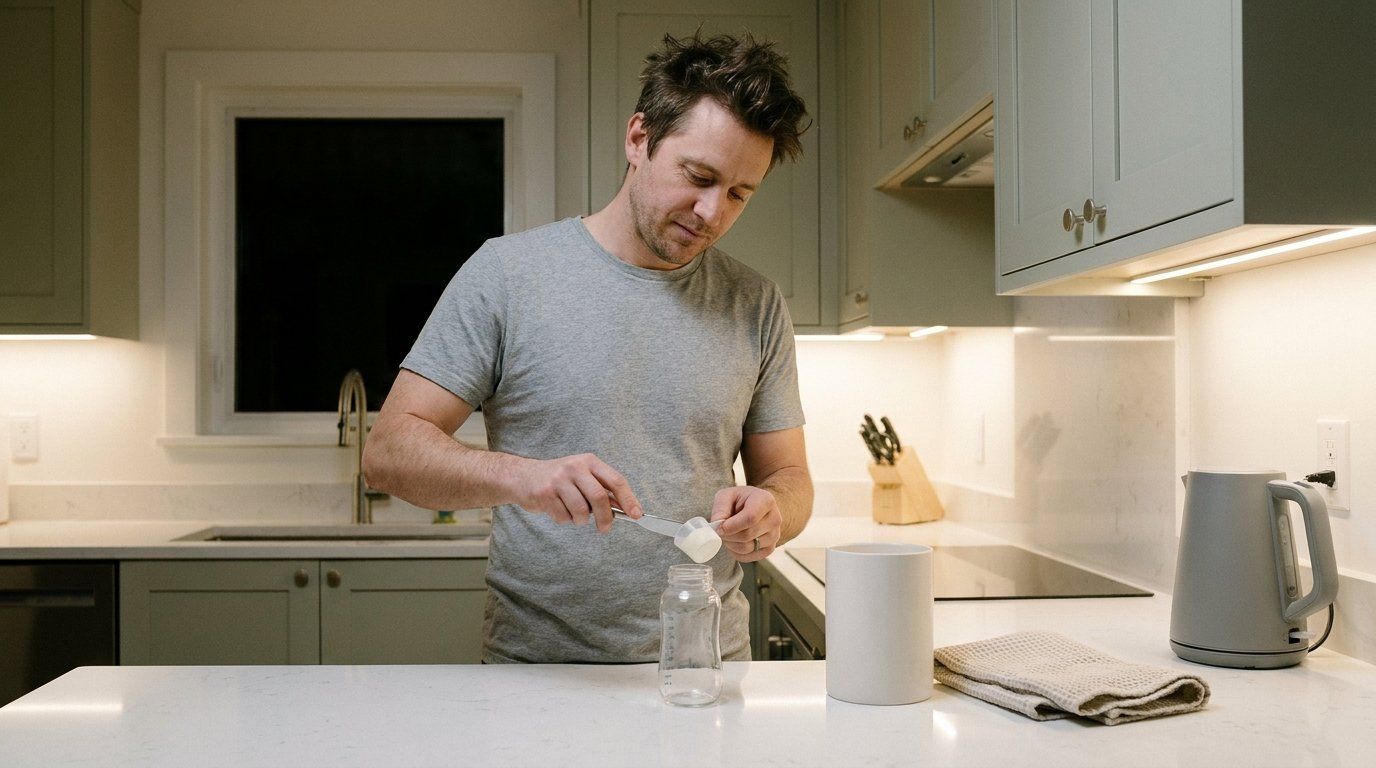
You’re standing in the kitchen with a scoop in one hand and a half-empty bottle in the other, and you want one number. Here it is: the AAP says a baby needs about 2½ ounces of formula a day for every pound of body weight, usually no more than about 32 ounces in 24 hours. Everything else in this guide is how to use that number: a chart by age, what to do at ages where no one has a real figure, how to tell hungry from full, and the mixing rules that matter.
A note before you start: this is general guidance, not medical advice for your baby. If your baby was born early, has a health condition or is gaining weight slowly, your pediatrician’s numbers come first.
The short answer
- By weight: about 2.5 ounces a day per pound, usually no more than about 32 ounces in 24 hours.
- First week: 1 to 2 ounces a feed, every 2 to 3 hours.
- End of month one: about 3 to 4 ounces, about every 3 to 4 hours.
- 6 months: 6 to 8 ounces, 4 or 5 times a day.
- 8 to 12 months: roughly 24 ounces a day, with solids.
- Then follow your baby, not the chart.
Formula chart by age
These are averages, not targets. Babies vary from day to day.
| Age | Typical per feed | How often |
|---|---|---|
| First day or two | ½ to 2 oz | Every 2 to 3 hours, at least 8 feeds in 24 hours |
| First week | 1 to 2 oz | Every 2 to 3 hours, at least 8 feeds in 24 hours |
| End of month 1 | 3 to 4 oz | About every 3 to 4 hours |
| 2 months | About 5 oz* | About every 3 to 4 hours |
| 3 months | No sourced number: use the weight rule | About every 3 to 4 hours |
| 4 months | About 6 oz* | About every 3 to 4 hours |
| 5 months | No sourced number: use the weight rule | About every 3 to 4 hours |
| 6 months | 6 to 8 oz | 4 or 5 feeds in 24 hours; solids start around now |
| 7 months | No sourced number | Formula or solids about 5 to 6 times in 24 hours |
| 8 to 12 months | Roughly 24 oz a day in total | Formula or solids about 5 to 6 times in 24 hours |
| 12 months | Move to whole cow’s milk | With meals |
*These two figures come from the symptom checker on the AAP’s HealthyChildren site, which lists averages. It’s a triage guide, not AAP policy.
Why the blanks? Most charts online print 3-month and 5-month numbers, but we couldn’t find either in any AAP, CDC or FDA page. The AAP does say babies add “an average of 1 ounce per month before leveling off at about 7 to 8 ounces per feeding,” so those ages fall somewhere between their neighbors. The weight rule below is the more honest answer.
Don’t multiply the columns. The AAP’s 6 to 8 ounces at 4 or 5 feeds would work out to 24 to 40 ounces a day, which is more than the usual limit. Per-feed and per-day figures are separate averages, so they won’t always add up.
How much formula by weight
The AAP’s rule: “about 2½ ounces (75 mL) of infant formula a day for every pound (453 g) of body weight.” Here’s that math, stopping at the usual limit:
| Baby’s weight | About this much in 24 hours |
|---|---|
| 6 lb | 15 oz |
| 7 lb | 17.5 oz |
| 8 lb | 20 oz |
| 9 lb | 22.5 oz |
| 10 lb | 25 oz |
| 11 lb | 27.5 oz |
| 12 lb | 30 oz |
| 13 lb and up | About 32 oz |
Example: a 12-pound baby at about 30 ounces a day, across 5 feeds, is about 6 ounces a feed. This is the best answer for a 3-month-old or a 5-month-old.
The AAP adds that babies “will regulate their intake from day to day,” so let them tell you when they’ve had enough. And it says “Your baby should usually drink no more than an average of about 32 ounces (960 mL) of formula in 24 hours.” If your baby consistently wants more or less, talk to your pediatrician. One older AAP book excerpt says 36 ounces, but every newer page says 32.
The first week
The AAP says that in the first week “babies should be eating no more than about 1 to 2 ounces (30 to 60 ml) per feed,” and some take only half an ounce in the first day or two. The CDC’s reason: “Your newborn baby’s belly is tiny.” Start with 1 to 2 ounces every 2 to 3 hours, and give more if they show hunger signs.
If your baby sleeps longer than 4 to 5 hours in the first few weeks and starts missing feeds, the AAP says to wake them and offer a bottle. More on the first weeks in our night feeds guide.
Dad’s job: keep a simple shared log of feeds and wet diapers. The pediatrician will ask, and tired parents don’t remember. See best apps for new dads.
Hungry or full? Reading your baby
The AAP’s advice for healthy full-term babies is to look to the baby rather than the clock. These are the CDC’s signs for birth to 5 months:
| Hungry | Full |
|---|---|
| Puts hands to mouth | Closes mouth |
| Turns head toward the bottle | Turns head away from the bottle |
| Puckers, smacks or licks lips | Relaxes hands |
| Clenched hands |
“Crying is often a late sign of hunger,” the CDC says. And not all sucking is hunger: the AAP says babies also suck for comfort, and some “may just want to suck on a pacifier after feeding.”
Still hungry? The AAP says that if a baby drains the bottle and keeps smacking their lips, they might still be hungry. Try increasing feeds by an ounce at a time.
Can you overfeed a formula baby?
Yes. The AAP says bottle-fed babies “may be more likely to overfeed, because drinking from a bottle is faster,” and that they may keep sucking when full. Overfed babies can have stomach pain and gas and may spit up more.
- Don’t push the last ounce. The CDC says: “Do not force your baby to finish the bottle if your baby is showing signs of fullness.”
- Start smaller. “It’s better to offer less, since you can always give more if your baby wants it,” the AAP says.
- Pause mid-feed. Pausing gives them a chance to realize they’re full.
- Don’t prop the bottle. The CDC says it raises the risk of choking, ear infections and tooth decay.
- No cereal in the bottle, unless your pediatrician tells you to. The CDC says it won’t make your baby sleep longer and could raise the risk of choking. When your baby is ready for real food, see when to start solids.
Dad’s job: you’re the one who wants to see the bottle finished. Leave the last ounce.
When solids start: 6 months and the 8-month question
The CDC says your child can begin solids at about 6 months, and not before 4 months. Formula doesn’t stop: “Breast milk and/or infant formula continues to be the main source of nutrition for your child from 6 to 12 months.” As your baby eats more solids, they’ll gradually need less formula.
How much formula for an 8-month-old? The AAP’s sample menu for 8- to 12-month-olds says “roughly 24 ounces (720 mL) a day,” for example 4 to 6 ounces with meals and 6 to 8 ounces before bed. That’s a sample, not a prescription.
At 12 months, the CDC says you can switch to whole cow’s milk. Before that, skip toddler formulas, and don’t give cow’s milk as a drink.
Is my baby getting enough?
- Wet diapers. The AAP says 2 to 3 a day in the first few days, then “at least 5 to 6 wet diapers a day” after the first 4 to 5 days.
- Weight. The AAP says most babies are back to birth weight by about 2 weeks, and “Your baby’s progress on the growth chart is one way to tell” if they’re getting enough.
- Mood. A baby who is happy most of the time and not spitting up too much is probably taking the right amount, the AAP says.
Growth spurts happen around 7 to 10 days and again between 3 and 6 weeks, the AAP says. Expect a few hungrier days, then follow the cues.
Spit-up or overfed?
“All babies spit up,” the AAP says. Spit-up flows out easily, often with a burp; vomiting is forceful. To reduce overfeeding, the AAP suggests smaller amounts more often. Always call if your baby vomits forcefully after every feed, or if there’s ever blood in the vomit. For technique, see how to burp a baby.
How to mix formula (never dilute it)
- Follow the can. “Use the amount of water listed on the instructions of the infant formula container. Always measure the water first and then add the powder,” the CDC says.
- Use that can’s scoop. Most US powder is 1 scoop per 2 ounces of water, but the AAP says some imported formulas differ.
- Never stretch it. “Watering down formula is dangerous,” the AAP says. Too much water can cause water intoxication and seizures. Too little can strain a baby’s kidneys, the CDC says.
- Never make it yourself. The FDA advises against homemade formula.
- Read the new can when you switch brands. The AAP says mixing instructions can differ.
If you’re struggling to afford or find formula, the AAP says to ask your pediatrician’s office for help; your local WIC office may also be able to help.
What water to use
The CDC says tap water, filtered or unfiltered, is usually fine, following the maker’s instructions. If you’re not sure your water is safe, ask your local health department. Two AAP lead tips: use the cold tap, never hot, and if water has sat in the pipes for 6 hours, let it run 15 to 30 seconds first.
Extra steps for babies under 2 months, born early or with a weakened immune system. Powder isn’t sterile. The CDC suggests liquid formula or boiling the water, waiting about five minutes, and then mixing, because very hot water kills germs. Cool it fully before feeding. Details are in our night feeds guide.
How long a bottle lasts
The CDC rule: use prepared formula within 2 hours of preparation and within 1 hour from when feeding begins. If you don’t start within 2 hours, put it in the fridge and use it within 24 hours. “Throw out any infant formula that is left in the bottle after feeding your baby.” Don’t refrigerate leftovers, and don’t top up a used bottle.
Dad trick from the AAP: “You’ll dump less out if you prepare and use 2-ounce to 4-ounce batches of formula.”
Formula doesn’t need warming, the CDC says. If your baby prefers it warm, use running warm water and test a few drops on your wrist. Never use a microwave. An opened can of powder doesn’t go in the fridge, and most need to be used within 1 month.
If you need a small bottle for those batches, this one comes up in our newborn essentials:
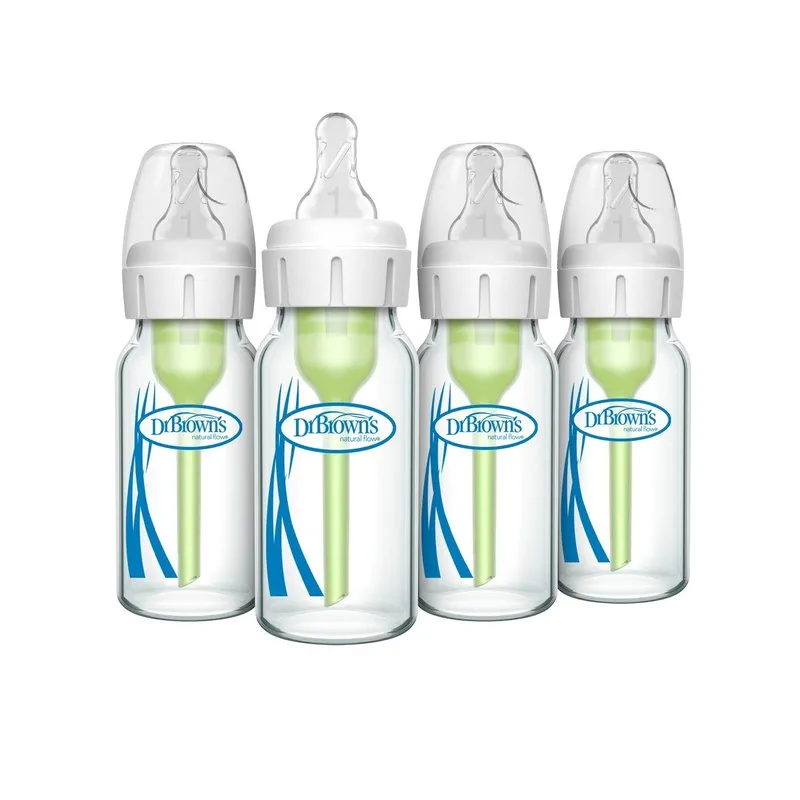
Dr. Brown's Options+ Narrow Glass Bottles, 4 oz (4-pack)
Small 4-ounce glass bottles with Level 1 slow-flow nipples, sized for the first weeks when a feed is 1 to 3 ounces. Dr. Brown's says the glass is heat and thermal-shock resistant.
Pros
- 4-ounce size matches newborn feeds
- Level 1 slow-flow nipple for newborns
- Glass, top-rack dishwasher safe
Cons
- More parts to wash than a simple bottle
- The AAP's bottle-feeding advice notes there is no good evidence for any one brand's anti-colic claims
Combo feeding and vitamin D
There’s no published number for babies getting both. The CDC says amounts may differ, so go by your baby’s cues and your pediatrician. The AAP suggests starting feeds with available breast milk, then giving formula if needed.
Vitamin D: 32 ounces has a second meaning. The CDC says babies getting about 32 ounces or more of formula a day don’t need extra vitamin D, while babies on breast milk or less than 32 ounces do. Most young babies don’t drink that much, so ask your pediatrician about drops. Don’t push a baby toward 32 ounces to skip them.
No water before 6 months
The AAP says babies in the first 6 months “do not need water or other liquids such as juices in addition to formula or breast milk,” unless a pediatrician advises otherwise. Around 6 months, it says you can offer a little water in a cup.
Switching brands, imports and recalls
- No brand is best. “No brand of infant formula is best,” the CDC says.
- Switching: for most babies, it’s OK to switch between milk-based formulas, including store brands, the AAP says, unless they’re on a specific hydrolyzed formula. The FDA says to do it with your pediatrician’s guidance.
- Imported formula: the FDA says all formula sold in the US must meet US requirements, and to use caution ordering online or from third-party sellers.
- Before you buy: the CDC says to check that it isn’t expired or recalled, with no dents, puffy ends or rust.
- Recalls in the news: the FDA investigated two infant botulism outbreaks tied to powdered formula, one from November 2025 (ByHeart) and one from June 2026 (Nara Organics). Both investigations have ended. Check the FDA’s recall page for anything current.
When to call the pediatrician
Get help right away if your baby can’t wake up, is hard to wake or is too weak to suck, or if a baby under 12 weeks has a fever of 100.4°F or higher. See our baby fever guide.
Call the same day for signs of dehydration: no urine in more than 8 hours, dark urine, a very dry mouth or no tears, or if your baby drinks very little for more than 8 hours.
Talk to your pediatrician if your baby doesn’t seem to be gaining enough weight, consistently wants much more or less than these amounts, seems hungry all the time even when full, or has very watery stools or blood in the stool.
FAQ
How much formula should a newborn eat?
About 1 to 2 ounces a feed in the first week, every 2 to 3 hours, at least 8 feeds in 24 hours. Some take only half an ounce in the first day or two.
How much formula for a 2-month-old or a 4-month-old?
The symptom checker on the AAP’s site lists averages of about 5 ounces at 2 months and 6 ounces at 4 months. Check that against 2.5 ounces per pound a day.
How much formula for a 3-month-old?
No AAP or CDC page gives a number. Use the weight rule: about 2.5 ounces a day per pound. A 12-pound baby would take about 30 ounces in 24 hours, spread across the day’s feeds.
What’s the most formula a baby should have in a day?
The AAP says usually no more than an average of about 32 ounces in 24 hours. If your baby always wants more, ask your pediatrician.
How much formula does an 8-month-old need?
Roughly 24 ounces a day for 8- to 12-month-olds eating solids, the AAP says.
Can I save a bottle my baby didn’t finish?
No. Use it within 1 hour of the start of the feed, then throw out what’s left. Don’t refrigerate it.
Can I add extra water to make formula last?
Never. It deprives your baby of nutrients and can cause seizures. If money is tight, call your pediatrician or WIC.
Sources
- American Academy of Pediatrics (HealthyChildren.org): Amount and schedule of formula feedings, How often and how much should your baby eat?, How much formula does my baby need?, Sample menu for an 8- to 12-month-old, Why babies spit up, First month growth, How to safely prepare formula with water, How long can bottles sit out?, Lead in tap water, Running low on money and Bottle-feeding symptom checker (Schmitt Pediatric Guidelines)
- CDC: How much and how often to feed formula, Preparation and storage, Signs your child is hungry or full, Bottle feeding, Starting solid foods, Choosing a formula, Vitamin D and Preventing Cronobacter
- U.S. Food and Drug Administration: Infant formula, Information for parents and caregivers, Homemade infant formula advisory, and outbreak investigations from November 2025 and June 2026