How to Get Baby to Sleep in a Bassinet (Without Waking Them)
Why your newborn wakes the second you put them down, and how to get baby to sleep in a bassinet: timing the transfer, a simple night routine, swaddles, white noise and pacifiers, plus the safe sleep rules that come first.
We choose everything we recommend independently. If you buy through our links, we may earn a commission. How we make money
In this guide
- The short answer
- First, the safe sleep rules
- Why your baby wakes up when you put them down
- How to put a sleeping baby down in the bassinet
- Drowsy but awake
- Make nights boring and days bright
- A simple bedtime routine
- Tools that help (and the rules for each)
- The bassinet itself
- The 2 a.m. danger: you falling asleep
- When will my baby sleep longer?
- When to call the doctor
- FAQ
- Sources
It’s 2 a.m. The baby finally fell asleep on your chest after the bottle. You stand up, inch toward the bassinet, lower them in, and the eyes snap open. If that’s your night, you’re not doing anything wrong. Newborns are built to wake easily, and there’s a reason the put-down is the hardest part. This guide explains why, then covers how to time the transfer, the night routine, and the tools that help, all within the safe sleep rules from the AAP, the NIH and the CPSC.
A note before you start: this is general guidance, not medical advice for your baby. If your baby was born early or has a health condition, ask your pediatrician about sleep.
The short answer
- Wait for deep sleep. Slow breathing and floppy arms before you move.
- Drowsy but awake when you can, so the baby learns to fall asleep in the bassinet.
- Dark, quiet, boring nights; bright, busy days.
- Same short routine every night.
- Swaddle, pacifier, quiet white noise can help.
- Safe sleep always: back, bare bassinet, your room, never the couch.
First, the safe sleep rules
Every tip below works inside these rules, not around them:
- On the back for every sleep. The AAP says the side position “is just as dangerous as the stomach position.”
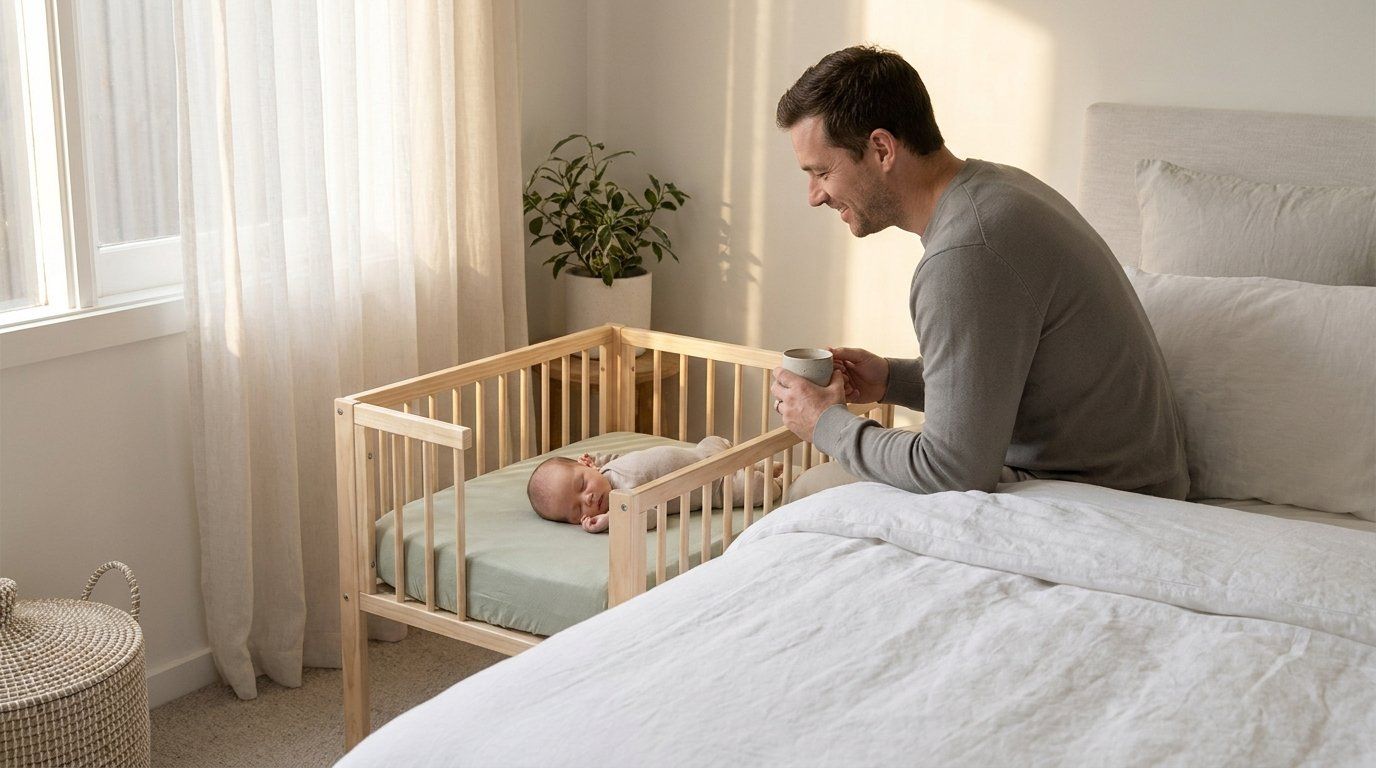
- Firm, flat, bare. Shopping for one? See the best bassinets. “Nothing but a fitted sheet in a crib, bassinet or play yard,” the CPSC says. A surface tilted more than 10 degrees isn’t safe for sleep, the AAP says.
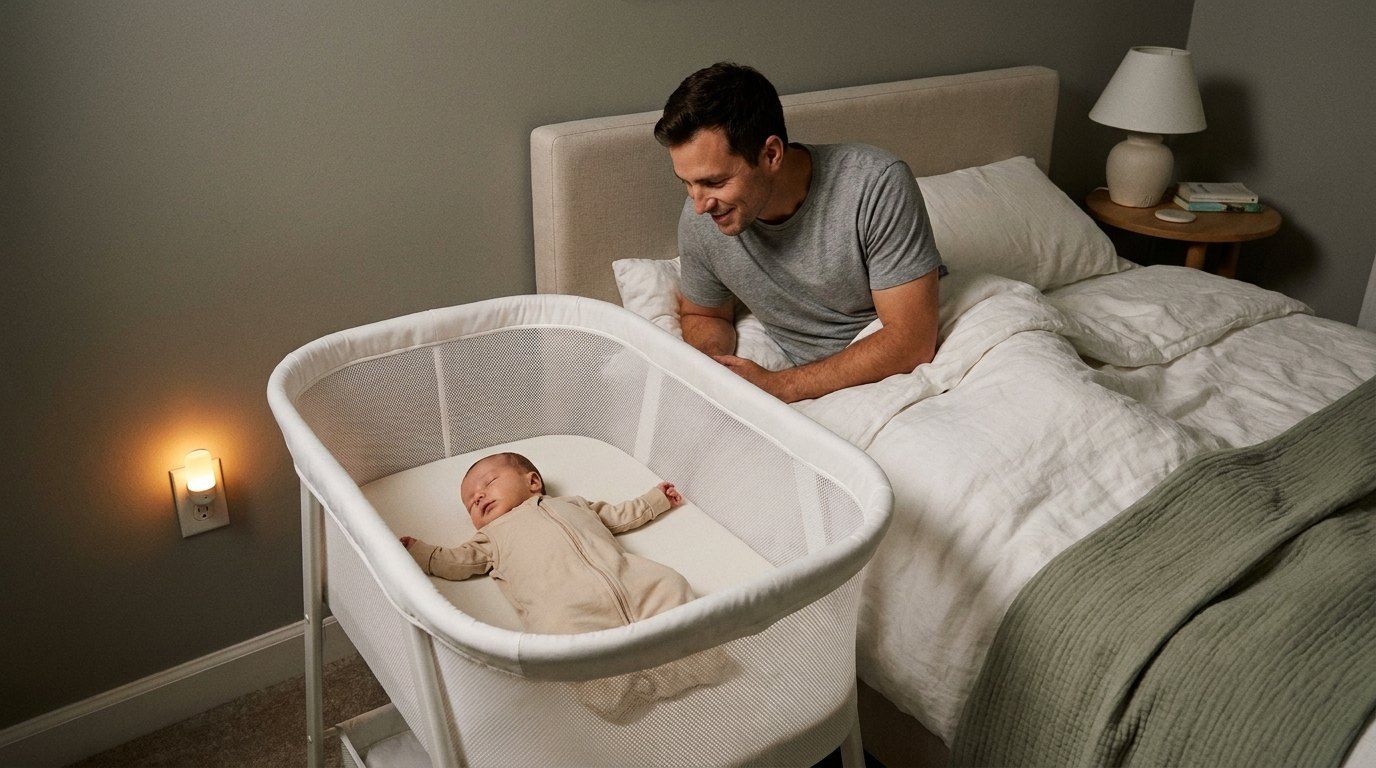
- In your room, not your bed. The AAP recommends room sharing for at least the first 6 months, which it says can lower the risk of SIDS by as much as 50%.
- No swings, car seats or loungers for sleep. If the baby falls asleep in one, move them to the bassinet on their back as soon as you can.
- No add-ons. No positioners, wedges, weighted sleep sacks, or extra mattresses that didn’t come with the bassinet.
For the full list, see safe sleep for newborns.
Why your baby wakes up when you put them down
They’re in light sleep. For newborns, sleep is split about equally between REM (active) sleep and non-REM sleep, the AAP says. In active sleep, babies twitch, their eyes move under the lids, and breathing can be irregular. Only later do “Twitching and other movements cease,” and the baby falls into deeper sleep, when they’re “more difficult to awake.” Put a baby down during light sleep and they’re likely to wake.
The startle reflex. If the baby’s head shifts suddenly or falls back, they throw out their arms and legs and pull them back in, the AAP explains. Being lowered into a bassinet can set it off. The reflex usually peaks in the first month and fades after about two months.
The handoff itself. A small Japanese study that filmed mothers putting babies down found sleeping infants were most likely to stir right as the mother started to pull away, and calmed once the separation was complete. Babies who’d been asleep longer before the put-down did better.
And newborns wake a lot anyway. The AAP says newborns sleep about 16 to 17 hours a day, but often only 1 or 2 hours at a time, and that waking every 2 to 3 hours to feed “is normal and healthy, and should be expected.”
How to put a sleeping baby down in the bassinet
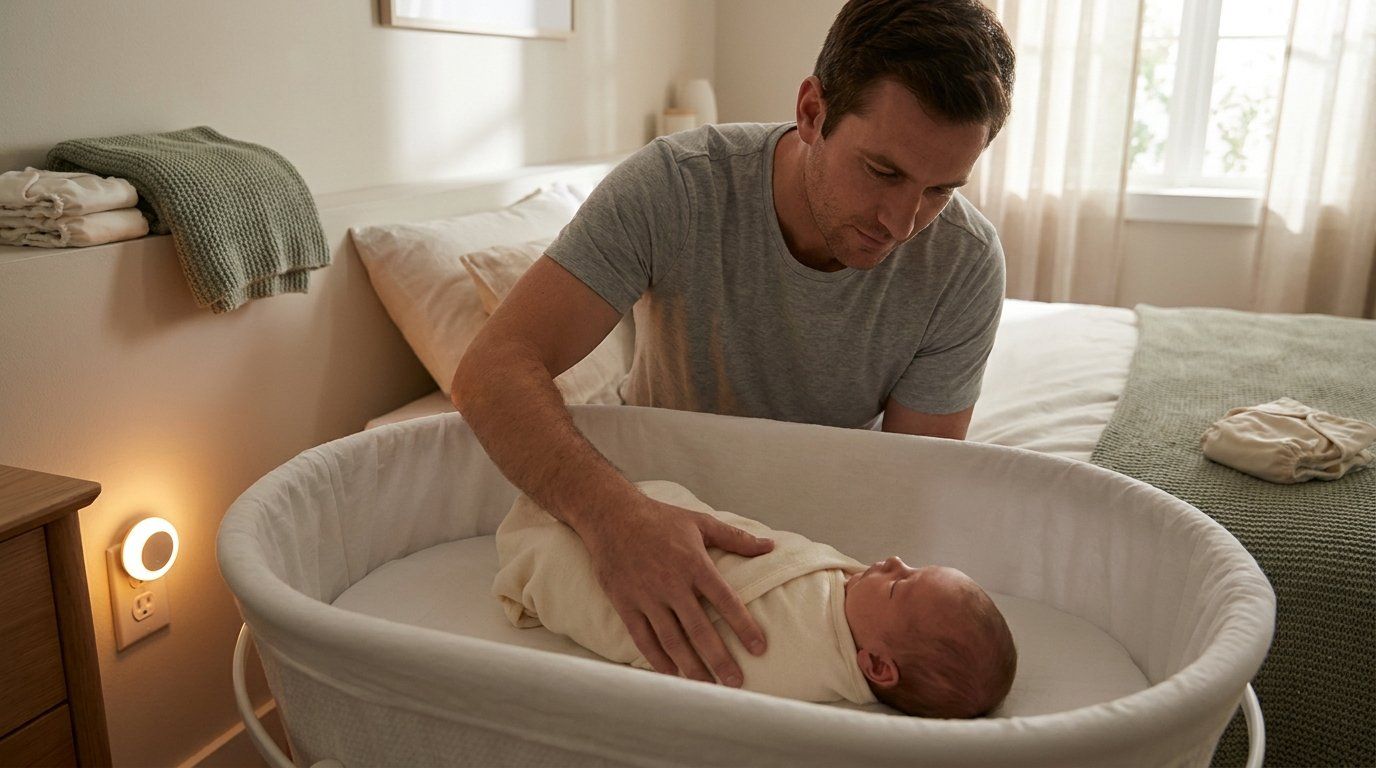
- Wait it out. Don’t move as soon as the eyes close. Wait until the twitching stops, breathing is slow and steady and arms flop when lifted: signs the baby has moved into deeper sleep.
- Get close first. Stand right next to the bassinet before you start lowering, so the move is short.
- Lower slowly, feet first, then head, keeping the head supported so it doesn’t drop back and trigger the startle.
- Keep contact for a moment. The AAP’s self-soothing tips include putting a hand on the baby’s belly or chest and talking softly while looking at them. Then slowly lift your hand.
- Back off slowly. If they stir, pause before picking them up. The AAP suggests trying one calming approach for about 5 minutes before moving to the next.
Dad’s job: own the put-down. Bounce-walk, wait, transfer. It’s a skill, and you’ll get faster at it.
Drowsy but awake
The AAP says to put your baby in the crib or bassinet “when they’re getting drowsy but are still awake,” and that holding or rocking them until they’re fully asleep “can make it harder for them to fall back asleep if they wake up during the night.” It’s a goal, not a test: with a newborn, it won’t work every time. Keep trying it once or twice a night and it gets easier as the baby gets older. One AAP page lists this tip for babies 4 months and older, but others recommend starting from the newborn weeks.
Make nights boring and days bright
Newborns sometimes mix up day and night, the AAP says. Help them sort it out:
- At night: keep the lights dim and the room quiet. “Nighttime feedings are not play time,” the AAP says; feed and change without chatting or playing.
- During the day: keep the baby awake longer between naps, in daylight, with normal household noise.
Babies don’t have regular sleep cycles until about 4 months, the AAP says, so expect this to take weeks, not days.
A simple bedtime routine
The AAP says to do “the same things each day in the same order at naptime and bedtime,” and to work with your partner on a routine you can both do. A routine can be a bath, a feed, a song, a swaddle and then the bassinet. Watch for early sleepy signs, because by the time a baby is rubbing their eyes it may already be too late, the AAP notes.
Dad’s job: take bedtime. A bath and the last bottle are perfect dad tasks, and they give your partner a break. See how to bathe a newborn.
Tools that help (and the rules for each)
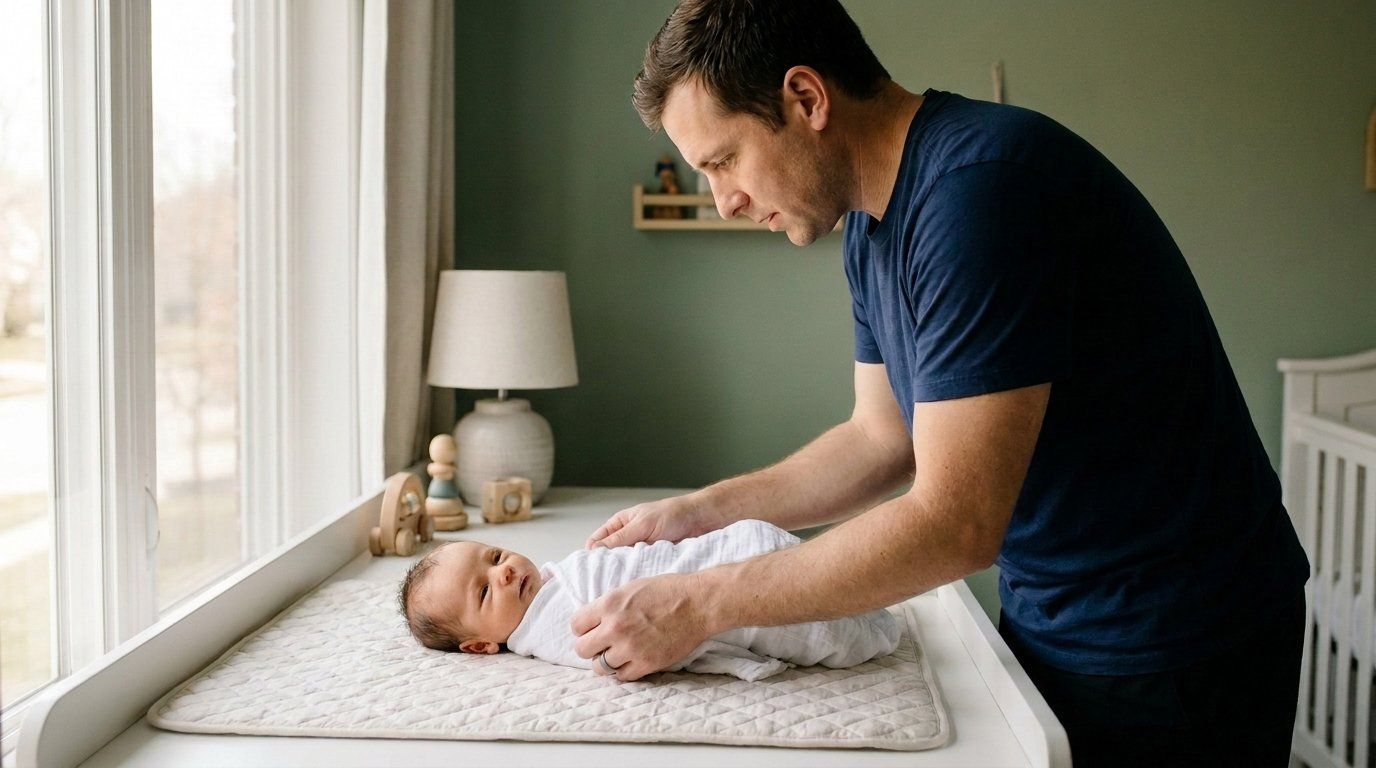
Swaddle. The AAP says swaddling “can be an effective technique to help calm infants and promote sleep.” Stop at the first signs of rolling, sometimes as early as 2 months. See how to swaddle a baby.

HALO SleepSack Swaddle, 100% Cotton
A wearable swaddle: adjustable wings wrap the arms and chest, and a loose sack covers the legs, so there's no blanket to come undone. HALO says the 3-way design allows arms in, hands to face or arms out, and that it is approved as hip healthy by the International Hip Dysplasia Institute. 100% cotton, rated 1.5 TOG.
Pros
- Wings can't unravel into a loose blanket the way a wrap can
- Roomy sack lets the legs bend up and out
- Double zipper for night diaper changes
Cons
- Like any swaddle, stop using it once the baby shows signs of rolling
- 1.5 TOG is warm: check the chest for sweat
Pacifier. The AAP says “Pacifiers help reduce the risk of SIDS, even if the pacifier falls out after your baby is asleep,” and you don’t have to put it back in. If breastfeeding, wait until it’s well established; don’t coat it with honey or anything sweet, and don’t force it.
White noise. The AAP says womb-like sounds such as a white noise device or a fan can be calming. It also warns some machines can be too loud: place it “as far away from the baby’s head as possible.” A study of 14 infant sleep machines found all of them louder than the recommended hospital nursery limit at 30 cm (about a foot) at full volume. Keep cords at least 3 feet away. More in best white noise machines for babies.
The right temperature. One AAP sleep page says the AAP and other groups recommend 68°F to 72°F for infants. Skip the hat indoors, and check the chest for sweat. Don’t warm the bassinet with a heating pad: the CPSC has recalled infant heating pads over burn injuries.
The bassinet itself
Use a bassinet that meets the federal bassinet standard, and only the mattress that came with it. Federal rules require bassinets to meet the ASTM safety standard, and starting in 2026 that standard also covers replacement bassinet mattresses because ill-fitting ones can cause entrapment and suffocation.
When to move to a crib. The federal rule’s warning uses a milestone, not just an age: stop using a bassinet when the baby “is able to push up on his hands and knees,” or at about five months. The CPSC found that most bassinet fall injuries happened to babies older than the 5-month limit. Follow your bassinet maker’s weight limit too.
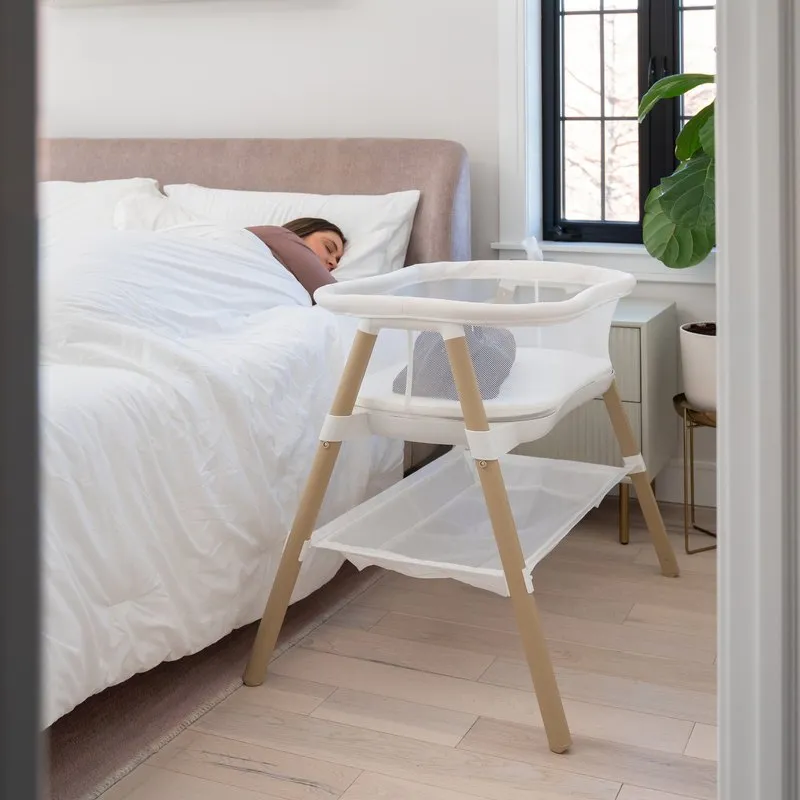
HALO BassiNest Essential Sleeper
A bassinet that stands next to your bed, so the baby sleeps in your room on their own surface, with breathable mesh walls and a fitted sheet included. HALO says every US BassiNest complies with the federal bassinet standard (16 CFR part 1218), and to move the baby to a crib at 20 pounds or 5 months, whichever comes first, or once they push up on hands and knees.
Pros
- Meets the federal bassinet standard, per HALO
- Makes room sharing easy for night feeds
- Fits beside most beds
Cons
- Outgrown at 20 pounds, 5 months, or once the baby pushes up on hands and knees
- Not height adjustable, so check it lines up with your bed
The 2 a.m. danger: you falling asleep
The biggest night risk isn’t the bassinet. It’s an exhausted parent dozing off with the baby.
- Never on the couch. The AAP says the risk of sleep-related death is “up to 67 times higher when infants sleep with someone on a couch.”
- If you might fall asleep feeding, a bed cleared of pillows and blankets is safer than a couch or armchair, the AAP and NIH say. Set an alarm to go off every few minutes, and if you do fall asleep, put the baby back in the bassinet on their back as soon as you wake.
- Sleep in shifts. The AAP suggests napping when the baby naps and going to bed right after the last feed. See night feeds for dads.
When will my baby sleep longer?
Gradually, and our sleep through the night timeline has the numbers by age. The AAP says most babies develop a regular sleep pattern by three to six months, and most formula-fed babies no longer need a middle-of-the-night feeding between 2 and 4 months or at about 12 pounds; breastfed babies often start sleeping longer around six months. Preemies may take until 6 to 8 months or later.
“Sleeping through the night” usually means a 6- to 8-hour stretch, and even that varies: a Canadian study found 28% to 57% of babies at 6 and 12 months didn’t do it. The AAP’s take: “a good sleeper is a child who wakes up frequently but can get himself back to sleep.”
For older babies, gentle sleep training methods are an option. Small trials in Australia found no harm to babies or to the parent-child relationship over 5 years; that’s a conversation for after 6 months, with your pediatrician.
When to call the doctor
Short pauses in breathing during sleep are normal in newborns and usually outgrown by about 6 months, the AAP says. Call 911 if your baby stops breathing for more than 20 seconds, turns blue, gray or pale, or is limp or unresponsive. Call your pediatrician for a fever of 100.4°F or higher in a baby under 3 months, or if night waking comes with poor weight gain or fewer than 5 to 6 wet diapers a day.
FAQ
Why does my baby wake up as soon as I put them down?
They’re usually still in light sleep, and the move can trigger the startle reflex. Wait until breathing is slow and limbs are floppy, lower them feet first with the head supported, and keep a hand on their chest for a moment before stepping back.
How do I get my newborn to sleep in the bassinet at night?
Keep night feeds dark and quiet, follow the same short bedtime routine, put the baby down drowsy when you can, and use a swaddle (until rolling), a pacifier and quiet white noise. Expect it to take weeks: newborns don’t have regular sleep cycles until about 4 months.
Can my baby sleep on me instead?
Only while you’re awake and alert. The AAP says the risk of sleep-related death is up to 67 times higher when babies sleep with someone on a couch. If you might fall asleep, move the baby to their bassinet on their back.
Is white noise safe for babies?
It can help, but keep it quiet and far away. The AAP says to place a sleep machine as far from the baby’s head as possible, and a study found all 14 machines tested were louder than the hospital nursery limit at full volume close up.
When should I move my baby from the bassinet to a crib?
When they can push up on hands and knees or are about 5 months old, under the federal bassinet rule, or sooner if they reach the maker’s weight limit.
What temperature should the room be for a newborn?
One AAP sleep page says 68°F to 72°F. Dress the baby for the room, skip the hat indoors, use a sleep sack instead of blankets, and check the chest for sweating.
Sources
- American Academy of Pediatrics (HealthyChildren.org): How to Keep Your Sleeping Baby Safe, Safe sleep tips for sleep-deprived parents, Safe sleep: back is best, Inclined Sleepers and Other Baby Registry Items to Avoid, Phases of Sleep, Getting Your Baby to Sleep, Reversing Day/Night Reversal, Sleeping Through the Night, Self-Soothing, How to Calm a Fussy Baby, How Noise Affects Your Child, Healthy Sleep Habits, Sleep Apnea Detection, Preemie Sleep Patterns, When to Call Emergency Medical Services and Fever: When to Call the Pediatrician
- NIH Safe to Sleep: Ways to Reduce Baby’s Risk and Breastfeeding and safe sleep
- U.S. Consumer Product Safety Commission: Safe Sleep, bassinet standard, 16 CFR 1218, bassinet final rule (2013), bassinet mattress update (2025) and infant heating pad recall
- Studies: Ohmura N, et al., A method to soothe and promote sleep in crying infants utilizing the transport response, Curr Biol, 2022; Hugh SC, et al., Infant sleep machines and hazardous sound pressures, Pediatrics, 2014; Pennestri MH, et al., Uninterrupted Infant Sleep, Development, and Maternal Mood, Pediatrics, 2018; Gradisar M, et al., Behavioral Interventions for Infant Sleep Problems: A Randomized Controlled Trial, Pediatrics, 2016; Price AMH, et al., Five-year follow-up of harms and benefits of behavioral infant sleep intervention, Pediatrics, 2012
- BassiNest Essential Sleeper and SleepSack Swaddle, HALO