How to Bathe a Newborn: A Dad's Guide (Plus Cord Care)
How to bathe a newborn step by step, from the first sponge baths to the tub, how often, water temperature, the one rule that prevents drowning, and how to care for the umbilical cord stump.
In this guide
- The short answer
- The one rule: never leave the baby in the bath
- Water temperature and scalds
- Step by step: the sponge bath (first weeks)
- Step by step: the tub bath
- Caring for the umbilical cord stump
- The first bath, in the hospital
- What’s normal on a newborn’s skin
- Circumcised or not
- Why bath time is a good dad job
- FAQ
- Sources
Learning how to bathe a newborn is a great job for a dad. It’s short, it’s hands-on, and it’s one of the calmer moments of the day once you’ve done it a few times. It’s also the moment that needs your full attention, because water is the one place a baby can get into serious trouble in seconds. This guide covers sponge baths and tub baths step by step, how often to bathe, water temperature, how to look after the umbilical cord stump, and what’s normal on a newborn’s skin.
The short answer
- First weeks: sponge baths until the umbilical cord stump falls off and the area heals. Then tub baths.
- How often: the American Academy of Pediatrics (AAP) says three baths a week in the first year may be enough. More can dry out the skin.
- Water: about 2 inches, warm but not hot to the inside of your wrist or elbow.
- The rule: never leave the baby in or near the bath, even for a second. Gather everything before you start.
- Cord stump: keep it clean and dry, fold the diaper below it, and let it fall off on its own, usually within 1 to 3 weeks.
The one rule: never leave the baby in the bath
The AAP says never to leave a baby alone in the bath, even for an instant. Babies can drown silently in an inch or two of water, and the CDC says three quarters of all drownings in babies under 1 happen in bathtubs.
What that means in practice:
- Gather everything first: towel, clean diaper, clothes, washcloth, soap. A study of children treated for bathtub drowning at hospitals in Central Texas found the most common reason a caregiver stepped away was to get a towel or clothes.
- If the phone or the door rings, wrap the baby in a towel and take them with you, or let it ring.
- Keep a hand on the baby the whole time.
- Bath seats and rings are not safety devices. The AAP advises against bath seats because they can tip over. Federal data on bath seat deaths found that in most cases, the caregiver had stepped away, often for as little as a minute.
- Don’t count on an older sibling to watch the baby in the bath.
Water temperature and scalds
- Test it. The AAP says the water should feel warm, not hot, to the inside of your wrist or elbow.
- Turn down the water heater. The AAP and the Consumer Product Safety Commission (CPSC) recommend 120°F or lower at the faucet. Hot tap water is the top cause of burns in babies and young children, and the CPSC says even 120°F water can cause third-degree burns after five minutes.
- No running water. The AAP says not to bathe a baby under running water, because the temperature can change suddenly. If you’re using the sink, turn the faucet off before the baby goes in.
Step by step: the sponge bath (first weeks)
The AAP recommends sponge baths until the cord stump falls off and the belly button heals.
- Set up in a warm room on a flat, padded surface: a changing table, the bed or a towel on the floor. If it’s off the floor, keep one hand on the baby.
- Keep the baby wrapped in a towel and uncover only the part you’re washing.
- Wash the face first, with a damp washcloth and plain water.
- Then the body, with a little mild soap if needed. Get into the creases: under the arms, behind the ears, around the neck.
- Diaper area last, front to back.
- Pat dry and dress the baby quickly.
Step by step: the tub bath
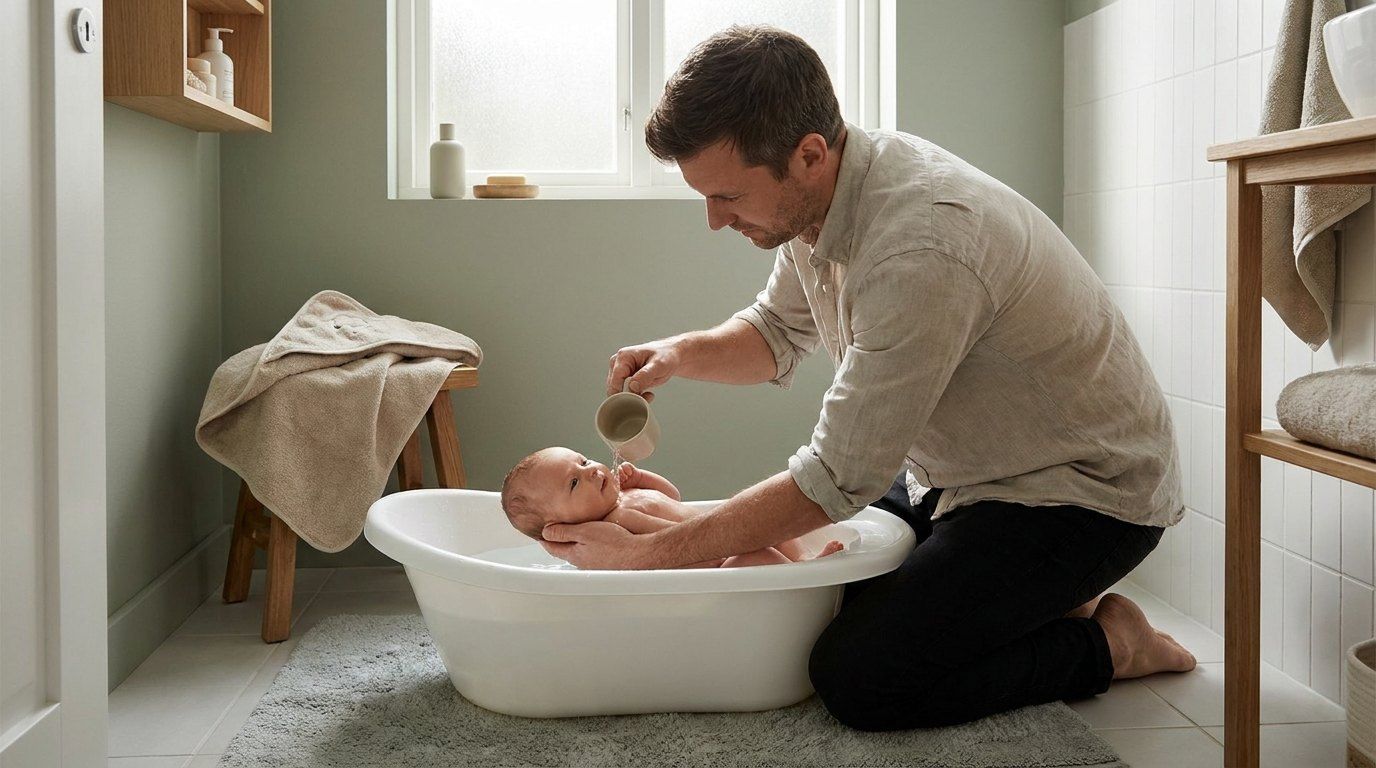
Once the cord area has healed, you can move to an infant tub or the sink. Keep the first baths short and gentle. If the baby hates it, the AAP says it’s fine to go back to sponge baths for a week or two.
- Fill the tub with about 2 inches of warm water and test it with your wrist or elbow.
- Undress the baby and put them in feet first, supporting the head and neck with one hand and forearm.
- Keep them warm: most of the body stays above the water, so pour cupfuls of warm water over the baby’s chest as you go.
- Wash from the top down. Face first with a soft cloth, without scrubbing, then the hair with a little mild shampoo. Cup your hand over the forehead so suds run to the sides, not into the eyes.
- Use soap sparingly. The AAP suggests a mild, neutral-pH soap without additives, only where needed, rinsed off right away.
- Lift the baby out and wrap their head and body in a towel right away. Pat dry.
- Moisturize if needed. The AAP suggests a small amount of fragrance-free, hypoallergenic lotion after the bath to help prevent dry skin.
Tub or sink? The AAP suggests a hard plastic infant tub with a sloped, textured surface or a sling, and the CPSC says tubs made since October 2, 2017 must meet the federal infant bath tub standard. A sink works too, but the AAP says to be extra careful: it’s slippery, and the faucet and handles stick out.
Caring for the umbilical cord stump
Keep it clean and dry. The AAP no longer recommends rubbing alcohol on the stump. Just keep it clean and dry, let it get air, and fold the top of the diaper down below it so urine doesn’t soak it. The World Health Organization also recommends clean, dry cord care. If it gets dirty, clean it gently with plain water and let it dry.
When does it fall off? Usually within 1 to 3 weeks. The AAP says it should be gone by 3 weeks; if it’s still there after that, see the pediatrician. Don’t pull it off, even if it’s hanging by a thread.
A little blood is normal. The AAP says a few drops of blood on the diaper around the time the stump falls off is normal. If it actively bleeds, call the pediatrician right away.
Signs of infection. Cord infections are uncommon, but the AAP and MedlinePlus say to call the pediatrician for:
- A foul-smelling yellow discharge or pus
- Redness or swelling spreading around the base of the cord
- Crying when you touch the cord or the skin around it
- A fever of 100.4°F or higher, poor feeding, unusual sleepiness or floppiness: call right away
After it falls off. The AAP says a small, moist red or brownish lump can be left behind. It’s called an umbilical granuloma and usually goes away in about a week; if not, the pediatrician can treat it. A belly button that bulges when the baby cries may be an umbilical hernia, which the AAP says usually closes on its own by 12 to 18 months. Don’t tape a coin over it.
The first bath, in the hospital
The World Health Organization recommends waiting at least 24 hours after birth before a healthy, full-term baby’s first bath. The AAP explains why: an early bath can make babies cold and lower their blood sugar, interrupts skin-to-skin time and breastfeeding, and washes off the vernix, the white coating that acts as a natural moisturizer. One US hospital study found that after it started delaying the first bath, mothers were more likely to start breastfeeding. Ask the nurses about it before the birth. If you want to give that first bath yourself, ask.
What’s normal on a newborn’s skin
- Peeling in the first weeks is normal and usually needs no treatment, the AAP says.
- Tiny white bumps (milia) on the nose and cheeks usually clear in the first 2 to 3 weeks.
- Cradle cap, the flaky, crusty patches on the scalp, is very common (more in our baby rashes guide). The AAP says it isn’t caused by poor hygiene. Washing the hair a bit more often with mild baby shampoo and a soft brush helps; for stubborn scales, a little mineral oil or petroleum jelly overnight. Don’t pick at it. See the pediatrician if it turns crusty, weepy or has pus bumps.
- Baby acne on the face is common and usually clears on its own.
- Dry, itchy, red patches that keep coming back can be eczema. Ask your pediatrician.
Circumcised or not
If your son was circumcised, the AAP says it fully heals in about 7 to 10 days. Keep the area clean, and follow your pediatrician’s advice on when to start tub baths. If he isn’t circumcised, wash the outside with warm water and never force the foreskin back. More in our guide to changing a diaper.
Why bath time is a good dad job
The AAP calls bath time a good chance to bond with your baby without distractions. A small study in Portugal found that both mothers’ and fathers’ time spent on everyday care and play predicted a more secure attachment with their babies. A large study in Japan linked fathers’ hands-on care at 6 months, including bathing, with fewer injuries in their children up to age 4. Those studies show links, not proof. But bath time is a ready-made routine that can be yours: same time, most evenings, then pajamas and a bottle. More ideas in not feeling bonded with your baby yet and skin-to-skin for dads.
FAQ
How do you bathe a newborn with the umbilical cord still on?
Give sponge baths until the stump falls off and the area heals. Wrap the baby in a towel, wash one part at a time with a damp washcloth, and keep the stump dry. Fold the diaper below the stump.
How often should you bathe a newborn?
The AAP says three baths a week in the first year may be enough. Bathing more often can dry out the baby’s skin.
What temperature should a newborn’s bath be?
Warm, not hot, to the inside of your wrist or elbow. The AAP and CPSC recommend setting your water heater so the hottest water at the faucet is 120°F or lower.
Can you bathe a newborn in the sink?
Yes, once the cord area has healed, with care. Line it with a towel, turn the faucet off before the baby goes in, and keep a hand on the baby. Watch out for the faucet and handles.
When does the umbilical cord fall off?
Usually within 1 to 3 weeks. The AAP says to see the pediatrician if it’s still there after 3 weeks. Don’t pull it off.
Is it normal for the umbilical cord to bleed or smell?
A few drops of blood on the diaper around the time it falls off are normal. Active bleeding, a foul-smelling yellow discharge, or redness around the base are reasons to call the pediatrician.
Sources
- Bathing Your Newborn, Infant Water Safety, Bathroom Safety, Umbilical Cord Care, Your Baby’s Umbilical Cord: 5 Surprising Facts, How Your Newborn Looks, Cradle Cap, Circumcision and Care for an Uncircumcised Penis, American Academy of Pediatrics (HealthyChildren.org)
- Risk Factors for Drowning, Centers for Disease Control and Prevention
- Umbilical cord care in newborns, MedlinePlus (National Library of Medicine)
- Avoiding Tap Water Scalds, Infant Bath Tubs business guidance and Safety Standard for Infant Bath Seats: Final Rule (2010), U.S. Consumer Product Safety Commission
- WHO recommendations on maternal and newborn care for a positive postnatal experience, World Health Organization, 2022
- Pediatric hospital visits for unintentional drowning in bathtubs in Central Texas, USA, Johnson et al., Injury Epidemiology, 2025
- Delaying the bath and in-hospital breastfeeding rates, Preer et al., Breastfeeding Medicine, 2013
- The effects of parental sensitivity and involvement in caregiving on mother-infant and father-infant attachment in a Portuguese sample, Fuertes et al., Journal of Family Psychology, 2016
- Association between paternal involvement in childcare and child injury: the Japan Environment and Children’s Study (JECS), Shimada et al., BMC Pediatrics, 2025
- Skin conditions: common skin rashes in infants, Zuniga and Nguyen, FP Essentials, 2013