Tummy Time by Age: How Long, How to Do It, and What You Don't Need
Tummy time by age with sourced numbers only: when to start, how many minutes, how to do it on your chest or the floor, what to do if your baby hates it, milestones, and which products to skip.
We choose everything we recommend independently. If you buy through our links, we may earn a commission. How we make money

Our quick picks
- If you want a play matLovevery The Play GymCheck price
A flat mat with no tummy time pillow, and it lasts past these months.
- Something to look atSassy Tummy Time Floor MirrorCheck price
Stands on the floor in front of your baby. Your face works too.
In this guide
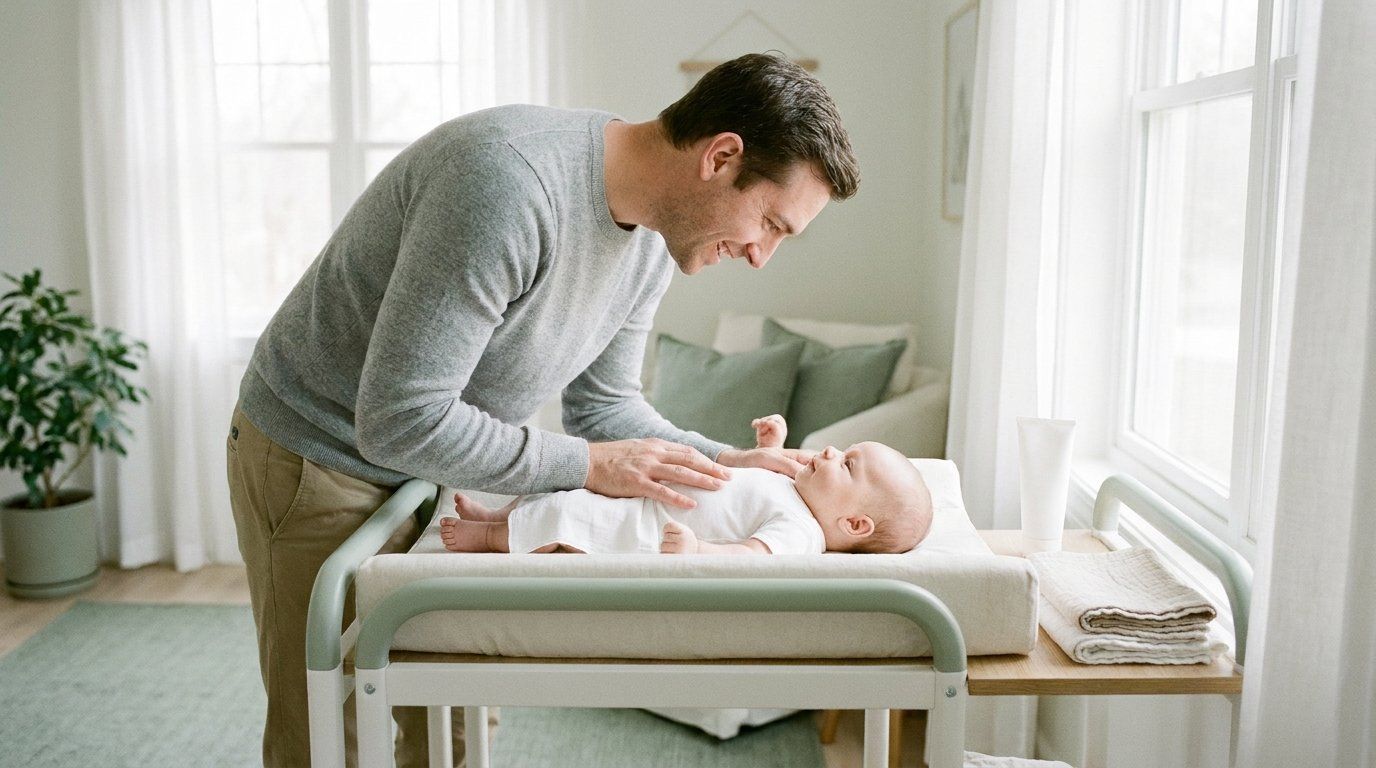
Tummy time is one of the easiest dad jobs there is: it takes a few minutes, you can do it right after a diaper change, and all it requires is a blanket. The AAP says “A great time to do tummy time activities with babies is after a diaper change or when they wake up from a nap.” This guide gives the numbers that come from real sources, since most minutes-by-month charts online don’t, plus how to do it, what to do if your baby hates it, and which products to skip.
How we made this list: we checked products on the makers’ sites and against the CPSC recall database. We haven’t tested them ourselves, and nothing here is required.
A note before you start: this is general guidance, not medical advice. If your baby was born early or has reflux disease or special needs, the AAP says to speak with your pediatrician about tummy time.
The short answer
- Start: the day your baby gets home, the AAP says.
- How long: 2 to 3 times a day for 3 to 5 minutes, working up to 15 to 30 minutes a day by 7 weeks.
- Awake and watched, always. Stay with your baby.
- All you need: a blanket on the floor.
- Sleepy? Onto their back, in their own sleep space.
How long by age, and who says what
| Source | Start | Early sessions | Daily target |
|---|---|---|---|
| AAP | The day your baby gets home | 2 to 3 times a day, 3 to 5 minutes | 15 to 30 minutes by 7 weeks |
| NIH Safe to Sleep | A day or two after birth | 2 or 3 times a day, 3 to 5 minutes | 15 to 30 minutes by about 2 months |
| Pathways.org | Once home | 2 to 5 minutes, a few times a day | 15 to 30 minutes by 2 months, at least 60 minutes by 6 months |
Those are the numbers we could trace. You’ll see charts online listing minutes for every month. They disagree with each other, and none of those month-by-month numbers come from the AAP or CDC. After about 2 months, neither gives a minutes figure by age. The 60-minute number comes from Pathways, a nonprofit, and an AAP flat-head page mentions working up to an hour a day but gives no age.
Total time counts, not one long stretch. The AAP says “several short sessions.” Pathways says to keep going until your baby can crawl.
Why it matters
Muscles first. The NIH says tummy time helps “Strengthen baby’s neck, shoulder, and arm muscles so the baby can start to sit up, crawl, and eventually walk on their own.” A 2020 review of 16 studies in Pediatrics linked it with better gross motor development, though most of the studies were observational.
Head shape second. The AAP says tummy time helps prevent flat head syndrome. The research is less clear than that sounds: the same review called the link to plagiocephaly (a flat spot on one side) “indeterminate,” while a 2024 analysis linked less tummy time with more flat heads. Either way, the AAP says positional skull deformities “do not affect brain growth or intellectual development” and are “purely cosmetic.” It also suggests limiting time in swings, bouncy chairs and car seats.
Tummy time doesn’t lower SIDS risk, the NIH says. It’s about development.
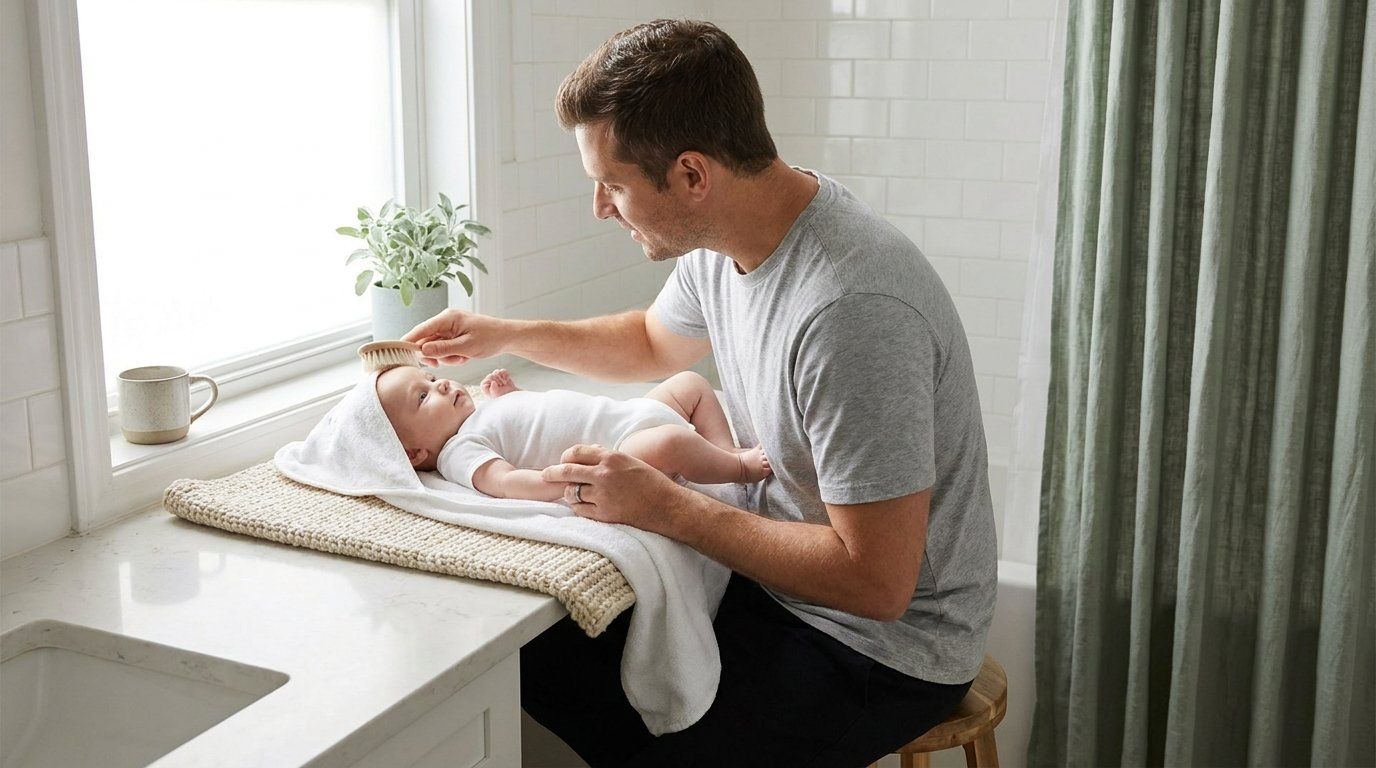
Dad’s job: check your baby’s head after a bath. The AAP says that’s “when their hair is wet” and it’s easiest to see.
How to do it
On your chest. “Lie on your back and place the baby on your chest,” the AAP says. “The baby will lift their head and use their arms to try to see your face.” You can do this before the umbilical cord falls off, while you’re awake and reclined. It’s a natural follow-on from skin-to-skin. Stay awake, and don’t do it somewhere you might doze off: the AAP says the risk of sleep-related death is up to 67 times higher when infants sleep with someone on a couch or armchair.
Across your lap. The AAP says you can lay your baby “tummy down across your lap lengthwise while providing head support.” If they fall asleep, transfer them to their sleep space on their back.
On the floor. “Spread out a blanket on a clear area of the floor,” the NIH says. The AAP adds that blankets should be secured so they don’t slide. Keep it firm and flat. Pathways says never on soft surfaces like beds or couches.
A little help. The NIH suggests a rolled-up towel under your baby’s arms to prop them up slightly, while you’re watching. If tummy really isn’t working, the AAP says “Side lying is a great alternative.”
Dad’s job: make it part of the routine. A few minutes after each diaper change adds up fast.
If your baby hates it
“It’s common for babies not to like Tummy Time, especially in the beginning,” Pathways says.
- Get down there. The AAP says to “Place yourself or a toy in reach.”
- Try your chest or lap instead of the floor.
- Go shorter and more often. Pathways says to “stop just before they get upset.”
- Give it time. The AAP says babies will be strong enough to lift their head by about a month.
If your baby consistently can’t tolerate it, Pathways says to bring it up with your doctor. For a crying spell, see how to soothe a crying newborn.
When to wait: after feeds and reflux
The AAP says “postponing it for a while after meals” is an easy way to avoid spit-up. Its pages suggest keeping your baby upright for at least 20 minutes after a feed, and up to about half an hour with reflux. Pathways says to wait 15 to 30 minutes after feeds if your baby has reflux. For reflux disease, ask your pediatrician first.
Milestones to watch
These are from the CDC’s milestones, revised with the AAP in 2022 to reflect what at least 75% of children are expected to do by that age. For the full list by age, see baby milestones by month.
| By | CDC milestone |
|---|---|
| 2 months | Holds head up when on tummy |
| 4 months | Pushes up onto elbows or forearms when on tummy; holds head steady without support when held |
| 6 months | Rolls from tummy to back; pushes up with straight arms when on tummy |
| 9 months | Gets to a sitting position alone; sits without support |
Because most babies are doing these by that age, a missed one is a reason to ask, not wait. “You know your child best. Don’t wait,” the CDC says.
Raise it with your pediatrician if your baby has trouble holding their head and neck steady, if their muscles seem stiff or floppy, or if you see a flat spot.
Premature babies
Ask your pediatrician first. Pathways suggests very short sessions when your baby is awake and alert. The AAP says to use your baby’s adjusted age when tracking development until age 2, and that preemies should sleep on their backs once they’re medically stable.
Tummy to play, back to sleep
Two rules, one baby. “An awake adult should supervise” tummy time, the AAP says. And healthy babies are safest sleeping on their backs, for naps and at night. If your baby gets sleepy, the CDC says to place them on their back in a safe sleep area. Once they’re rolling both ways on their own, the AAP says you don’t need to keep turning them back. More in our safe sleep guide.
What you actually need: a blanket
“The most natural place to play is on a clean floor, a nap mat or blankets of different textures,” the AAP says. That’s the whole list. Everything below is an extra.
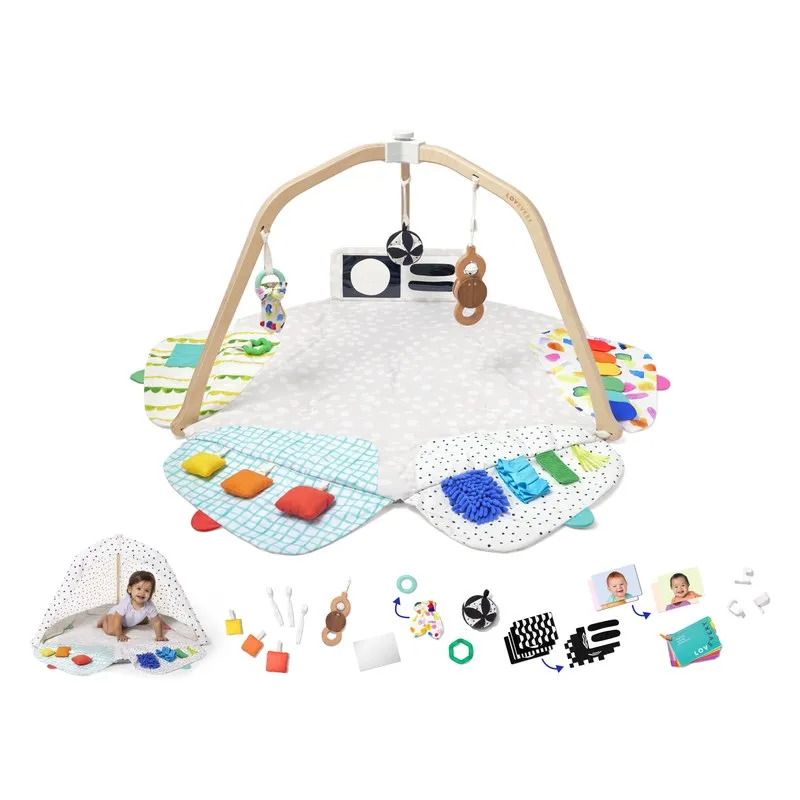
If you want a play mat: Lovevery The Play Gym
The AAP suggests “a flat play mat during awake time” over a lounger. This one is a mat with a wooden arch and 5 detachable toys, for ages 0 to 12 months, Lovevery says, with no tummy time pillow mentioned on its page. It’s machine washable and big: about 4 feet long with the zones open. We couldn’t confirm how it’s treated under the CPSC’s cushion rule below, and it’s for awake time only.
Lovevery The Play Gym
A play mat with a wooden arch, 5 detachable activity toys and 3 sets of cards, designed for 0 to 12 months, Lovevery says. The mat and zones are machine washable in cold water. It's an extra, not a need: a blanket on the floor does the same job.
Pros
- No tummy time pillow included
- Machine-washable mat
- Lasts past the tummy time months
Cons
- Takes up floor space: about 4 feet long with the zones open
- Awake and supervised only, like any play mat
Something to look at: Sassy Tummy Time Floor Mirror
A soft-framed mirror with an easel back that stands in front of your baby. Your baby doesn’t lie on it. Sassy labels it for 0+ months, though the AAP says babies enjoy mirrors more “Closer to 6 months.” Your face works just as well.
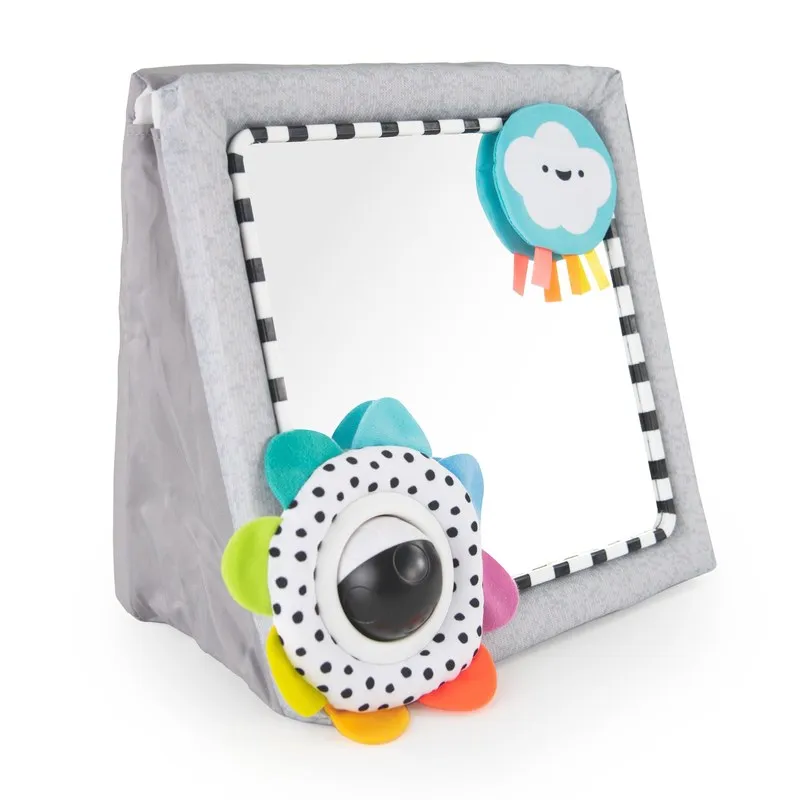
Sassy Tummy Time Floor Mirror
A soft-framed mirror with an easel back that stands on the floor in front of your baby, labeled for 0+ months. It's about 9.5 inches long and tall, with an easy-to-wipe surface.
Pros
- Gives your baby something to look at on the floor
- Soft frame and easy-to-wipe material
Cons
- Your face works too, and the AAP says babies enjoy mirrors more closer to 6 months
- It stands in front of the baby; your baby doesn't lie on it
What to skip
- Tummy time pillows. The CPSC says infants can suffocate when these “conform to an infant’s face and occlude the airways,” and that the “AAP and NICHD, while endorsing tummy time, do not recommend specifically using tummy time pillows.” They’re regulated, not banned: a federal rule covers products made after May 5, 2025, so older and secondhand ones may not meet it. In January 2026, the CPSC recalled baby gyms that convert “to a tummy-time pillow mat.”
- Gyms that come with a pillow. Many do. Leave the pillow in the box, or skip the set.
- Nursing pillows and loungers. “Never use them with sleeping babies,” the AAP says of nursing pillows. The CPSC recalled more nursing pillows as recently as November 2026.
- Head-shaping pillows. “No, head-shaping support pillows for babies are not safe,” the AAP says.
Dad’s job: check anything padded on the CPSC site before you buy. See our baby registry checklist.
What about water mats?
We found no AAP, CDC or NIH guidance on water mats, and no CPSC recall with “water mat” in the title (a title search isn’t proof there’s none). They’re a nice-to-have at best. If you use one, keep it on the floor and stay with your baby.
FAQ
When should I start tummy time with a newborn?
The AAP says the day you bring your baby home. On your chest counts, even before the cord falls off.
How much tummy time does a baby need by age?
The AAP says 2 to 3 short sessions of 3 to 5 minutes to start, then 15 to 30 minutes a day by 7 weeks. After that there’s no official chart. Pathways says at least 60 minutes a day by 6 months.
Does tummy time on my chest count?
Yes. The AAP lists it as a way to do tummy time, as long as you stay awake.
What if my baby hates tummy time?
It’s common. Get down within reach, try your chest or lap, and stop before the crying starts.
Can I do tummy time right after feeding?
The AAP suggests postponing it for a while after meals. With reflux, Pathways says wait 15 to 30 minutes.
Do I need a tummy time pillow or mat?
No. A blanket on the floor works. The CPSC says the AAP and NIH don’t recommend tummy time pillows.
Are water mats safe for tummy time?
No US health group we found has weighed in. If you use one, keep it on the floor and stay with your baby.
Sources
- American Academy of Pediatrics (HealthyChildren.org): Back to sleep, tummy to play, The importance of tummy time, Safe sleep, Registry items to avoid, Positional skull deformities, Why babies spit up, GERD and reflux, Preemie milestones, Physical development and How active is your baby?
- NIH Safe to Sleep: Tummy time; Pathways.org: Tummy time guide
- CDC milestones: 2 months, 4 months, 6 months and 9 months
- U.S. Consumer Product Safety Commission: Infant support cushions, final rule, baby gym recall and nursing pillow recall
- Studies (PubMed): Hewitt et al. 2020, Hillyar et al. 2024, Zubler et al. 2022
- Product pages: Lovevery The Play Gym, Sassy floor mirror