Baby Rashes: What's Normal, Cradle Cap, Eczema, and When to Call
A dad's guide to baby rashes: the call-now list first, then newborn spots that need nothing, cradle cap, heat rash, eczema, hives and drool rash, with what the AAP and dermatologists actually say.
In this guide
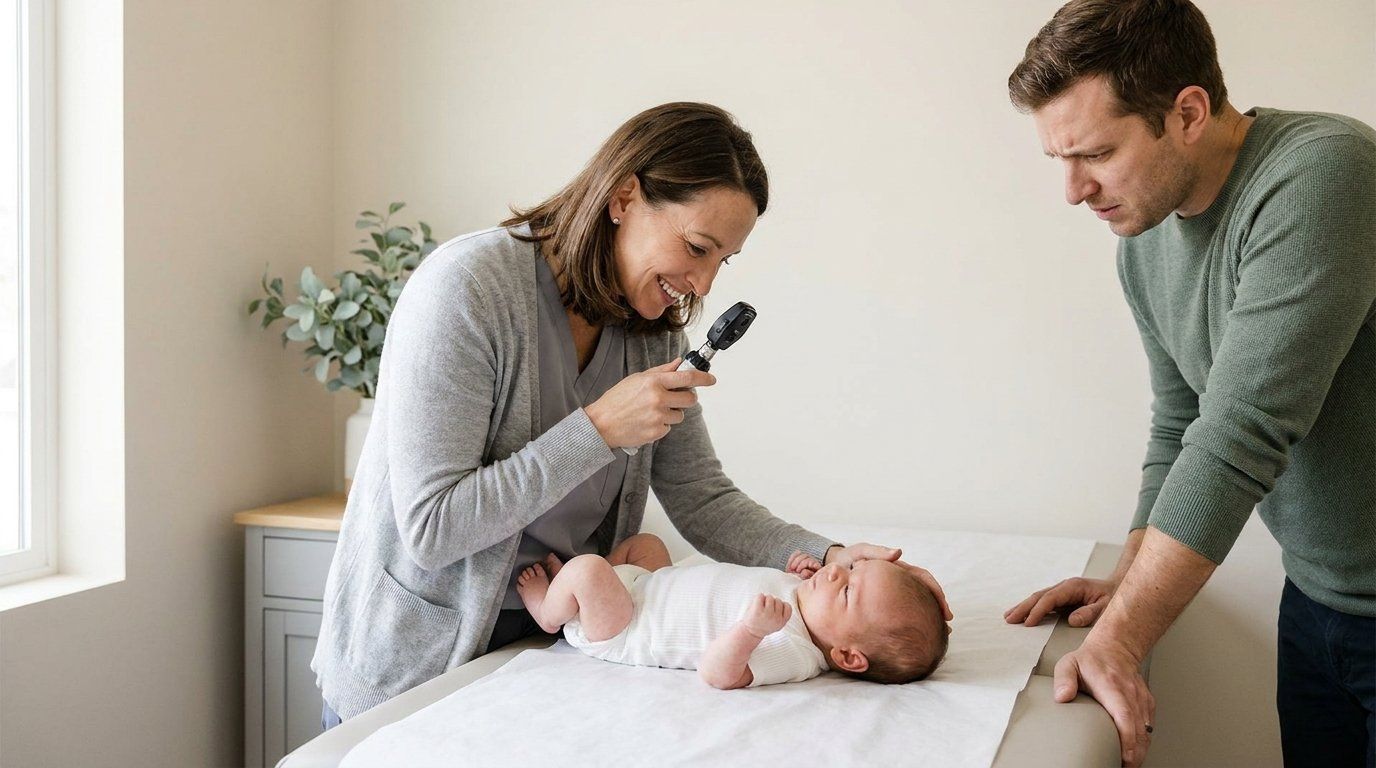
You’re looking at red spots with your phone flashlight, wondering if this is a call. Usually it isn’t: “Fortunately, most childhood rashes aren’t serious,” Cleveland Clinic says. So the call-now list comes first, and after that you can look up what you’re seeing.
A note before you start: this is general guidance, not medical advice. If your baby is under 1 month or seems sick, call your pediatrician.
The short answer
- Purple or blood-colored spots: 911 with a fever, ER without one.
- Under 3 months with 100.4°F or higher: call now.
- Blisters in a young baby: call now.
- Most newborn spots need nothing, and oils can make them worse.
- Cradle cap doesn’t have to be treated at all.
Does this need a call?
| Do this | If you see |
|---|---|
| Call 911 or go to the ER | Purple or blood-colored spots or tiny dots. Hives with swelling of the face, lips, tongue or throat, or trouble breathing or swallowing. Bluish or gray lips, tongue or face. A baby you can’t wake |
| Call now | A baby under 3 months with 100.4°F or higher. Tiny blisters or pimples in a baby under 1 month. A baby under 1 month who looks or acts abnormal. Bright red skin peeling off in sheets, or large blisters. A baby under 1 year with hives all over |
| Call the same day or during office hours | A rash that looks infected, with pus or tenderness. Scalp scales that smell, ooze or look swollen. Acne that starts after 6 weeks. Heat rash not gone after 3 days |
Several of these come from Schmitt Pediatric Guidelines, the triage guide on the AAP’s site, which isn’t AAP policy. The AAP adds that “it is always important to have all blister-like rashes evaluated by your baby’s doctor to rule out infection.”
Dad’s job: take a clear photo in daylight, and note when it started, any fever, and any new foods or products. That’s our tip, and it makes the phone call much shorter. For temperatures, see our fever guide.
Purple spots and the glass test
Petechiae are tiny purple or dark red dots from bleeding into the skin, and they don’t fade when you press on them. With a fever, they can mean a serious blood infection. The AAP says a meningococcal rash “starts as small red dots that turn into large bruises,” and “A child can become very sick in only a few hours.”
The glass test can warn you, but it can never clear your baby. Press a clear glass against the rash: a rash that doesn’t fade is an emergency. But Cleveland Clinic says meningitis can cause a rash that fades early on, and “If your child has symptoms of meningitis or appears very ill, don’t make decisions based on the glass test.”
On darker skin, these marks “can be hard to see,” Cleveland Clinic says. The UK’s NHS suggests checking paler areas like the palms, soles, roof of the mouth, and inside the eyelids.
There may be no rash at all. In infants the AAP lists fever, vomiting, poor appetite, unusual crankiness and sleepiness. In newborns, “The signs can be subtle, so it is better to call for medical advice.”
The newborn spots that need nothing
| Rash | Looks like | When | How long |
|---|---|---|---|
| Erythema toxicum | Red splotches with yellowish white bumps in the center, not on palms or soles | Starts day 2 or 3 | About a week |
| Milia | Tiny white or yellow bumps on cheeks, chin, nose | Newborn weeks | 2 to 3 weeks (AAP), up to 1 to 2 months (Schmitt) |
| Baby acne | Pimples on the face | About 2 to 4 weeks | A few weeks to months |
| Mottling | Blotchy patches from cool air | When cold | Disappears when you cover your baby |
| Blue-gray birthmarks | Brown, gray or blue patches, like a bruise | At birth | Very common, especially in dark-skinned babies |
Baby acne: the American Academy of Dermatology says it’s “generally nothing to worry about.” “Never put acne medicine or acne wash on your baby’s skin,” it adds, unless a doctor says to. Clean the face with water and a gentle, fragrance-free baby soap. If acne starts after 6 weeks, the AAD says to see a dermatologist.
The Schmitt guidelines say ointments or baby oil can make erythema toxicum, milia and baby acne worse.
Dad’s job: hands off. No oils, no pimple cream.
Cradle cap
Those greasy, flaky scales on the scalp are cradle cap. “Cradle cap usually starts between three weeks and two months after birth,” the AAP says, and 70% of 3-month-olds have it. On darker skin, the AAD says it can look like patches of darker skin instead of red.
It isn’t an allergy or an infection, and it isn’t from poor hygiene. It rarely bothers your baby. Most important: “You don’t need to treat cradle cap,” the AAP says. In most cases it clears by 1 year.
If you want to treat it:
- Wash the hair more often with a mild baby shampoo. “Every other day is helpful for most babies,” the AAP says.
- Soften tough scales with a little oil (see below).
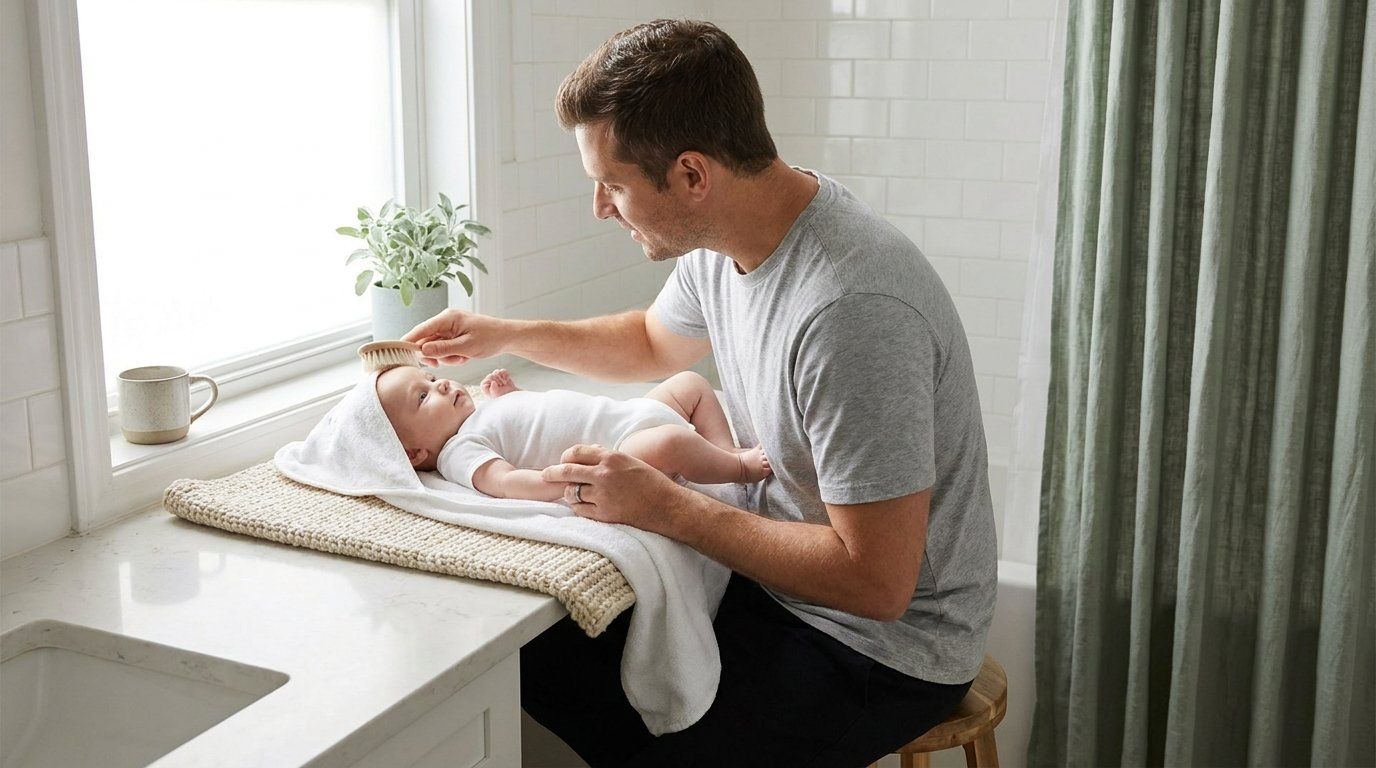
- Loosen with a soft brush or baby comb, during the bath.
- Don’t pick. It raises the risk of infection. Some hair may come off with the scales, and that’s OK.
Which oil, and for how long? The experts don’t agree.
| Source | What to use | How long |
|---|---|---|
| AAP | Mineral oil, coconut oil or petroleum jelly | Overnight, for tough scales |
| AAD | A non-food oil, like baby oil | Before the bath |
| UPMC | Baby oil, mineral oil or petroleum jelly, never food oils | Before washing |
| Cleveland Clinic | A nickel-size amount of oil | About 30 minutes before bath |
| Schmitt guidelines | Baby oil, and wash it all off | 15 minutes |
We found no cradle cap trial comparing oils. Our read: start with a little mineral or baby oil before the bath and wash it out. The Schmitt guidelines say no olive oil. The evidence behind that isn’t about cradle cap (a small adult forearm study and a UK newborn pilot), but there’s no reason to reach for it either.
Dandruff shampoo: skip it unless your pediatrician says otherwise. The AAD says “dandruff shampoo is not recommended for children,” and the National Eczema Association agrees. The AAP says to check first. You may see a Schmitt page on the AAP’s site that suggests one, but labels vary, and some say not under 2.
Hydrocortisone: only if your doctor says so. The label on over-the-counter cream says to ask a doctor for children under 2.
Call the pediatrician if it becomes crusted, weepy or has pus bumps, or smells, oozes, bleeds or looks swollen. For bath basics, see how to bathe a newborn.
Heat rash
“Heat rash, or miliaria, is a skin condition that happens mostly in babies and young children. It looks like tiny red bumps or tiny blisters,” the AAP says. It shows up on the upper chest and back, in neck folds, around the hairline or under the diaper.
- Cool your baby with a cool bath or moist compresses, then dry completely.
- No thick ointments. The AAP says they can block sweat glands further.
- Dress in loose cotton and skip the extra layers.
Call if it looks infected, your baby has a fever, or it isn’t gone after 3 days. In a baby under 1 month, treat any blisters as a call.
Dad’s job: feel the back of your baby’s neck. If it’s sweaty, take a layer off.
Eczema
Up to 1 in 4 children have eczema, the AAP says. “In babies, eczema usually starts on the scalp and face,” with red, dry rashes on the cheeks, forehead and around the mouth. It usually skips the diaper area. On darker skin, the AAD says baby eczema can look “dark brown-to-purple,” and small, rough bumps are more common.
Food usually isn’t the cause, the AAP says, though up to 40% of patients with eczema also develop food allergies. If your baby has severe eczema, read about peanut in when to start solids.
The daily routine, from the AAP:
- Bathe every day or every other day for 5 to 10 minutes in lukewarm water.
- Apply any prescribed medicine to the rash first.
- Moisturize the whole body right after, while the skin is still damp.
The AAP says ointments like petroleum jelly or fragrance-free creams are good choices, and “lotions are thinner and less effective.”
Steroid creams. Parents worry about these, and the AAP says they’re “very effective and safe when used appropriately.” But the AAD says babies are more sensitive to them, and they can damage skin if used incorrectly or for too long. So: from your doctor, on your doctor’s schedule. Bleach baths are also a doctor’s call.
Watch for infection: yellow or honey-colored crusting, weepy skin, or pus bumps. “If your child has eczema and develops new blisters or sores, call your pediatrician,” the AAP says. Cold sores are dangerous to young babies, so anyone with one shouldn’t kiss the baby.
Labels: “hypoallergenic” has no federal definition. The FDA says “The term means whatever a particular company wants it to mean.” The National Eczema Association’s Seal is a voluntary review, and it doesn’t guarantee a product suits every child.
For some children, eczema starts to go away by age 4.
Can moisturizing prevent eczema?
Honest answer: maybe a little, and it isn’t settled.
- Two small 2014 trials in high-risk newborns found a benefit.
- Two large 2020 trials, in the UK and in Norway and Sweden, found none. The UK trial also found some evidence of more skin infections.
- A 2022 Cochrane review said it’s probably not effective in healthy babies.
- A 2025 US trial of 1,247 babies found a modest benefit: 36.1% had eczema by 24 months with daily moisturizer, versus 43.0% without, and no difference in skin side effects.
- The AAD’s 2026 guideline gives moisturizing a conditional recommendation, which means benefits and burdens are closely balanced.
These are studies and a dermatology guideline. We found no AAP recommendation. It’s cheap and low-stakes, so ask your pediatrician, but it’s not a reason to buy anything special.
Drool rash and diaper rash
Drool rash comes and goes on the chin and cheeks. The Schmitt guidelines say to rinse the face with water after feeds. See baby teething for more.
Diaper rash has its own guide: diaper rash treatment.
Hives
“Hives, also known as urticaria, are raised welts or wheals that can develop suddenly anywhere on the body,” the AAP says. They usually flatten out in hours. On dark skin they may match the surrounding skin or look slightly darker. “Viral infections are one of the most common causes of hives in young children.”
Get medical help right away with swelling of the face, lips, tongue or throat, trouble breathing or swallowing, or vomiting. If it follows a new food, see when to start solids. For itching, ask your doctor before giving any antihistamine. The Schmitt guidelines set an age limit of 1 and older for Benadryl.
Skin care that prevents trouble
- Baths: “Three baths per week during baby’s first year may be enough,” the AAP says. Babies with eczema are different, as above.
- Sunscreen under 6 months: keep babies in shade and clothing. The FDA says to check with your pediatrician first, the AAD says avoid it if possible, and the AAP allows small areas like the face if shade and clothing aren’t available.
- Sunburn under 1 year: call your pediatrician.
FAQ
How do I know if a baby rash is serious?
Purple or blood-colored spots, blisters in a young baby, a fever in a baby under 3 months, or a baby who seems sick all mean call right away or go in.
What does the glass test tell me?
A rash that doesn’t fade under a glass is an emergency. A rash that fades doesn’t rule out anything, so go by how your baby looks.
Should I put olive oil on cradle cap?
We wouldn’t. The AAD says use a non-food oil, the Schmitt guidelines say no olive oil, and the AAP’s list doesn’t include it. No trial has tested oils on cradle cap.
Can I use dandruff shampoo on my baby?
Check with your pediatrician first. The AAD says it isn’t recommended for children, and some labels say not under 2.
Can I use hydrocortisone on my baby’s rash?
Only if your doctor says so. The label says to ask a doctor for children under 2.
Is it baby acne or eczema?
Baby acne is pimples on the face at around 2 to 4 weeks. Eczema is dry, red, rough patches that often start on the scalp and face. Your pediatrician can tell quickly.
Should I moisturize my newborn to prevent eczema?
The evidence is mixed. A 2025 US trial found a modest benefit, and earlier large trials found none. Ask your pediatrician.
Sources
- American Academy of Pediatrics (HealthyChildren.org): How your newborn looks, Cradle cap, Heat rash, Bathing your newborn, Eczema, Treating eczema, AAP eczema update, Hives, Cold sores, Meningitis, Meningococcal infections, Sepsis, When to call about fever, Sun safety
- Schmitt Pediatric Guidelines (not AAP policy): Newborn rashes, Rash or redness, widespread, Cradle cap, Hives, Newborn illness
- American Academy of Dermatology: Baby acne, Treat cradle cap, Seborrheic dermatitis, Signs of baby eczema, Treating babies, Sunscreen FAQs, 2026 pediatric guidelines
- Other: National Eczema Association on moisturizing and seborrheic dermatitis; Cleveland Clinic on skin conditions, the glass test and cradle cap; UPMC on cradle cap; Children’s Wisconsin; NHS on meningitis (UK); FDA on hypoallergenic claims and sunscreen for infants
- Studies: Simpson et al. 2014, Horimukai et al. 2014, BEEP, 2020, PreventADALL, 2020, Cochrane, 2022, CASCADE, 2025, AAD guideline, 2026; Danby et al. 2013, Cooke et al. 2016