How to Install an Infant Car Seat: A Dad's Step-by-Step Guide
How to install a rear-facing infant car seat: base with LATCH or the seat belt, without the base, the 1-inch test, the recline angle, buckling the baby in, where in the car, and getting it checked.
We choose everything we recommend independently. If you buy through our links, we may earn a commission. How we make money
In this guide
- The short answer
- Why it’s worth getting right
- Before you start
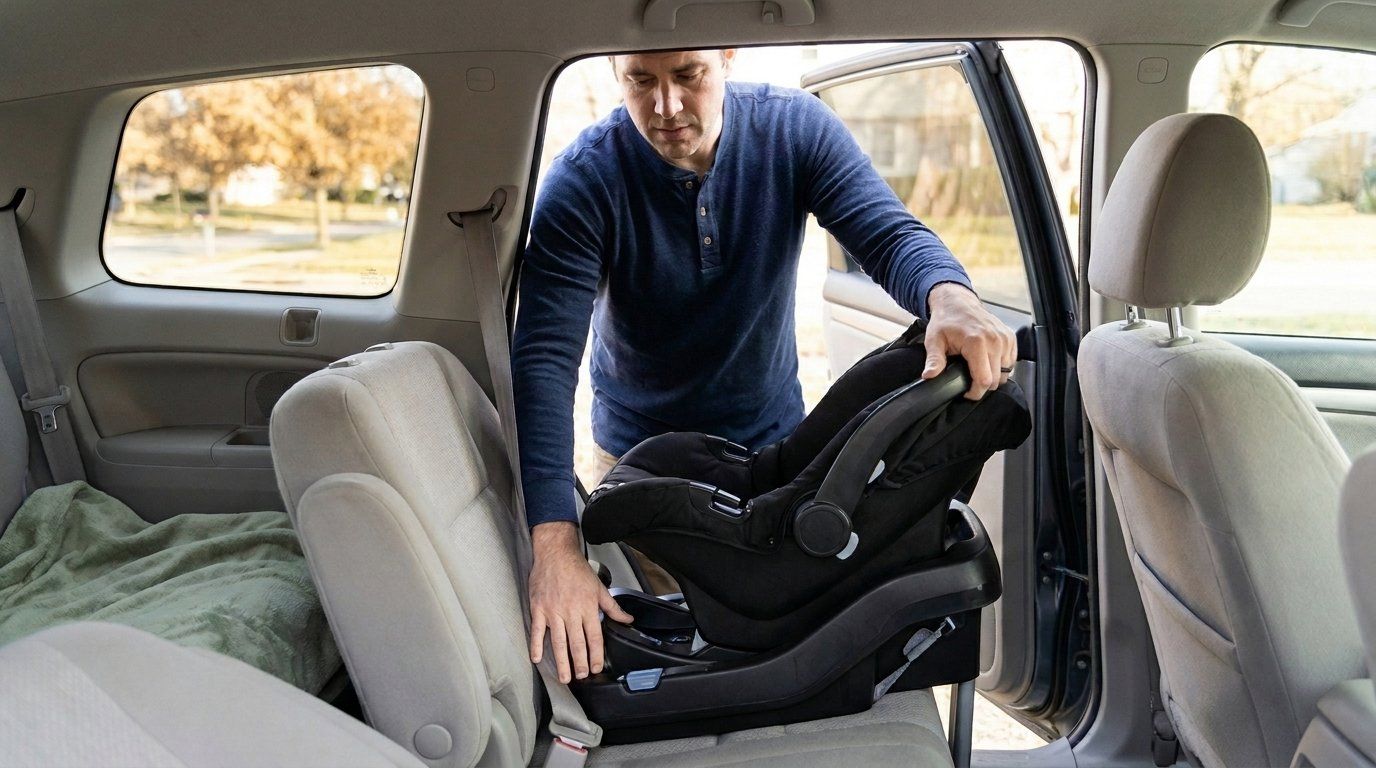
- Installing the base with the lower anchors (LATCH)
- Installing the base with the seat belt
- Installing the infant seat without the base
- The checks: 1 inch, the angle, the handle
- Buckling the baby in
- Get it checked by a certified technician
- Two cars? Get a second base
- After the install: register it, and know its limits
- FAQ
- Sources
Installing the infant car seat is usually dad’s job, and it’s easy to feel sure you got it right. That’s the trap. In NHTSA’s survey of car seats in use, 73% of drivers said they were confident about their install, and 45% of those confident drivers had at least one mistake. This guide walks you through the install with the base, with the seat belt, and without the base, then the checks that catch the common mistakes, using guidance from NHTSA, the AAP, the CDC and Safe Kids.
A note before you start: your car seat manual and your vehicle owner’s manual come first. The AAP says to read both “each time you install the seat.” Where this guide uses a specific seat as an example, it’s the Chicco KeyFit 35, and other seats differ.
The short answer
- Rear-facing, back seat, never in front of an active airbag.
- LATCH or the seat belt, not both, unless both manuals allow it.
- Press down and tighten until the seat moves less than 1 inch at the belt path.
- Check the angle with the seat’s level indicator, on flat ground.
- Harness straps at or below the baby’s shoulders, chest clip at armpit level, and no slack you can pinch.
- Get it checked by a certified technician before the birth. NHTSA says it’s free in most cases.
- Register the seat so you hear about recalls.
Why it’s worth getting right
NHTSA says child safety seats “reduce fatal injury by 71 percent for infants under 1 year old.” The catch is that the seat has to be used correctly, and often it isn’t:
- NHTSA’s field survey (2011 data, published 2015) found an overall misuse rate of 46%, and 49% for rear-facing infant seats.
- The single most common mistake on rear-facing infant seats was the wrong amount of recline, at 16%.
- 15% of drivers hadn’t read any instructions at all.
Safe Kids suggests choosing and practicing with your seat in the fourth or fifth month of pregnancy, and using a teddy bear to practice adjusting the harness. Do the final install a few weeks before the due date (see the third trimester guide), so you’re not learning it in the hospital parking lot.
Before you start
- Read both manuals. The car seat manual tells you how the seat installs; the vehicle manual tells you where the anchors are and how your seat belts lock.
- Park on flat ground. Angle indicators read wrong on a slope. Chicco’s KeyFit manual says to make sure the vehicle is on a level surface.
- Pick the spot. The AAP says the back seat is safest and the middle may be best if possible, but “It is safest to put the car safety seat in a position where you can install it tightly.” Many vehicles don’t have lower anchors in the middle seat, the AAP notes.
- Never in front of an active airbag. The AAP says that if the airbag inflates, “it will hit the back of the car safety seat, right against your child’s head.”
NHTSA’s short video shows the basics for any rear-facing seat:
Installing the base with the lower anchors (LATCH)
LATCH uses two small bars between the seat back and the seat cushion. NHTSA says vehicles have them in at least two rear seats, and the AAP says nearly all cars and car seats made since September 1, 2002, have LATCH.
- Set the base rear-facing in the back seat, on a flat part of the cushion.
- Clip the base’s connectors onto the lower anchors. You should hear or feel them latch.
- Press down firmly on the base and tighten the strap. NHTSA: “press down firmly on the car seat base and tighten the straps.”
- Check the angle with the base’s level indicator and adjust the recline foot if needed.
- Do the 1-inch test (below).
Weight limit. The AAP says all lower anchors are rated for a maximum of 65 pounds, counting the car seat and the child together. An infant carrier plus a baby rarely gets close, but if your seat’s manual gives a lower LATCH limit, switch to a seat belt install when you reach it.
Infant seats don’t use the top tether. NHTSA says most rear-facing seats in the US don’t use one.
Installing the base with the seat belt
The AAP and NHTSA say LATCH and the seat belt are equally safe. Use the belt when the spot you want has no lower anchors, or when it gives you a tighter fit.
- Thread the belt through the base’s rear-facing belt path. NHTSA says to check that there are no twists in it.
- Buckle and press down on the base while you pull the belt tight.
- Lock the belt. The AAP says “you must make sure the seat belt locks to hold the seat tightly.” In most newer cars, you lock it by pulling the belt all the way out and letting it feed back in, the AAP says. Many bases have a built-in lock-off instead. NHTSA’s rule: lock it with the vehicle’s seat belt system or the car seat lock-off. On the KeyFit 35 base, Chicco says the lock-off replaces the need to switch the belt to locked mode, and that switching it as well “may cause Child Restraint to tilt.”
- Check the angle and do the 1-inch test.
LATCH and seat belt together? NHTSA says “never both.” The AAP says to use one “unless the car safety seat and vehicle manufacturers say it is OK to use 2 systems at the same time.” In practice: one, not both, unless both manuals say so.
Here is the seat belt install on a KeyFit 35 base, from Chicco. Other bases differ, so follow your own manual:
Installing the infant seat without the base
This is the install for taxis, rideshares, rental cars, Grandma’s car and planes. Practice it once in your driveway before you need it. Not every infant seat allows it, so check your manual first. Using the KeyFit 35 as the example:
- Set the carrier rear-facing on the vehicle seat.
- Route the lap belt through the guides on the carrier. Chicco calls its version “European belt routing”: the shoulder belt goes around a guide on the back of the carrier for a third point of contact.
- Lock the belt. Chicco says to pull out all of the shoulder belt and activate the belt’s locking mode, and “If belt does not lock, do not use that seating position.”
- Level it. Chicco says to position the seat so the level line on the seat label is level with the ground. Its manual allows “A tightly rolled towel” under the front edge to adjust the angle, but not anything to raise the seat off the vehicle seat, “such as a noodle or towel.” Other makers’ rules differ: only use a towel or pool noodle if your manual says so.
- Do the 1-inch test at the belt path.
Chicco’s video of the KeyFit 35 installed without its base:
On a plane. The FAA and the AAP recommend a certified child restraint for children under 40 pounds. The label should say “This restraint is certified for use in motor vehicles and aircraft,” and the FAA says buying the baby a ticket is the only way to be sure you can use it. For the rest of flying with a baby, see Christmas with a newborn.
The checks: 1 inch, the angle, the handle
The 1-inch test. Grab the seat where the belt or LATCH strap goes through it and tug. The AAP says “If you can move the seat at the belt path more than an inch side to side or front to back, it’s not tight enough.” NHTSA, the CDC and Safe Kids give the same 1-inch rule. Check at the belt path, not the top of the seat, which will always move more.
The angle. This is the mistake NHTSA found most often on rear-facing infant seats. The AAP says the right angle keeps the baby’s head from flopping forward, and to avoid a chin-to-chest position that blocks the airway. All rear-facing seats have recline indicators: use yours, with the car on flat ground. On the KeyFit 35 base, you raise or lower the recline foot until the bubble falls between the arrows.
The handle. Put it where your manual says. The KeyFit 35 manual says any of its locked positions works in the car; other brands have their own rules.
Check it again before every ride. Chicco’s manual says to check the installation before every use. It takes five seconds.
Buckling the baby in
The install is half the job. The harness is the other half:
- Straps at or below the shoulders. The AAP says rear-facing harness straps go in slots “at or below your child’s shoulders.”
- Snug enough that you can’t pinch slack. NHTSA says the harness is snug “when you cannot pinch any extra material at the shoulder.”
- Chest clip at armpit level, in the center of the chest.
- Support only from the box. If your newborn needs support, the AAP says you can place a tightly rolled receiving blanket on both sides, but nothing under or behind the baby and no insert that didn’t come with the seat. The KeyFit 35 includes a newborn positioner for babies from 4 to 11 pounds.
- No puffy coats under the harness. Buckle the baby in thin layers, then put the coat or a blanket over the straps. See how to dress a baby for winter for the full routine.
If your baby was born early, the AAP says preterm babies should be screened in the hospital to make sure they can sit safely in a semi-reclined position.
Get it checked by a certified technician
A certified child passenger safety technician (CPST) will check your install and show you how to buckle the baby in. NHTSA says they inspect car seats “free of charge, in most cases,” and some now offer virtual checks. The AAP recommends seeing one before the baby is born. Safe Kids says there are over 41,000 certified technicians.
- Find one with NHTSA’s car seat inspection station finder, through Safe Kids Worldwide (which also lists checkup events), or by calling 877-366-8154, the number the AAP gives.
- A store install isn’t a check. Safe Kids says that a store offering to put the seat in your car “does not mean your helper is properly trained to install car seats.”
Bring both manuals, the car you’ll use most and, if you can, the baby. For what else to have ready, see the hospital bag checklist and when to go to the hospital.
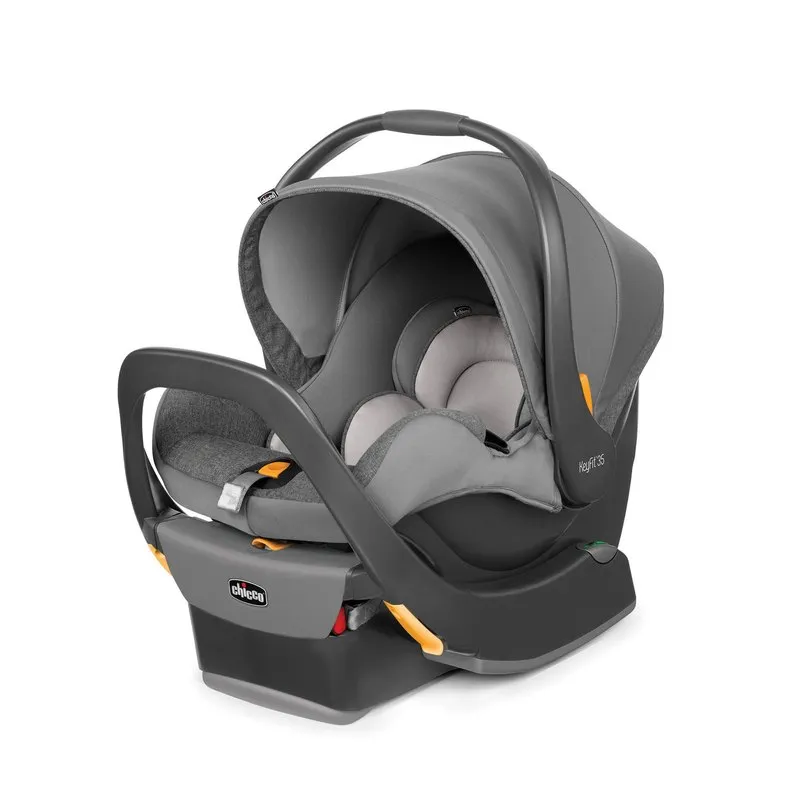
Chicco KeyFit 35 Infant Car Seat
A rear-facing-only infant car seat for babies from 4 to 35 pounds and up to 32 inches, with a newborn positioner and a built-in anti-rebound bar. The carrier weighs 10 pounds.
Pros
- Rear-facing from 4 pounds, so it fits the ride home
- Built-in anti-rebound bar
- Clicks into Chicco strollers
Cons
- For the car only: the AAP says not to let babies sleep in it outside the vehicle
Two cars? Get a second base
The AAP says the infant seat “clicks into and out of the base so you don’t have to install the seat each time you use it,” and that parents can buy more than one base for other vehicles. If both of you drive the baby, a second base is cheaper than installing the carrier with a seat belt every day. It still needs a full install and the 1-inch test in that car.
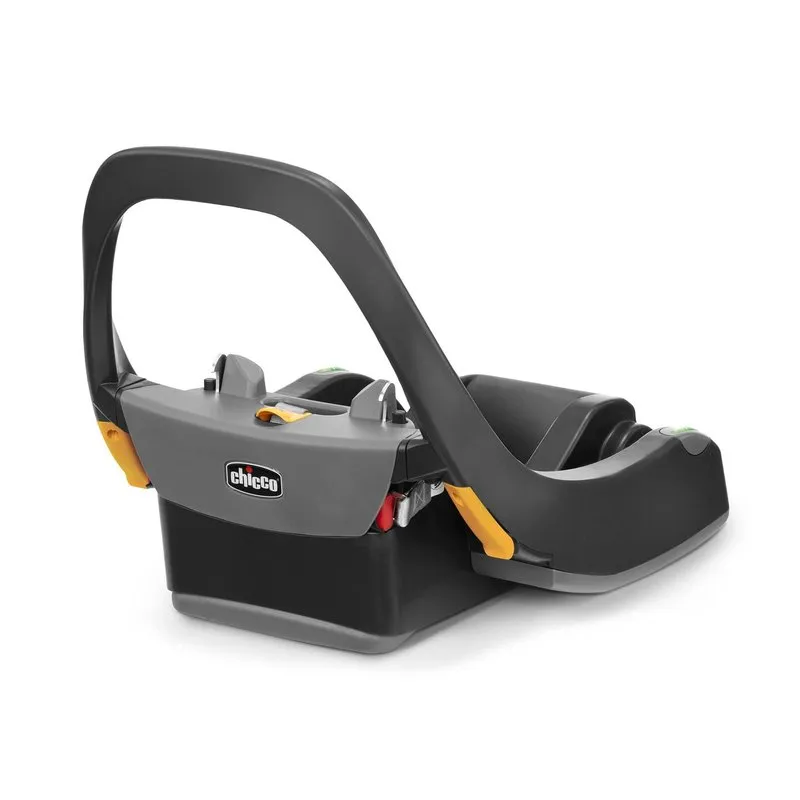
Chicco KeyFit 35 Base
An extra stay-in-car base for a second car, so the KeyFit carrier clicks in without a new install each time. Chicco says it accepts the KeyFit, KeyFit 30 and KeyFit 35 infant car seats, with a spring-loaded leveling foot and steel-reinforced lock-offs for seat belt installs.
Pros
- Same base as the one in the box, so the carrier clicks into either car
- Leveling foot and bubble levels for the angle
- Lock-offs hold the seat belt for you
Cons
- Not compatible with KeyFit Max carriers
- Still needs a full install and the 1-inch test in the second car
After the install: register it, and know its limits
Register the seat. NHTSA says to send in the card that came with the seat or register on the maker’s website. Safe Kids says that information can only be used to tell you about a recall. NHTSA’s free SaferCar app also sends recall alerts.
Know the expiration date. The AAP says to look on the label for the date the seat was made and check with the maker how long to use it. Safe Kids says seats usually expire between 6 and 10 years; the KeyFit 35 manual says 6. Safe Kids suggests taking a photo of the label with your phone.
Used seats. The AAP says to “Avoid used car seats if you don’t know the seat’s history.” NHTSA has a checklist for secondhand seats, including that it has never been in a moderate or severe crash and still has its date and model labels.
After a crash. NHTSA recommends replacing a car seat after a moderate or severe crash, and says seats don’t automatically need replacing after a minor one, which it defines as all five of these: the car could be driven away, the door nearest the car seat wasn’t damaged, nobody was hurt, the airbags didn’t go off, and the seat has no visible damage. Some makers go further: Chicco says to replace the KeyFit 35 after any crash, “even if you cannot see visible damage.” Follow your manual.
Skip the add-ons. The AAP says not to use extra products unless they came with the seat or the maker approved them: “These products are not covered by any federal safety standards.” Safe Kids says add-ons like harness strap padding can make your child less safe. That includes inserts, head supports and strap covers sold separately. Keep loose, heavy things out of the back seat too.
The car seat is for the car. The AAP says babies can sleep in a properly installed car seat while you drive, but it’s not a safe place to sleep once you’re out of the car. Move the baby to a flat sleep space when you arrive. Chicco also warns never to put the carrier on a counter, table or soft surface, or on a shopping cart. For long drives, the AAP suggests a break every 2 to 3 hours.
FAQ
How do I install an infant car seat with a seat belt without the base?
Check that your manual allows it first. Set the carrier rear-facing, route the lap belt through the carrier’s belt guides (and the shoulder belt around the back, if your seat has European routing), buckle, then pull the belt all the way out to lock it. Level the seat using the line on its label, then make sure it moves less than 1 inch at the belt path.
Should I use LATCH or the seat belt?
Either. The AAP says both are equally safe. Use the one that gets a tight install in the spot you choose, and don’t use both unless your car seat and vehicle manuals say it’s OK.
Where is the safest place for an infant car seat?
The back seat, rear-facing. The AAP says the middle may be best if possible, but the safest spot is the one where you can install the seat tightly, which is often a side seat. Never put a rear-facing seat in front of an active airbag.
How tight should an infant car seat base be?
It should move no more than 1 inch side to side or front to back when you pull at the belt path. Press down on the base while you tighten the LATCH strap or seat belt.
Is a car seat check free?
In most cases. NHTSA says certified technicians inspect car seats free of charge in most cases, and the CDC says these services are usually free. Find one through NHTSA’s inspection station finder or Safe Kids Worldwide.
Do I need to replace the car seat after a car accident?
After a moderate or severe crash, yes, NHTSA says. After a minor crash, NHTSA says a seat doesn’t automatically need replacing, but some makers, including Chicco for the KeyFit 35, say to replace it after any crash. Follow your car seat’s manual.
Can I use an infant car seat on a plane?
Yes, if its label says it is certified for use in motor vehicles and aircraft. The FAA says buying the baby a seat is the only way to be sure you can use it.
Sources
- Car Seats and Booster Seats, How to Install Rear-Facing Car Seats, Car Seat Use After a Crash, Used Car Seat Safety Checklist, Children: 2023 Data and Results of the 2011 National Child Restraint Use Special Study, National Highway Traffic Safety Administration
- Car Seats: Information for Families, Winter Car Seat Safety Tips and Is it safe for my baby to travel in a car seat for hours at a time?, American Academy of Pediatrics (HealthyChildren.org)
- Child Passenger Safety: Reducing Risk, Centers for Disease Control and Prevention
- Installing, Buying, FAQs, Car seat checkup events and CPS certification, Safe Kids Worldwide
- Kids Corner, Federal Aviation Administration
- Videos: Rear-Facing Car Seat Tips, NHTSA; Installing KeyFit 35 Base with Seatbelt and Installing Without a Base, Chicco USA
- KeyFit 35 Infant Car Seat, KeyFit 35 manual and KeyFit 35 Base, Chicco