Baby Fever: Temperature Chart and When to Call the Doctor
Fever in babies, explained for the 2 a.m. dad: what temperature counts as a fever by method, the under-3-months rule, when to call vs go to the ER vs call 911, fever medicine rules, teething, shots and febrile seizures.
We choose everything we recommend independently. If you buy through our links, we may earn a commission. How we make money

In this guide
- The short answer
- What counts as a fever: the chart
- Under 3 months: the one rule to memorize
- Call, ER or 911? (3 months and older)
- How to take a baby’s temperature
- Fever medicine: the rules, not the doses
- Comfort care: what helps and what doesn’t
- Is it teething?
- Fever after shots
- Febrile seizures: what to do
- A fever isn’t the enemy
- Dad’s 2 a.m. checklist: what to write down before you call
- FAQ
- Sources
Your baby feels hot, it’s the middle of the night, and you need to know two things: is this a fever, and does it need a call right now? This guide covers fever in babies the way you’ll need it at 2 a.m.: the numbers, the one rule for babies under 3 months, when to call versus go to the ER, and what to write down before you pick up the phone.
A note before you start: this is general guidance, not medical advice for your baby. If you’re unsure, call your pediatrician’s office, including the after-hours line. That’s what it’s for.
The short answer
- Fever = 100.4°F (38°C) or higher, taken rectally.
- Under 3 months (12 weeks): call right away at 100.4°F, even if the baby seems fine. No fever medicine before the baby is seen.
- 3 to 6 months: call for 101°F (38.3°C) or higher. Over 6 months: call for 103°F (39.4°C) or higher.
- Any age: call right away if the fever rises above 104°F (40°C) repeatedly, or the baby looks very ill, is hard to wake, has trouble breathing or has had a seizure.
- Medicine: no ibuprofen under 6 months, acetaminophen under 2 years only with your doctor’s guidance on the dose, never aspirin.
- Teething doesn’t cause a real fever.
What counts as a fever: the chart
The AAP says a rectal reading of 100.4°F (38°C) or higher “is considered a fever,” and that a rectal reading “is the most reliable and accurate for infants, especially babies under 3 months old.” Here’s how the cutoffs work by method:
| Where you take it | Fever at or above | Notes |
|---|---|---|
| Rectal (bottom) | 100.4°F (38°C) | Most accurate; the one to use under 3 months |
| Forehead (temporal artery) | 100.4°F (38°C) | AAP: next most accurate |
| Ear | 100.4°F (38°C) | Only from 6 months; baby ear canals are too narrow |
| Armpit | 99°F (37.2°C) | Least accurate; recheck rectally if it reads high |
| Mouth | Not for babies | AAP: oral use not recommended until age 4 |
A few things make a reading look higher than it is. The AAP notes body temperature is “highest in the late afternoon and early evening,” and that infants run a little warmer than older kids. A baby who is overdressed or has been in a hot car may be overheated, which is different from a fever. And don’t go by touch: the AAP says feeling the forehead “is not accurate.”
Under 3 months: the one rule to memorize
If your baby is under 3 months (12 weeks) and has a rectal temperature of 100.4°F or higher, call your pediatrician right away. The AAP says this is “very important, even if your baby shows no other signs or symptoms of being ill.”
Why the rush: fever in the first 3 months “can be serious,” the pediatric triage guidelines on HealthyChildren.org explain, because “bacterial infections in this age group can get worse quickly.” The doctor will need to examine the baby, and the AAP says a baby with fever in the first 12 weeks “will need to be checked in a health care setting to see what tests are needed.”
Two things to know:
- Don’t give fever medicine first. The same guidelines say: “do NOT give your baby any fever medicine before being seen.” Medicine can hide the fever the doctor needs to know about.
- You may be sent straight to the ER. Children’s Hospital of Philadelphia, for example, tells parents of babies under 2 months with a rectal temperature over 100.4°F to “go to an emergency department immediately.” Your pediatrician will tell you where to go.
This includes the day of the 2-month shots: if your baby is under 3 months, call anyway and let the doctor decide.
Call, ER or 911? (3 months and older)
For older babies, how the baby looks and acts matters as much as the number. Johns Hopkins puts it this way: how sick the child looks “and your gut feeling should help make the decision.” These three tiers come from the pediatric triage guidelines on HealthyChildren.org, with additions from the AAP and MedlinePlus:
| Do this | If your baby has a fever and |
|---|---|
| Call 911 | Can’t wake up, isn’t moving or is very weak, has severe trouble breathing (struggling for each breath), has purple or blood-colored spots on the skin, or has blue lips, tongue or nails |
| Go to the ER now | Has a stiff neck, a bulging or swollen soft spot (under 1 year), is hard to wake up, or had a seizure with the fever |
| Call the doctor now | Has a fever over 104°F (40°C), shaking chills lasting more than 30 minutes, nonstop crying or cries when touched or moved, or signs of dehydration |
By age, call your pediatrician when:
- 3 to 6 months: 101°F (38.3°C) or higher, per the AAP. The symptom checker says any fever at this age deserves a call within 24 hours.
- Over 6 months: 103°F (39.4°C) or higher.
- Any age: the fever rises above 104°F repeatedly, lasts more than 24 hours in a child under 2, the baby seems to be getting worse, or has a rash, repeated vomiting or diarrhea, or trouble breathing.
Dehydration signs to watch for: crying without tears, a dry mouth, a sunken soft spot and fewer wet diapers. The triage guidelines flag no urine in more than 8 hours.
If you’re torn between “call” and “wait,” call. A nurse would rather hear from you.
How to take a baby’s temperature
Use a digital thermometer. The AAP is blunt: “Do NOT use a mercury thermometer.”
Rectal, step by step (AAP):
- Put a little petroleum jelly on the tip of the thermometer and on your baby’s bottom.
- Lay the baby belly down across your lap, or on their back with legs pulled up to the chest.
- Turn it on and slide it in gently, about 1/2 inch for babies under 6 months, up to 1 inch for older babies. If you feel resistance, stop.
- Hold it still until it beeps, then read it.
Label the rectal thermometer “so it is not accidentally used in the mouth,” the AAP says, and disinfect it before and after each use with soap and water or an alcohol swab.
Other methods: the AAP says forehead thermometers “can be used on children of any age” but that direct sun or cold after being outside can throw them off. Johns Hopkins suggests using a forehead reading as a first pass under 3 months and confirming rectally, which is the safe move before you act on a number. Ear thermometers are for 6 months and up. With no-touch thermometers, the FDA notes that the right distance from the forehead is specific to each model, so follow the instructions. After coming in from the cold, wait 15 minutes.
For a side-by-side of thermometer types and our picks, see our best baby thermometer guide. If you just want one simple rectal thermometer for the newborn months, this is the one we suggest:
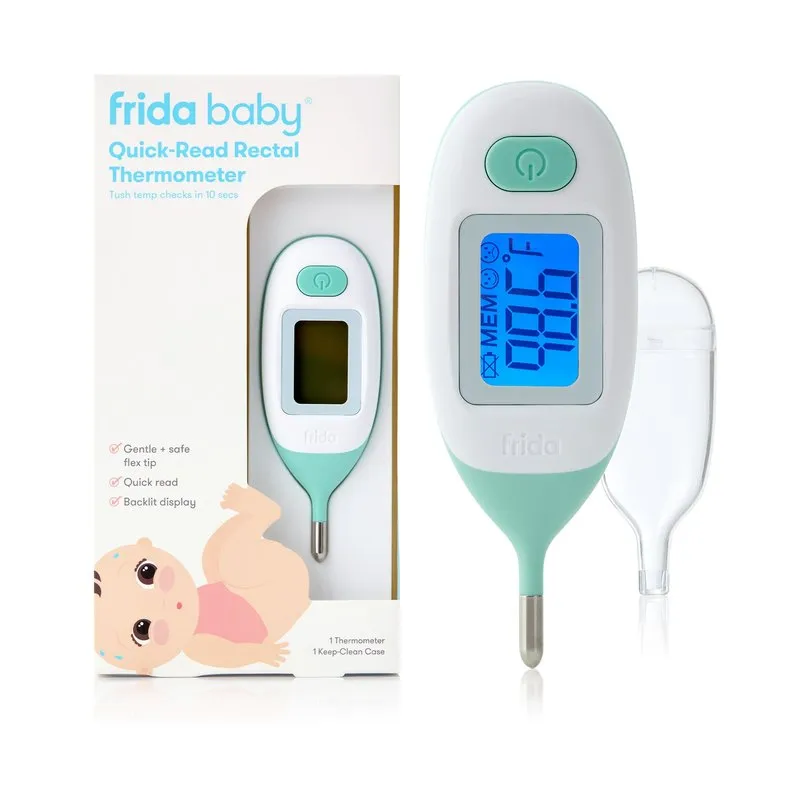
Frida Baby Quick-Read Digital Rectal Thermometer
A digital rectal thermometer with a 10-second read, a backlit display for night checks and memory for the last 10 readings. A flexible tip and stopper keep it from going in too far.
Pros
- Rectal: the most accurate way to check a baby, per the AAP
- Backlit screen for 3 a.m. checks
- Flexible tip with a stopper
Cons
- Label it for rectal use only, so it never ends up in a mouth
Fever medicine: the rules, not the doses
We don’t print dose tables, on purpose. Doses go by weight, products differ, and the AAP says to “check with your child’s doctor to make sure you are giving the right amount.” These are the rules that apply to every baby:
- Under 12 weeks: no fever medicine before the baby is seen (see above).
- Acetaminophen (Tylenol; called paracetamol outside the US) “should not be given to children under 2 years of age without the guidance of a doctor,” the AAP says. Ask for the dose by weight.
- Ibuprofen (Motrin, Advil): not under 6 months unless your doctor tells you to. The AAP notes its use under 6 months “is also not approved by the FDA.”
- Never aspirin. It can cause Reye syndrome, a rare but dangerous illness. MedlinePlus adds that Pepto-Bismol and products with oil of wintergreen contain aspirin-like compounds too.
- Read the strength on the box. Liquid acetaminophen now comes in one strength, 160 mg/5 mL, after the FDA pushed makers to a single strength in 2011. Liquid ibuprofen still comes in two: infant drops at 50 mg/1.25 mL and children’s liquid at 100 mg/5 mL. Per mL, the drops are twice as strong.
- Use the syringe in that box. The AAP says never use a kitchen spoon, and the FDA says “Never mix and match dosing devices.”
- No combination or cough and cold products. The FDA says children under 2 should not get any cough and cold product with a decongestant or antihistamine.
- Don’t alternate acetaminophen and ibuprofen unless your doctor tells you to. The AAP says rotating “is likely not needed,” and Seattle Children’s warns that switching raises the risk of giving too much.
- Don’t wake a sleeping baby to give fever medicine, Seattle Children’s says.
- Too much medicine? Call Poison Control at 1-800-222-1222, open 24 hours.
Dad’s job: keep a medicine log in your phone notes. Write the time, the medicine, the strength and how much, every time. The AAP recommends exactly this, and it stops two tired parents from giving the same dose twice.
Comfort care: what helps and what doesn’t
Fever medicine “won’t make an infection go away any faster,” the AAP says; it’s for comfort. Things that help:
- Fluids. Under 6 months, that means extra breast milk or formula only. No water, no juice.
- Light clothing. A single layer. The triage guidelines warn: if a baby under 1 has a fever, “never overdress or bundle up,” because babies overheat more easily.
- A comfortably cool room.
- Shivering? The AAP says you can give a blanket for chills. Use it while you’re holding your baby awake. In the crib, safe sleep rules still apply: nothing but a fitted sheet. See our safe sleep guide.
What to skip: the AAP says to avoid “ice baths or sponging, rubbing alcohol, and aspirin.” Ice baths cause shivering, which can raise the temperature, and rubbing alcohol can be absorbed through the skin or inhaled.
Is it teething?
No, not if it’s a real fever. The AAP says “teething does not cause fever, diarrhea or excess crying,” and that “extensive studies show this is a false symptom of teething.” Teething can nudge the temperature up a little, within the normal range. A reading of 100.4°F or higher means something else is going on, so treat it like any fever.
While you’re at it, the AAP says to skip numbing gels with benzocaine and teething necklaces, which carry choking and strangulation risks. Our baby teething guide has the rest.
Fever after shots
A mild fever after vaccines is common. The triage guidelines say fever with most vaccines begins within 12 hours and lasts 2 to 3 days. Timing varies by vaccine: CHOP’s Vaccine Education Center notes most fevers happen within a week, but the chickenpox vaccine’s usually show up 14 to 27 days later. CHOP also advises against giving fever medicine before a shot visit, because it may weaken the immune response.
Two rules still apply: under 3 months, call for any fever of 100.4°F or higher, even after shots, and for any baby, the AAP says to talk to your doctor if a fever follows a vaccine.
Febrile seizures: what to do
Some young children have a seizure with a fever. The AAP says febrile seizures happen in 3 or 4 of every 100 children, between 6 months and 5 years, most often around 12 to 18 months. They’re terrifying to watch, but the AAP says they “usually are harmless” and most are short.
If it happens:
- Lay your child on the floor or bed, away from hard or sharp objects.
- Turn the head to the side so saliva or vomit can drain.
- Don’t put anything in the mouth. They “will not swallow their tongue.”
- Don’t hold them down.
- Start a timer. If the seizure lasts more than 5 minutes, call 911. The AAP and the NIH both use 5 minutes.
- If it’s your child’s first febrile seizure, get them seen right away, even after it stops.
Fever medicine lowers the temperature but, the AAP says, it doesn’t prevent febrile seizures.
A fever isn’t the enemy
The AAP says fevers “are generally harmless” and “can be a good sign that your child’s immune system is working.” A temperature that doesn’t come down with medicine “doesn’t mean that a child is more seriously ill,” Johns Hopkins notes. And a baby who plays and interacts after a dose is a good sign, the AAP says. The goal of comfort care is a more comfortable baby, not a perfect number. The exceptions are the ones above: any fever under 3 months, and the red flags at any age.
Dad’s 2 a.m. checklist: what to write down before you call
Nurses ask the same questions every time. Have the answers ready in your phone notes:
- Age (in weeks if under 3 months).
- The reading, how you took it, and when. Johns Hopkins and the AAP both say to tell the doctor where the temperature was taken.
- Every dose given: medicine, strength, amount, time.
- Wet diapers since the last check, and the last feed.
- Other symptoms: rash, cough, vomiting, diarrhea, breathing, how the baby is acting.
- Recent shots, including the past few weeks.
Keep the thermometer and your pediatrician’s number where you can find them in the dark, as the AAP suggests. Call your pediatrician’s after-hours line first. Some children’s hospitals and health plans also run free nurse lines; it’s worth finding yours before you need it. If your partner is recovering from birth, taking the night call is a good way to support her postpartum. For logging feeds and diapers, see best apps for new dads and our night feeds guide.
FAQ
What temperature is a fever in a baby?
100.4°F (38°C) or higher, taken rectally. Forehead and ear readings use the same cutoff (ear only from 6 months). An armpit reading of 99°F (37.2°C) or higher counts, but it’s the least accurate, so recheck rectally.
When should I call the doctor for my baby’s fever?
Right away if your baby is under 3 months and has a temperature of 100.4°F or higher, even if they seem fine. For older babies, call at 101°F from 3 to 6 months, 103°F over 6 months, if the fever rises above 104°F repeatedly, lasts more than 24 hours under age 2, or your baby looks very sick.
When is a baby’s fever an emergency?
Call 911 if your baby can’t wake up, struggles to breathe, has purple spots on the skin or blue lips. Go to the ER for a stiff neck, a bulging soft spot or a seizure with the fever.
Can I give my baby Tylenol or Motrin for a fever?
Not under 12 weeks before the baby is seen. Acetaminophen (Tylenol) under 2 years only with your doctor’s guidance on the dose, by weight. Ibuprofen (Motrin) not under 6 months unless your doctor says so. Never aspirin.
Can teething cause a fever?
No. The AAP says teething can raise the temperature slightly within the normal range but doesn’t cause a true fever. A reading of 100.4°F or higher has another cause.
Is a fever after vaccines normal?
A mild fever is common, usually within 12 hours and gone in 2 to 3 days, though the chickenpox vaccine’s fever can come 2 to 4 weeks later. Under 3 months, call for any fever of 100.4°F or higher.
Should I alternate Tylenol and Motrin?
Only if your pediatrician tells you to. The AAP says it’s likely not needed, and switching raises the chance of giving too much.
Sources
- American Academy of Pediatrics (HealthyChildren.org): Fever and Your Baby, When to Call the Pediatrician, How to Take a Child’s Temperature, Signs and Symptoms of Fever, Treating Your Child’s Fever: FAQs, Fever Without Fear, Acetaminophen, Ibuprofen, Teething Pain, Febrile Seizures and Safe Sleep
- Pediatric triage guidelines (Schmitt Pediatric Guidelines) on HealthyChildren.org: Fever symptom checker
- U.S. Food and Drug Administration: infant acetaminophen concentration change, cough and cold products for kids and non-contact infrared thermometers
- National Institutes of Health: Febrile Seizures (NINDS); MedlinePlus: Fever, When your baby or infant has a fever, Ibuprofen dosing for children and Reye syndrome
- CDC: Flu vaccines and febrile seizures
- Children’s Hospital of Philadelphia: Fever in the newborn and Fever and vaccines; Johns Hopkins Medicine: Measuring a baby’s temperature; Seattle Children’s: Fever