How to Clear a Baby's Stuffy Nose: Safe Steps, by Age
How to clear a baby's stuffy nose safely: saline and suction step by step, what to do without an aspirator, feeding and sleep when congested, cold remedies by age, what to avoid, and when to call the doctor.
We choose everything we recommend independently. If you buy through our links, we may earn a commission. How we make money
In this guide
- The short answer
- Why babies get so stuffy
- How to clear it: saline and suction
- Bulb, snot sucker or electric?
- How to clear a baby’s stuffy nose without an aspirator
- Feeding a stuffy baby
- Humidifier and steam
- How to help a stuffy baby sleep (safely)
- What not to do
- Baby cold remedies by age
- When to call the doctor, go to the ER or call 911
- How long will this last?
- Daycare colds
- FAQ
- Sources
It’s the middle of the night, the baby is snorting through a blocked nose, and nobody is sleeping. The AAP says babies’ nasal passages “are a lot smaller than an adult’s,” so a little mucus goes a long way, and a baby can’t breathe with their mouth closed on a bottle or breast. The good news: the fix is simple and cheap. This guide covers how to clear it, what to do if you don’t have an aspirator, how to feed and sleep a stuffy baby safely, what to avoid, and when to call.
A note before you start: this is general guidance, not medical advice for your baby. If your baby was born early or has a heart or lung condition, ask your pediatrician what applies to them.
The short answer
- Saline, wait, suction: 2 to 3 drops per nostril, wait about a minute, gentle suction.
- When: about 15 minutes before a feed or bedtime. Not right after a feed.
- How often: about 4 suction sessions a day at most.
- Sleep: flat on the back. Nothing propped.
- Skip: cold medicine, vapor rub, honey under 12 months.
- Under 3 months: call at the first sign of illness.
- Struggling for each breath: call 911.
Why babies get so stuffy
Small nasal passages clog easily. A stuffy nose isn’t only mucus; the AAP says the tissues inside the nose also fill with fluid. Winter makes it worse: “Winter’s cold, dry air can make nasal mucus thicker.” Tobacco smoke can cause congestion too.
Noisy but usually fine. The symptom checker on the AAP’s site says newborn nasal noises are “usually caused by dried mucus in the nose.” Throat gurgles are often air passing over saliva or milk. Sneezing is a normal reflex. Short breathing pauses under 10 seconds can be normal too, if the baby is comfortable during them.
Not fine: breathing pauses longer than 10 seconds, or a repeated high-pitched squeaking sound, which you should mention to your doctor.
Dad’s job: watch the chest for a minute. Is it just noise in the nose, or is the body working to breathe? Our RSV guide shows the breathing signs to learn.
How to clear it: saline and suction
- Wash your hands and lay your baby on their back.
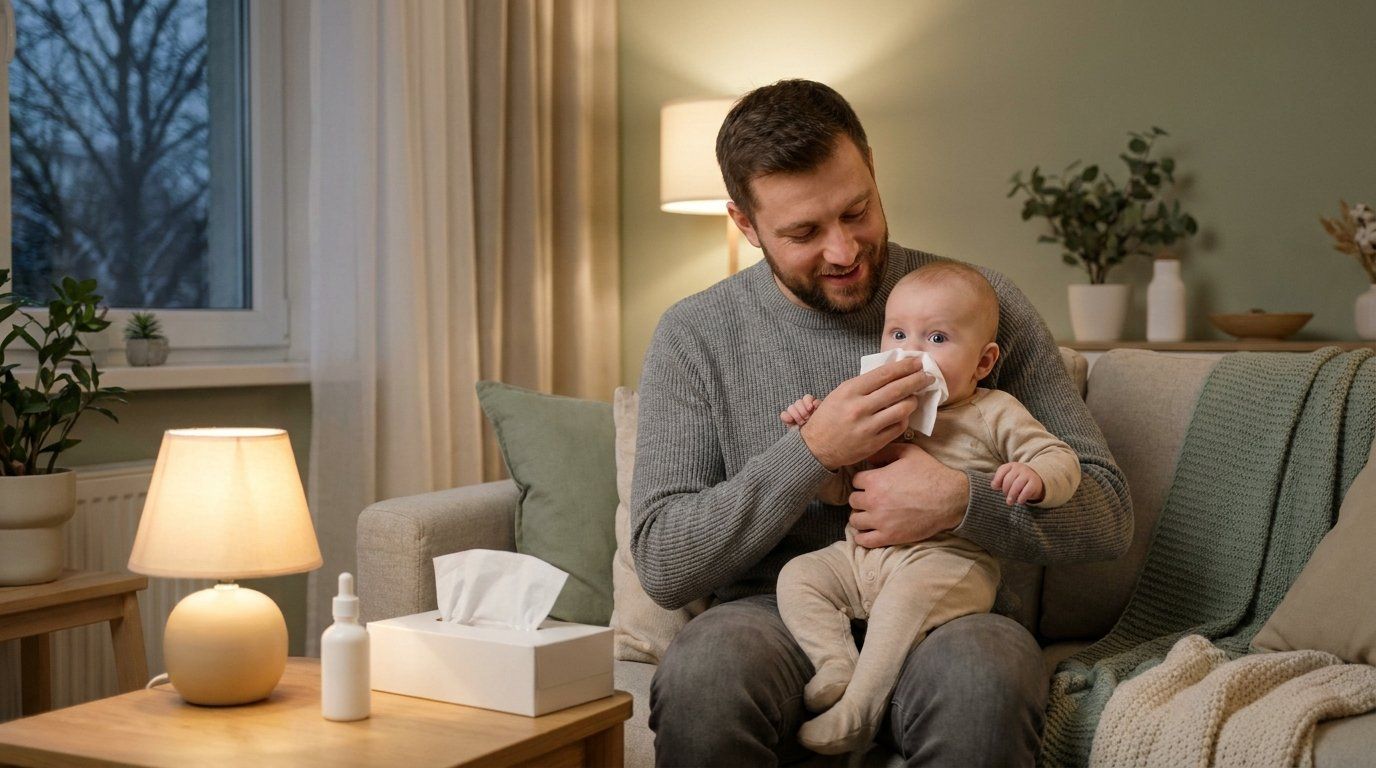
- Add saline. Use plain saline drops without medicine. The AAP says 2 to 3 drops per nostril, one side at a time.
- Wait about a minute. Saline softens the mucus. Seattle Children’s notes “suction alone can’t remove dried or sticky mucus.”
- Suction gently. With a bulb, the AAP says to “squeeze the bulb before placing it in your baby’s nostril,” then release slowly. With a tube aspirator, seal it against the outside of the nostril.
- Repeat on the other side, wipe, and clean the tool in warm soapy water.
Timing: the AAP suggests “15 minutes before feeding or naptime.” Cincinnati Children’s says “Avoid suctioning after feeding,” since it can make babies vomit.
How often: Nationwide Children’s says to limit suction to no more than 4 times a day, and another children’s hospital warns that more can dry out the inside of the nose. Stop if the nose looks sore or you see blood. Saline alone is gentler; the AAP says “These are safe to use multiple times a day.”
If your baby is happy and eating, leave it alone. The AAP says a baby whose stuffy nose isn’t bothering them likely doesn’t need treatment.
Dad’s job: one adult holds, one does the drops and suction. Alone at night, it helps to swaddle the arms for two minutes, if your baby isn’t rolling yet.
Bulb, snot sucker or electric?
| Type | How it works | Worth knowing |
|---|---|---|
| Bulb syringe | Squeeze first, then release | Hospitals send you home with one. The FDA says suctioning this way “works very well for children younger than a year old.” |
| Tube aspirator | You suck through a tube with a filter | Sits outside the nostril; new filter each time |
| Electric | Battery-powered suction | Parents like them, but the evidence isn’t better |
A Canadian trial tested a battery-powered device against a bulb before feeds in babies with bronchiolitis. There were “no group differences in revisits or feeding and sleeping adequacy,” though parents were more satisfied with the device. That’s one trial in a different illness, but it’s a reason not to overspend.
Our pick is the tube type. It sits at the outside of the nostril rather than inside, and the parts are top-rack dishwasher safe:
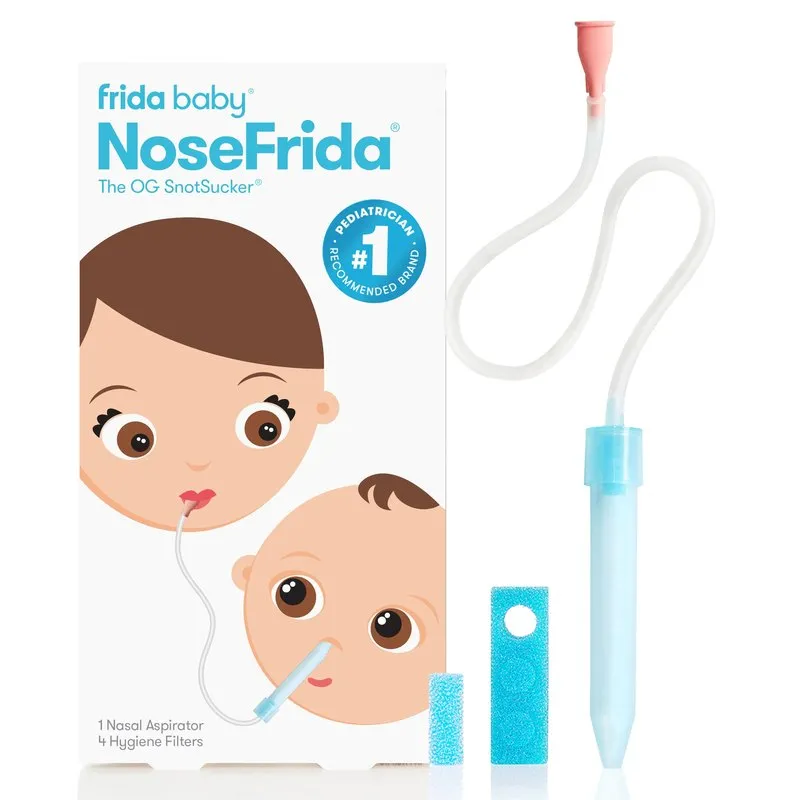
NoseFrida the SnotSucker
A manual nasal aspirator: you suck through a tube, and a disposable filter keeps the mucus in the barrel. It comes with 4 filters; the mouthpiece and tube are top-rack dishwasher safe.
Pros
- Works with saline drops, the AAP's first step for a stuffy nose
- Filters keep it hygienic
- No batteries
Cons
- Replace the filter after every use
Any plain sterile saline from the pharmacy works. This one is just salt and water and turns into drops when you flip the bottle:
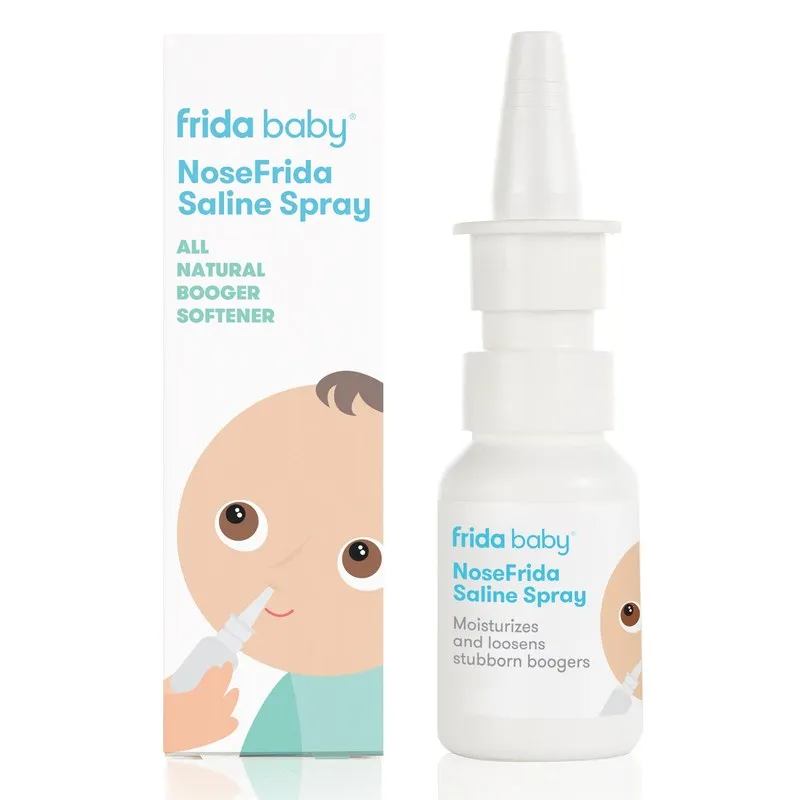
NoseFrida Saline Spray
A 20 mL bottle of plain saline made with two ingredients, salt and water, and no medication, Frida says. Spray it, or turn the bottle upside down to dispense drops, which is what the AAP's steps call for.
Pros
- Plain salt and water, no medicine
- Works as a spray or as drops
- Small enough for the diaper bag
Cons
- Small bottle; any plain sterile saline does the same job
- Keep suction to about 4 times a day, whatever the label says about saline
How to clear a baby’s stuffy nose without an aspirator
It’s 2 a.m. and you have no aspirator. Here’s what still works:
- Saline drops alone. The loosened mucus “can be sneezed out or swallowed,” the AAP’s symptom checker says.
- Wipe the outside. Use a wet cotton ball around the nose. Nothing goes inside.
- Feed. See below.
- Run a cool-mist humidifier.
Out of saline? A pharmacy bottle is best. The AAP gives a home recipe: ½ teaspoon of non-iodized salt and ¼ teaspoon of baking soda in a cup of “sterile, distilled or previously boiled water.” Don’t use plain tap water: the FDA says “Tap water isn’t safe for use as a nasal rinse because it’s not adequately filtered or treated.” If you boil it, the FDA says boil for 3 to 5 minutes, then cool until lukewarm.
“Naturally”? All of this is natural. To be honest about the evidence, a Cochrane review called saline only “possibly” beneficial, based on small trials. It’s still low risk and the best first step.
Feeding a stuffy baby
Stuffy babies feed slower, so the AAP says to “suction your baby’s nose before nursing or bottle-feeding them.” If nursing is too hard, expressed milk in a bottle or cup may be an option. Keep breastfeeding through a cold; the AAP says it’s still recommended.
Water only from 6 months, in small amounts. Smaller, more frequent feeds can help; see our formula guide for amounts.
Dad’s job: this is the part you can own. Suction before the bottle, at every feed that needs it. More in our night feeds guide.
Humidifier and steam
A cool-mist humidifier may make your baby more comfortable. Don’t use warm mist: the FDA says it can “cause nasal passages to swell and make breathing more difficult.” Our best humidifier for baby guide covers types, cleaning and placement.
Steamy bathroom: the AAP and CDC both suggest sitting with a child in a bathroom filled with steam from a running shower, while the AAP’s croup page says “there are no studies to prove that inhaling steam in a bathroom is effective.” Think of it as optional comfort, with your baby in your arms and away from the hot water. Never use a bowl or pot of hot water: an Australian study found steam home care “carries an under-recognised risk of serious scalding.”
How to help a stuffy baby sleep (safely)
This is where a lot of online advice is wrong. You’ll read tips about putting a towel under the mattress or tilting the crib. Dr. Rachel Moon, writing for the AAP, says parents may want to “incline their mattress, but it is NOT safe.” Babies should “always sleep flat on their backs on an even, firm surface,” even when they’re sick.
Her explanation: “Think of your baby’s airway as a straw.” On an incline, the neck can bend and pinch it, the same way a bent straw stops working.
- No wedges or sleep positioners, “even if you’re using a device that seems made for the job.”
- No sleeping in swings, rockers or bouncers. If your baby falls asleep in a car seat or carrier, the AAP says to “move them to a dedicated sleep space as soon as you can.”
- Don’t overbundle. The AAP says to “make sure they don’t overheat.”
- Do the routine first. Saline and suction about 15 minutes before bed.
Dad’s job: if you’re holding your baby upright to soothe them, you stay awake. The moment you feel sleep coming, the baby goes in the bassinet. See safe sleep for newborns.
What not to do
| Don’t | Why |
|---|---|
| Cough and cold medicine | The FDA says not under 2, the AAP not under 4, the CDC not under 6. Nobody supports it for a baby. |
| Medicated nose drops | The AAP: “Never use nonprescription nose drops that contain medicine.” |
| Homeopathic cold products | The FDA says “There are no FDA-approved homeopathic products.” |
| Vapor rub | The AAP: “Never use mentholated rub on babies or children under 2 years old.” |
| Honey under 12 months | The CDC: “Do not feed honey to a child who is younger than 1 year old.” That includes honey pacifiers. |
| Essential oils | Poison Control says to consider discarding them if you have young children. Nothing but water goes in the humidifier. |
| Antibiotics for a cold | The CDC: they “don’t work against viruses.” |
| Hot-water steam bowls | Scald risk. |
Breast milk in the nose is a common tip. We found no US health organization that recommends it, so we’d stick to saline.
Baby cold remedies by age
| Age | What helps | Avoid | When to call |
|---|---|---|---|
| Under 3 months | Saline, gentle suction, feeds | Any medicine before a doctor says so; water; honey | At the first sign of illness; any fever of 100.4°F or higher |
| 3 to 6 months | The same | Water; ibuprofen; cold medicine; honey | Within 24 hours, a triage guide says; sooner for breathing or feeding trouble |
| 6 to 12 months | The same, plus small sips of water | Cold medicine; rubs; honey | Breathing, feeding or wet-diaper problems; a blocked nose keeps waking them |
| 12 months and up | The same; honey (2 to 5 mL) for a cough | Cold medicine; no rub until 2 | Mucus past 10 to 14 days, or worse again after improving |
When to call the doctor, go to the ER or call 911
| Do this | If your baby |
|---|---|
| Call 911 | “Is struggling for each breath,” can barely make sounds or cry, has bluish lips or face, or seems to have something caught in their throat |
| Go to the ER | Has ribs pulling in with each breath, or isn’t alert |
| Call now | Has trouble breathing that doesn’t clear after you clean the nose, takes less than half the usual milk, has no urine in more than 8 hours, or is under 12 weeks with a temperature of 100.4°F or higher |
| Call within a day | Is under 6 months with a cold, a triage guide says. Under 3 months, the AAP says call at the first sign of illness. |
| Call during office hours | Keeps waking from a blocked nose, or has had nasal mucus longer than 10 to 14 days |
For fever rules by age, see our baby fever guide.
How long will this last?
Sources differ. The CDC says colds usually last less than a week, and the AAP says symptoms go away slowly after 7 to 10 days. Seattle Children’s says nasal drainage can last 7 to 14 days and a cough 2 to 3 weeks. So a stuffy nose that hangs on for up to 2 weeks is normal.
The stuffy stage often starts a few days in, so day 3 feeling worse doesn’t mean you did anything wrong. The AAP says thick, colored mucus is an expected stage. Call if your baby gets better and then worse again.
How many colds are normal? “More than 200 respiratory viruses can cause colds,” the CDC says. Mayo Clinic says babies usually have 6 to 8 colds a year. It feels like one long cold in winter, and it’s normal.
Daycare colds
Babies in child care catch more colds. The AAP says a first year in group care can mean “as many as 8 to 12 more colds.” Under AAP guidance, a runny nose or cold without fever doesn’t usually mean staying home. Respiratory symptoms with a fever do: back after “at least 24 hours without the use of fever-reducing medicine.” Program rules vary, and some are stricter.
Dad’s job: know your program’s policy before the first cold, and agree who takes the call at 11 a.m.
FAQ
How do I clear my baby’s stuffy nose fast?
Put 2 to 3 drops of plain saline in each nostril, wait about a minute, then gently suction, ideally 15 minutes before a feed or bedtime.
How can I clear my baby’s nose without an aspirator?
Use saline drops and let your baby sneeze or swallow the loosened mucus, wipe around the outside of the nose with a wet cotton ball, and feed.
Can a baby with a stuffy nose sleep on an incline?
No. The AAP says propping your baby or inclining the mattress isn’t safe, even with a product made for it. Flat on the back, on a firm surface.
Is it normal for a newborn to sound stuffy with no other symptoms?
Often, yes. The symptom checker on the AAP’s site says nasal noises are usually dried mucus. Call if breathing looks hard or saline doesn’t help.
How often can I suction my baby’s nose?
Hospitals generally say no more than about 4 times a day, because more can irritate the nose. Saline alone is safe several times a day.
Can I use Vicks or honey for my baby’s cold?
No vapor rub under 2, and no honey under 12 months, including honey pacifiers.
How long does a baby’s cold last?
Usually 7 to 10 days, and the nose can run for up to 2 weeks. Call if it lasts longer or your baby gets worse after improving. Under 3 months, call at the first sign of illness.
Sources
- American Academy of Pediatrics (HealthyChildren.org): My baby has a stuffy nose: how can I help them sleep safely?, Cough and cold survival kit, Coughs and colds: medicines or home remedies?, Caring for kids with colds and flu, Children and colds, Croup treatment, Noisy breathing and stridor, When to keep your child home from child care, and the newborn behavior and colds 0-12 months symptom checkers (Schmitt Pediatric Guidelines)
- CDC: About the common cold, Treating the common cold and Preventing botulism
- U.S. Food and Drug Administration: Should you give kids medicine for coughs and colds? and Rinsing your sinuses with neti pots
- Children’s hospitals: Seattle Children’s Colds (0-12 months); Cincinnati Children’s Suctioning with a bulb syringe; Nationwide Children’s Suctioning the nose and Humidifiers; CHKD Clearing your baby’s congestion; Mayo Clinic Common cold in babies
- Poison Control: Essential oils
- Studies: Schuh et al., nasal suctioning trial, JAMA Netw Open, 2023 (Canada); King et al., Saline nasal irrigation, Cochrane, 2015 (Australia); Wallis et al., Vapour inhalation scalds, Burns, 2008 (Australia)
- Product pages: NoseFrida and NoseFrida Saline, Frida