How to Change a Diaper: A Dad's Step-by-Step Guide
How to change a diaper step by step, the tricks for boys and girls, how many diapers to expect, what the poop colors mean, diaper rash, and changing on the go.
We choose everything we recommend independently. If you buy through our links, we may earn a commission. How we make money
In this guide
Learning how to change a diaper is the first baby skill most dads master, and you’ll get plenty of practice. The American Academy of Pediatrics (AAP) says a newborn may need as many as 8 to 12 changes a day, and that parents in the US average about six a day across the first year. This guide walks through it step by step, with the tricks for boys and girls, what to look for in the diaper, how to handle diaper rash, and how to change a baby when there’s no changing table in sight.
The short answer
- Set up everything within reach before you start.
- Keep one hand on the baby the whole time.
- Slide the clean diaper under the baby before you remove the dirty one.
- Wipe front to back, then let the skin dry.
- Fasten the new diaper snugly at about belly-button height, with no gaps at the legs.
- Wash your hands, and the baby’s.
Step by step
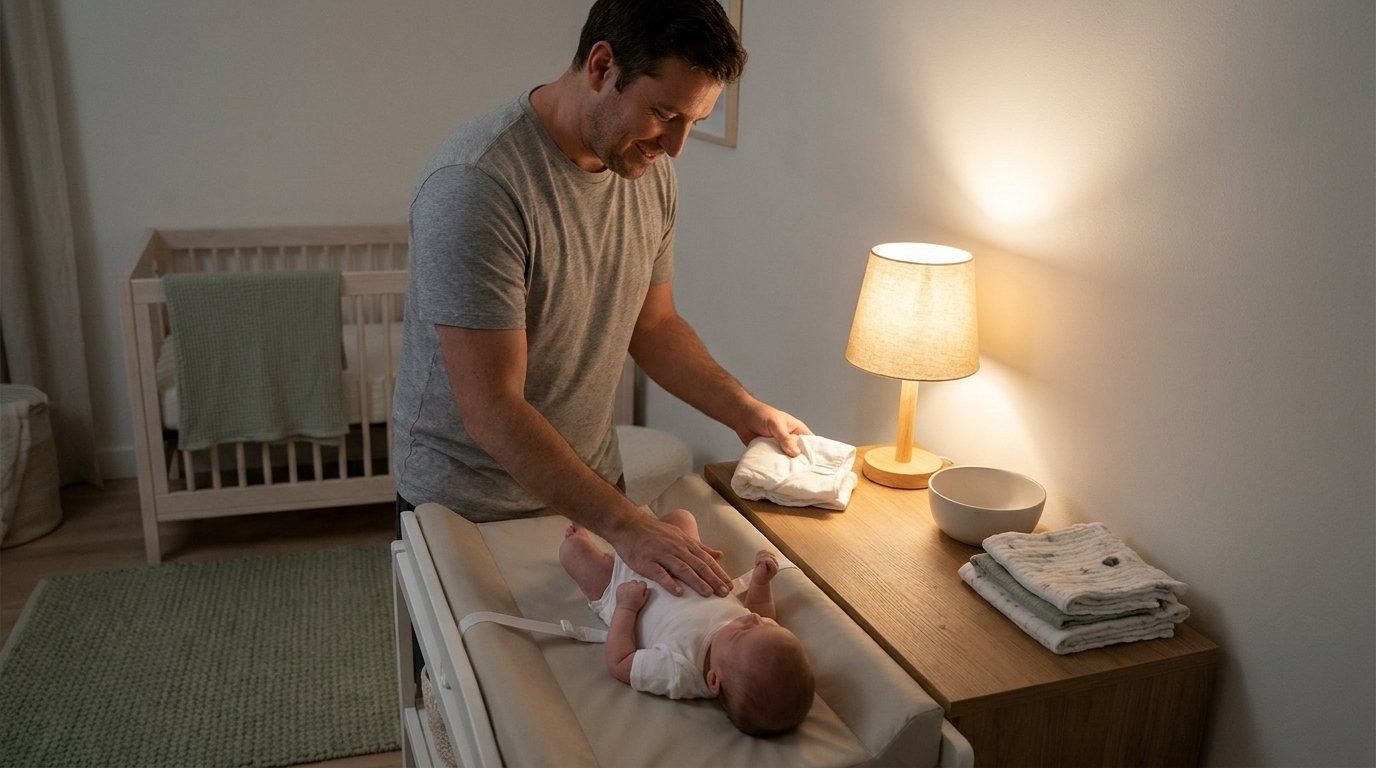
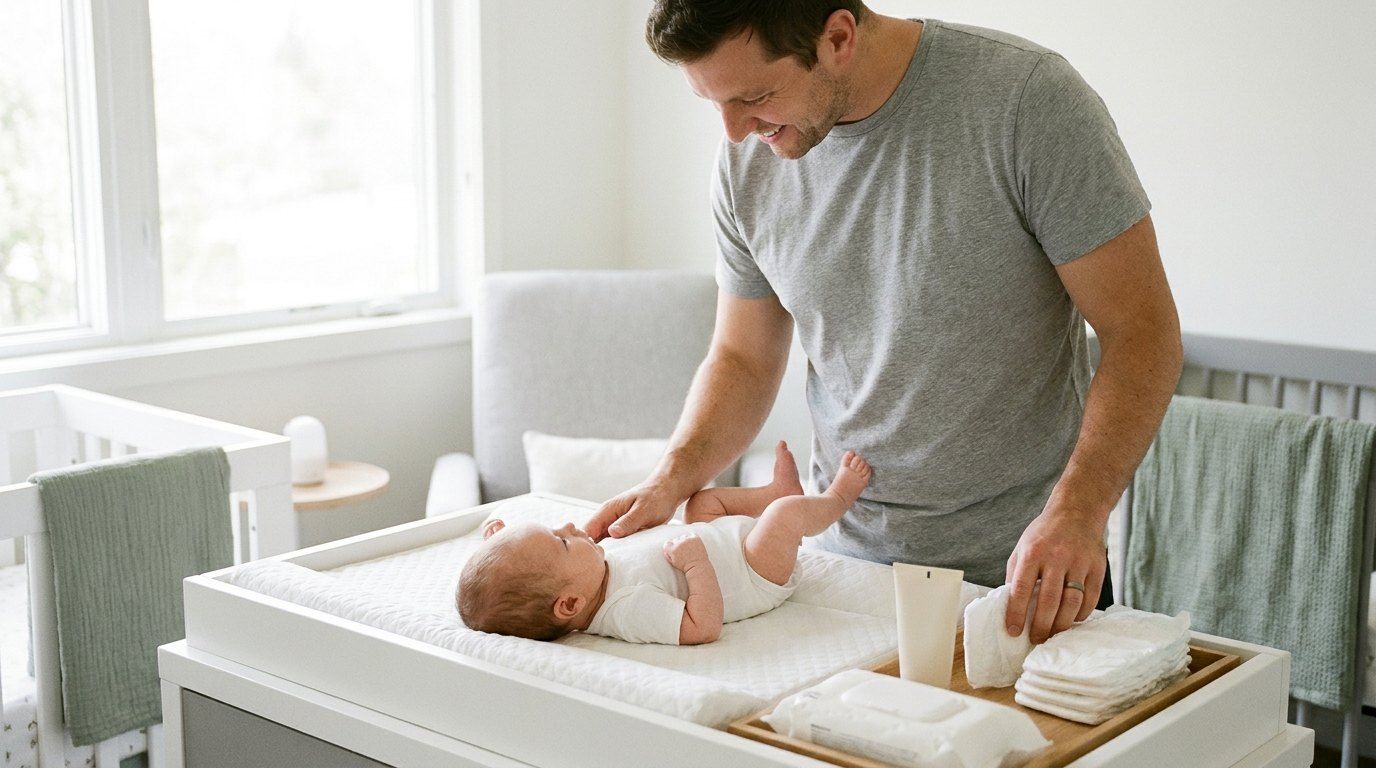
1. Get everything ready. The AAP says to set up first so everything you need is within reach: a clean diaper, wipes or a damp washcloth, and diaper cream if you use it. Never walk away mid-change to grab something.
2. Keep a hand on the baby. Both the CDC and the AAP say to keep a hand on the baby at all times. Babies wriggle and roll earlier than you’d expect.
3. Slide the clean diaper under. Open the clean diaper, gently lift the baby’s legs with one hand, and slide it under the dirty one, with the tabs underneath. Now any surprise lands on a clean diaper, not the changing pad.
4. Open the dirty diaper and do a first wipe with it. The AAP suggests using the front, inner part of the dirty diaper to wipe off most of the mess, then folding it under the baby’s bottom.
5. Clean up. Wipe from front to back, as the CDC advises, using a fresh wipe each time and getting into the skin folds. Pull the dirty diaper out, fold it closed and set it somewhere the baby can’t reach.
6. Let the skin dry. A few seconds of air helps prevent rash. Add a layer of diaper cream if the skin looks red.
7. Fasten the clean diaper. Pull the front up between the legs to about the same height as the back, roughly at the belly button, and fasten the tabs evenly. Check that the ruffles around the legs are pulled out, not tucked in, so it doesn’t leak.
8. Wash your hands. The CDC’s steps: wash the baby’s hands, clean the changing surface, then wash your own.
Keep the baby covered as much as you can while you work. Plenty of babies pee the moment cool air hits.
Changing a boy
- Cover him. The AAP suggests keeping your hand, a diaper or a tissue over his penis while you change him.
- Aim down. If pee keeps leaking out the top of the diaper, point his penis downward before you close it.
- If he’s circumcised, the AAP says the head of the penis may have a light dressing with petroleum jelly at first, which usually comes off at the next pee. Some redness and a yellowish film in the first days are normal healing. Call the pediatrician for redness or swelling that doesn’t go away, or crusted yellow sores.
- If he’s not circumcised, clean the outside with warm water only. The AAP says never to force the foreskin back; it separates on its own over months or years.
Changing a girl
- Always wipe front to back, to keep poop away from the vagina.
- Clean gently between the folds of the labia, front to back.
- A little discharge can be normal. In the first days, the AAP says a white discharge, sometimes with a little blood, is harmless and comes from the mother’s hormones. After the first week, blood in the diaper isn’t normal: call the pediatrician.
The umbilical cord stump
Until the stump falls off, the AAP says to fold the top of the diaper down below the cord so urine doesn’t soak it. A few drops of blood on the diaper when it falls off are normal. Active bleeding is a reason to call. For more on cord care, see our guide to bathing a newborn.
How many diapers to expect
Counting diapers is one of the best ways to tell whether a newborn is eating enough. The CDC’s guide for breastfed babies:
| Baby’s age | Wet diapers a day (at least) | Poops a day (at least) |
|---|---|---|
| Day 1 | 1 | 1 |
| Day 2 | 2 | 3 |
| Day 3 | 5 | 3 |
| Days 4 to 7 | 6 | 3 |
The CDC says to call the pediatrician if the baby has fewer than 3 poops and fewer than 6 wet diapers a day by day 5. The AAP says to expect 2 to 3 wet diapers a day in the first few days and at least 5 to 6 a day after the first 4 to 5 days.
Orange or brick-red stain? In the first week, the AAP says this is usually concentrated urine, not blood, as long as the baby wets at least four diapers a day. Call if it keeps showing up.
What’s normal in the diaper
The first poops. For the first few days, poop is thick and black or dark green. This is meconium, and it’s normal. It then turns greenish-yellow.
After that:
- Breastfed babies: mustard yellow, loose and seedy.
- Formula-fed babies: tan or yellow, a bit firmer, but no firmer than soft clay.
- Green is usually nothing to worry about.
How often? It varies a lot. The CDC says that from the end of the first week to about 6 weeks, a breastfed baby might poop 6 or more times a day, and less after that. The AAP says some breastfed babies older than 3 to 6 weeks go several days, even a week, without pooping, and that’s fine if the poop is soft when it comes and the baby is eating and growing well.
Colors that mean call the pediatrician:
- Red, which can mean blood.
- Black, after the first meconium days, which can be digested blood.
- White, gray or very pale. The AAP says pale poop can be a sign of a liver problem, and the NIH says babies with biliary atresia, a rare liver disease, may have pale yellow, gray or white stools, often with jaundice that lasts past 3 weeks. It’s rare, roughly 1 in 8,000 to 18,000 newborns according to the AAP’s 2025 guidance, but it needs to be seen quickly. Our baby poop color chart covers every color.
Also call for: watery poop that’s much more frequent than usual, poop with mucus, hard dry poop, straining for more than 10 minutes without success, a hard, swollen belly, or any diarrhea in a baby 3 months or younger.
Diaper rash
The AAP says at least half of all babies get diaper rash at some point. Most of it is easy to prevent and treat, and our diaper rash treatment guide goes deeper:
- Change wet or dirty diapers promptly.
- Use gentle wipes free of alcohol and fragrance. On irritated skin, the AAP suggests water and a soft cloth or a squirt bottle instead, and patting the skin dry. The AAP also notes that not every change needs a wipe: pee is rarely irritating.
- Let the skin air-dry, and give the baby some diaper-free time on a towel.
- Use a thick barrier cream. The AAP says zinc oxide and petroleum jelly are both good choices. Fragrance-free is best, spread on thickly, like icing on a cupcake.
- Don’t fasten the diaper too tight.
- Skip baby powder. It can get into the baby’s lungs.
- Don’t use antibiotic ointment on a diaper rash, the AAP says.
A yeast rash looks different: shiny, bright red or pink patches with sharp edges, often worse in the skin folds of the groin, and more likely after antibiotics. If you see it, call the pediatrician.
Call the pediatrician if the rash isn’t better after two to three days of treatment, has blisters, pimples, pus or crusty sores, seems very painful, spreads beyond the diaper area, or comes with a fever.
Changing on the go
- Pack a portable changing pad. The AAP calls it something every man should always have in his diaper bag. See the best diaper bags for dads; most come with one.
- No changing table in the men’s room? Look for a family restroom. The AAP says not to change the baby on a bathroom countertop, and suggests the floor on a changing pad, a reclined stroller or the back of the car instead.
- At the airport: federal law requires larger US airports that receive certain federal grants to have a changing table in at least one men’s and one women’s restroom in each terminal.
- On a plane: the AAP suggests changing the diaper right before you board, and asking the crew whether the plane’s restroom has a changing table. If you use the closed toilet seat, keep a hand on the baby the whole time.
Changing table safety
Changing tables are high, and falls happen fast. The Consumer Product Safety Commission (CPSC) estimates that about 5,400 children under 5 were treated in US emergency rooms in 2024 for injuries involving changing tables.
- Never leave the baby on the table, even for a moment. If you have to step away, take the baby with you or put them in the crib.
- Use a table with a raised rail around all four sides; the AAP suggests at least 2 inches, and a concave pad.
- Use the safety strap, but don’t rely on it. The CPSC warns that straps can give parents a false sense of security, and that a baby left in a single waist strap can be at risk of strangulation.
- Keep supplies within your reach and out of the baby’s.
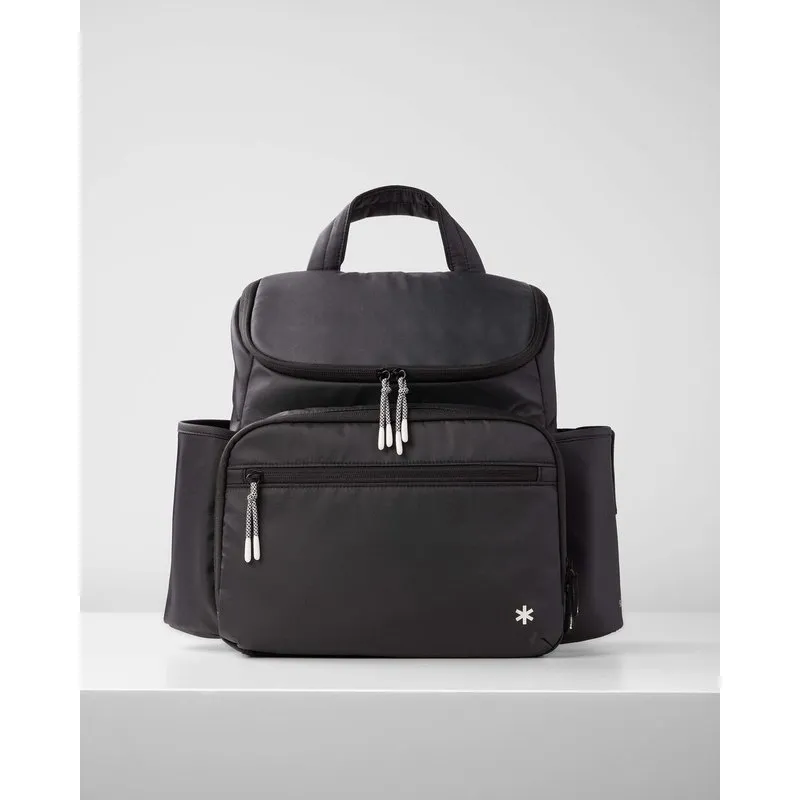
Skip Hop Forma Next Diaper Backpack
The newest version of Skip Hop's best-selling backpack. Skip Hop lists 9 pockets, an insulated packing cube and a mesh one, an adjustable bottle pocket that fits a 30-ounce tumbler, a changing pad and stroller straps, water-repellent fabric and room for a 14-inch laptop.
Pros
- Well equipped for the price
- Insulated cube for bottles
- Fits a 14-inch laptop
Cons
- No weight or warranty listed
- Looks like a diaper bag
If you need a bag for changes on the go, the Skip Hop Forma Next comes with a changing pad and has an insulated cube for bottles. More options in the best diaper bags for dads.
Why it’s worth owning this job
Diapering is one of the easiest ways to be hands-on from day one, and most dads already do it. A US government survey of 2006 to 2010 found that 9 out of 10 fathers living with children under 5 bathed, diapered or dressed them every day or several times a week. Large studies in Japan have found that fathers who were more involved in baby care, including diaper changes, had children with fewer injuries as toddlers and better well-being as teenagers. Those studies show links, not proof, but the direction is consistent. More on building that connection in not feeling bonded with your baby yet.
FAQ
How do you change a newborn’s diaper step by step?
Set up your supplies, keep a hand on the baby, slide the clean diaper under, open the dirty one and wipe front to back, let the skin dry, fasten the clean diaper at belly-button height and wash your hands. Fold the diaper below the umbilical cord stump until it falls off.
How often should you change a newborn’s diaper?
Whenever it’s wet or dirty. The AAP says newborns may need 8 to 12 changes a day. Changing promptly also helps prevent diaper rash.
How do you change a boy’s diaper without getting peed on?
Keep a hand, a diaper or a tissue over his penis while you work, and point his penis down before you close the new diaper so pee doesn’t leak out the top.
What color should newborn poop be?
Black and sticky for the first few days, then greenish, then yellow. Breastfed poop is usually mustard yellow and seedy; formula poop is tan or yellow and firmer. Call the pediatrician for red, black (after the first days), white or very pale poop.
How do you change a diaper on a plane?
Change the baby right before you board, ask the crew whether the restroom has a changing table, and keep a hand on the baby the whole time. A portable changing pad helps.
What is the best cream for diaper rash?
The AAP says thick barrier creams with zinc oxide or petroleum jelly are both good choices, ideally fragrance-free. Call the pediatrician if the rash isn’t better after two to three days.
Sources
- Changing Diapers, Changing Table Safety, How to Make Baby’s Room Safe, Umbilical Cord Care, How to Tell if Baby is Getting Enough Milk, Bringing Baby Home, Baby’s First Days: Bowel Movements and Urination, The Many Colors of Poop, Pooping By the Numbers, Biliary Atresia, Diarrhea in Babies, Infant Constipation, Diaper Rash, A Word on Wipes, Caring for Your Son’s Penis, Care for an Uncircumcised Penis, How Your Newborn Looks, Flying with Baby and Are changing tables in all public men’s restrooms now?, American Academy of Pediatrics (HealthyChildren.org)
- Diaper Changing Steps at Home and Newborn Breastfeeding Basics, Centers for Disease Control and Prevention
- Symptoms and Causes of Biliary Atresia, National Institute of Diabetes and Digestive and Kidney Diseases (NIH)
- Diaper rash, MedlinePlus (National Library of Medicine)
- Nursery Product-Related Injuries and Deaths, 2025 Annual Report and Safety Standard for Baby Changing Products: Final Rule, U.S. Consumer Product Safety Commission
- 49 U.S.C. 47107(w), baby changing tables in airport restrooms, U.S. Code
- Fathers’ Involvement With Their Children: United States, 2006-2010, National Center for Health Statistics, 2013
- Paternal involvement in childcare and unintentional injury of young children: a population-based cohort study in Japan, Fujiwara et al., International Journal of Epidemiology, 2010
- The long-term association between paternal involvement in infant care and children’s psychological well-being at age 16 years, Kato et al., Journal of Affective Disorders, 2023