Best Pregnancy Pillow: A Dad's Guide to Buying One (and Keeping Half the Bed)
The best pregnancy pillows by shape and bed size, what doctors actually say about sleep position in pregnancy, the stillbirth research explained honestly, and when sleep trouble is a reason to call her OB.
We choose everything we recommend independently. If you buy through our links, we may earn a commission. How we make money
Our quick picks
- Best full-body (U)Momcozy Huggable U-ShapedCheck price
Supports back and belly at once, with an adjustable fill and washable cover.
- Best for a queen bedFrida Mom Compact 4-in-1Check price
One bendable pillow that makes four shapes and leaves you room.
- SmallestBoppy Side SleeperCheck price
Belly and back cushions only, built to leave room for a partner.
In this guide
- The short answer
- Why she can’t sleep
- What doctors actually say about sleep position
- The stillbirth question, plainly
- Does a pregnancy pillow actually help?
- U, C or compact: the bed math
- Our picks
- When to start using one
- Your side of the bed
- When it’s not a pillow problem
- After the baby comes: the pillow is hers, not the baby’s
- FAQ
- Sources
By the third trimester, a good night’s sleep gets hard to come by. ACOG’s guide for partners says the last trimester “is usually the most uncomfortable for your partner,” and that she “may have trouble sleeping.” A pregnancy pillow is one of the few things you can buy that actually helps her get comfortable, and it’s a good gift. This guide covers what doctors say about sleep position, how to pick a shape for your bed, our four picks, and when trouble sleeping is a reason to call her OB.
A note before you start: this is general information, not medical advice. Her OB or midwife knows her pregnancy; ask them about anything specific.
The short answer
- Pick by bed and by how she sleeps: a full U-shape for a king or a side-flipper; a C-shape, compact or two-piece pillow for a queen.
- Side sleeping is what ACOG suggests later in pregnancy: knees bent, a pillow between the knees and under the belly.
- Left or right? Left is often advised, but the right side is fine too.
- Woke up on her back? Roll back over. Short stretches are unlikely to do harm.
- Call her OB for severe back pain, new upper-belly pain or a headache that won’t go away, or loud snoring with gasping.
- After the birth, the pillow never goes near the baby’s sleep space.
Why she can’t sleep
A review of 24 studies found insomnia symptoms in about 25% of pregnant women in the first trimester, 27% in the second and almost 40% in the third. In a US survey of more than 2,400 women, 79% had trouble finding a comfortable sleep position and 83% got up to use the bathroom. MedlinePlus lists the usual culprits: a growing belly that makes positions hard, leg and back aches from the extra weight, bathroom trips and heartburn.
Dad’s job: take the night jobs that can be yours (the dog, the toddler, the early alarm), and look after your own sleep too. ACOG tells partners: “Try to make sure you both get enough sleep.” More on that stretch in our third trimester guide.
What doctors actually say about sleep position
ACOG’s advice is simple: “Sleeping on your side during your second and third trimesters may be best. Keep one or both knees bent. It may help to place a pillow between your knees and another under your belly. You also can try a full-length body pillow for support.”
Why not the back: ACOG says back sleeping “puts the weight of your uterus on your spine and back muscles,” and later in pregnancy, lying on the back “may compress a major blood vessel that takes blood to your uterus, making you feel dizzy and possibly reducing blood flow to your fetus.”
Left or right? ACOG just says “side.” MedlinePlus notes that many providers advise the left side but says switching to the right for a while is fine. A Cleveland Clinic ob-gyn puts it plainly: “most experts say it’s OK to sleep on either side.”
Stomach sleeping is “just fine” early on, the same Cleveland Clinic ob-gyn says. After 20 weeks, she’s “better off not spending the entire night flat on your back.”
If she wakes up on her back, don’t panic. The ob-gyn says it’s “not likely going to do any lasting harm,” and short periods “probably do no harm.” A tip from the same article: put a pillow between her back and the mattress, so if she rolls over, she’s still on an incline.
The stillbirth question, plainly
You may have read that sleeping on the back in late pregnancy is linked to stillbirth. Here’s what the research actually found:
- UK and New Zealand studies asked women who had a late stillbirth how they went to sleep, and compared them with women who didn’t. Going to sleep on the back was linked to about 2 to 4 times the risk. A pooled analysis of these studies found going to sleep on the left or right side “appears equally safe.”
- A large US study funded by the NIH followed more than 8,700 first-time mothers forward in time and found back or side sleeping through 30 weeks “does not appear to increase the risk of stillbirth.” Its authors cautioned that it says nothing about sleep position later in pregnancy.
- The NIH noted the earlier studies asked women after the loss, which raises “the possibility of recall bias.” A Cleveland Clinic ob-gyn says those studies were small and “shouldn’t be taken as definite proof.”
- The UK’s national guidance tells UK clinicians to advise women to avoid going to sleep on their back after 28 weeks and to consider using pillows to stay on their side. That’s UK guidance; ACOG’s patient pages recommend side sleeping without mentioning stillbirth.
The practical takeaway is the same either way: going to sleep on her side, especially late in pregnancy, is the safe default. And no pillow has been shown to lower stillbirth risk. In an Australian trial, a pillow designed to stop back-sleeping didn’t reduce it.
Dad’s job: if you notice she’s rolled onto her back, there’s no need to wake her in a panic. Side is the goal when she falls asleep, and a pillow behind her back helps.
Does a pregnancy pillow actually help?
The evidence is thin. Two small trials from the same Turkish research group found better comfort and sleep scores with a pregnancy pillow (75 women) and less fatigue (77 women). The Australian trial above found a pillow built to keep women off their backs didn’t change their position. ACOG and Cleveland Clinic list a body pillow as an option for comfort, not as treatment.
So think of it as comfort gear. That’s not nothing in the third trimester.
U, C or compact: the bed math
| Shape | What it supports | Bed space | Best for |
|---|---|---|---|
| U-shape | Back and belly at once, plus head and knees | A lot (the Momcozy is about 57 by 30 inches) | A king bed, or someone who flips sides all night |
| C-shape | Head, belly and knees on one side | Less than a U | A queen bed; she can lean back into the curve |
| Compact / convertible | One long pillow you bend into shapes | Little | A queen, or trying shapes before committing |
| Two-piece side pillow | Belly and back only | The least | Leaving room for you; pair with a pillow between the knees |
What about stomach sleepers? Belly sleeping is fine early on. Later, MedlinePlus notes that natural back and stomach sleepers find it hard to get used to the side. A pillow under the belly and between the knees makes the side feel more natural. No US source names a special pillow for stomach sleepers.
Dad’s job: measure the bed before you order. The makers themselves say to plan around the partner: Momcozy’s page tells buyers to “picture where your partner sleeps.”
Our picks
Best full-body (U-shape): Momcozy Huggable U-Shaped Pregnancy Pillow
The full U: support behind her and in front of her at once, so she doesn’t have to rearrange pillows every time she turns over. Momcozy lists it at “57 in long × 30 in wide × 7 in high when fully expanded,” with a removable, machine-washable cover and an inner zipper so the fill can be adjusted. It’s big. Momcozy’s page also calls it “fantastic for back-” sleepers; given the side-sleeping advice above, we’d ignore that line.
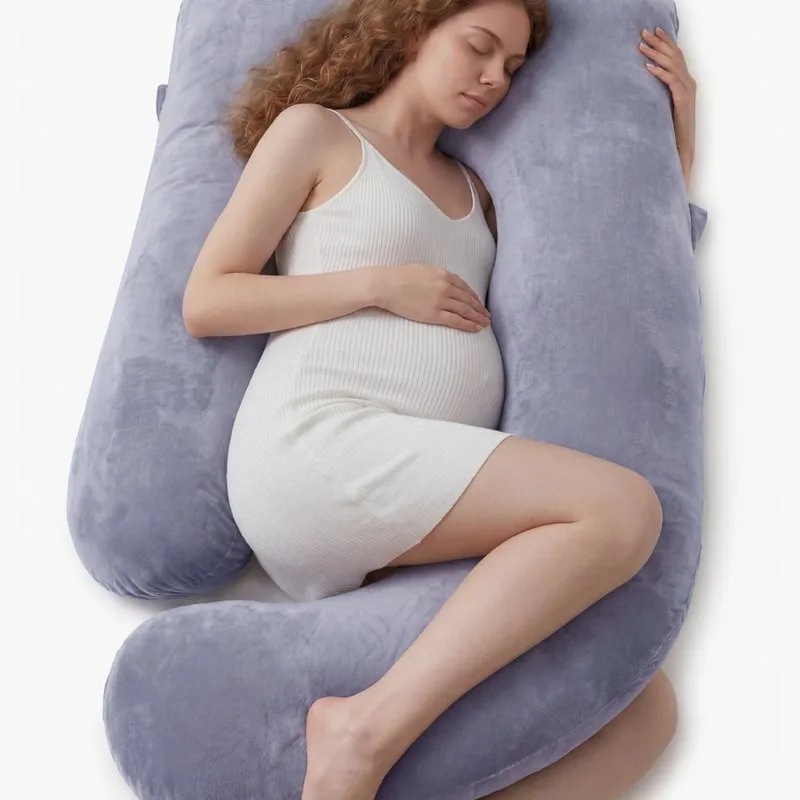
Momcozy Huggable U-Shaped Pregnancy Pillow
A full U-shaped body pillow that supports both sides at once, about 57 inches long, 30 inches wide and 7 inches high, Momcozy says. The plush cover is removable and machine washable, and the polyfill is adjustable through a zippered inner case.
Pros
- Supports back and belly at the same time, good if she flips sides
- Removable, machine-washable cover
- Fill is adjustable through a separate inner zipper
Cons
- Takes up a lot of bed: best with a king
- Arrives vacuum-compressed, so give it time to fluff up
Best C-shape: Boppy Total Body Pregnancy Pillow
A C-shaped pillow “Curved to match your natural leg line when side sleeping,” supporting her head, belly and knees on one side. Boppy says “The body pillow and the pillow cover are both machine washable,” though the pillow itself needs a commercial-size washer or dryer. It’s a good middle ground between the U’s coverage and a queen bed’s limits.
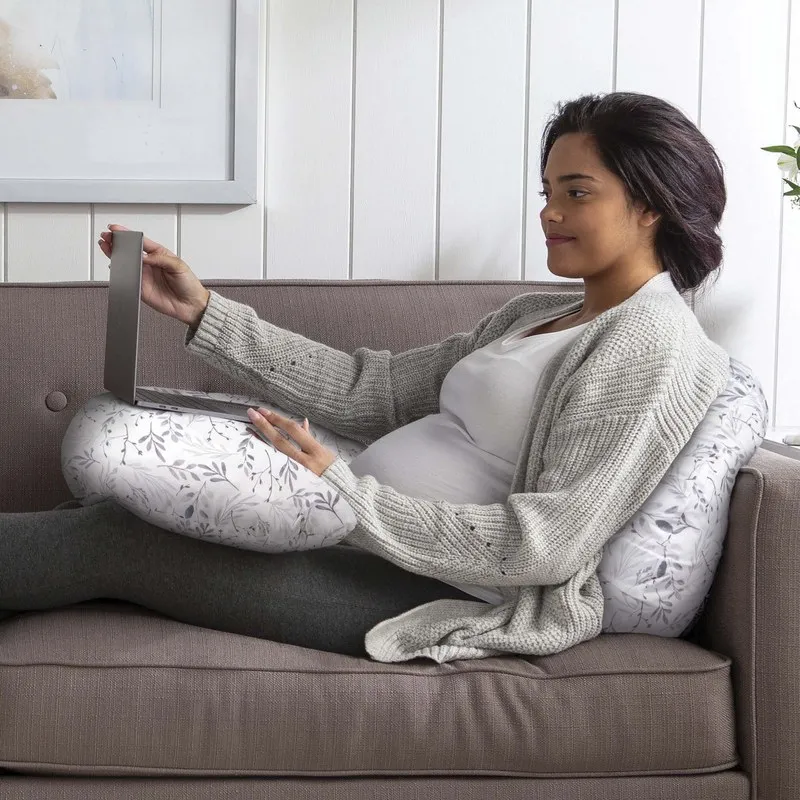
Boppy Total Body Pregnancy Pillow
A C-shaped body pillow curved to follow the leg line when side sleeping, with polyester fill and a removable slipcover. Boppy says both the pillow and the cover are machine washable.
Pros
- Supports head, belly and knees on one side
- Smaller footprint than a full U
- Pillow and cover are both machine washable
Cons
- Boppy says the pillow itself needs a commercial-size washer or dryer
- Supports one side at a time, so it has to move when she rolls over
Best for a queen bed: Frida Mom Compact Support 4-in-1
One long, bendable pillow that “twists and bends into I-, C-, L-, and U-shapes,” Frida says, so she can figure out what works before you lose half the bed. The cover is removable and machine washable, and it comes with a reusable vacuum-sealed storage bag. Frida’s page doesn’t list the fill or exact dimensions.
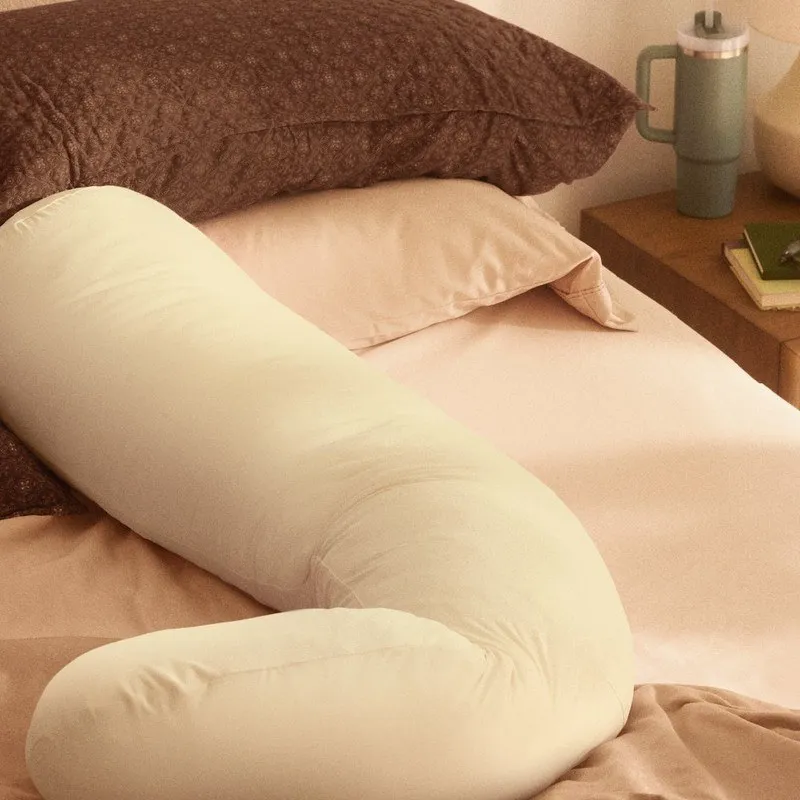
Frida Mom Compact Support 4-in-1 Pregnancy Pillow
A single bendable pillow that twists into I, C, L and U shapes, made to save bed space, Frida says. The cover is removable and machine washable, and it comes with a reusable vacuum-sealed storage bag.
Pros
- One pillow, four shapes: try what works before committing
- Compact, so it leaves room on a queen bed
- Machine-washable cover and a storage bag for after the baby
Cons
- Less all-around support than a full U
- Frida's page doesn't list the fill or dimensions
Smallest: Boppy Side Sleeper Pregnancy Pillow
Two small cushions, one for the belly and one for the back, held together by a stretch panel. Boppy pitches it as “the perfect pregnancy pillow if you are trying to leave a little room for your partner.” It doesn’t support her head or knees, so add a regular pillow between the knees. Boppy also says it keeps you from rolling onto your back; the Australian trial suggests not to count on that.
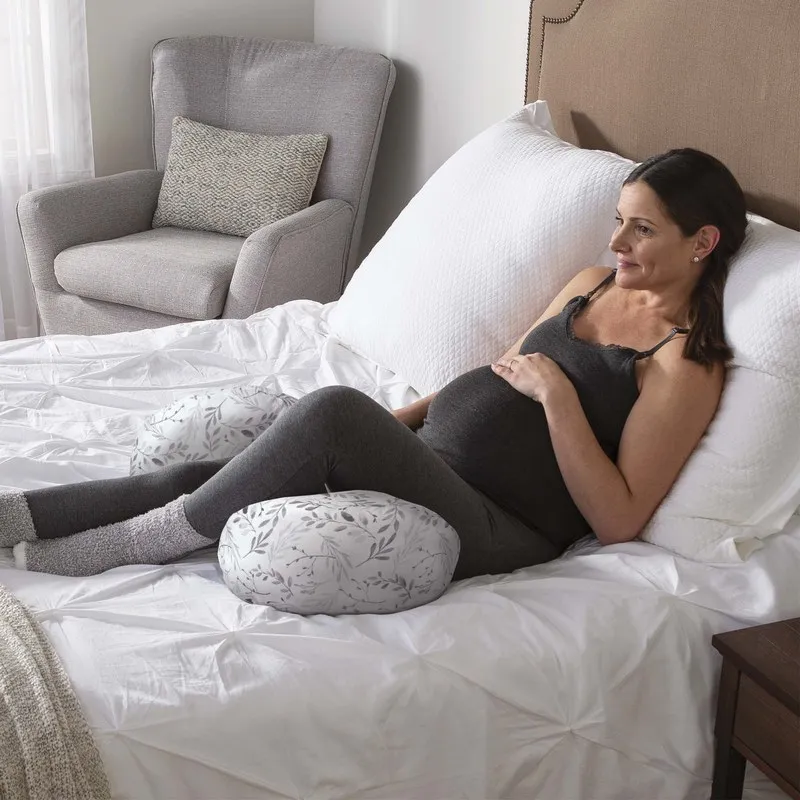
Boppy Side Sleeper Pregnancy Pillow
Two small cushions, one for the belly and one for the back, joined by a panel. Boppy designed it to support side sleeping while leaving room for a partner, and says the pillows and cover are machine washable.
Pros
- Smallest option here: barely takes any bed space
- Belly and back support for side sleeping
- Pillows and cover are machine washable
Cons
- No head or knee support; pair with a regular pillow between the knees
- A small trial found a pillow made to stop back-sleeping didn't, so don't count on it to keep her on her side
When to start using one
No US guideline names a week. ACOG’s side-sleeping advice applies to the second and third trimesters, and the Cleveland Clinic ob-gyn uses 20 weeks as the point to stop spending whole nights on the back. In practice: buy it when she starts waking up sore or can’t get comfortable, often somewhere mid-pregnancy. It also makes a good gift; see gifts for your pregnant wife.
Your side of the bed
A U-shaped pillow plus a pregnant partner can leave you a sliver of mattress. A few things that help:
- Pick the shape for the bed you have, not the one in the ad.
- Give her the side nearest the bathroom.
- Try a mattress topper on her side of the bed for sore hips, an idea MedlinePlus suggests. Our best mattress for new parents guide covers toppers.
- If her snoring keeps you up, tell her, gently. New or worse snoring is something the NIH says to mention to her provider (more below).
Dad’s job: set up the pillow, wash the cover, and be honest if you need a couch night now and then.
When it’s not a pillow problem
Some sleep problems are a reason to call her OB or midwife, not to buy a pillow:
- Back pain that’s severe or lasts more than two weeks. ACOG says to call, and notes “back pain can be a symptom of preterm labor.” Call too for back pain with a fever, burning when she pees, or vaginal bleeding.
- New pain in the upper belly or shoulder, or a headache that won’t go away, especially in the second half of pregnancy. ACOG lists these as possible signs of preeclampsia: “call your ob-gyn right away.” Don’t assume it’s heartburn.
- Loud snoring, gasping or daytime sleepiness. The NIH says sleep-disordered breathing occurs in 3% to 8% of pregnant women, and a 2018 NIH-funded study found sleep apnea “almost doubles” the risk of preeclampsia. She should mention new or worse snoring to her provider.
- Restless legs. Cleveland Clinic says most women with restless legs syndrome get worse during pregnancy. Her provider can check things like folate.
- No sleep aids without asking. MedlinePlus says not to take any, over-the-counter or herbal, without checking with her provider.
For heartburn, Cleveland Clinic suggests smaller meals through the day and not going to bed within two hours of eating. And if she’s running on empty, our guide to a pregnant wife who’s angry and exhausted is worth a read.
After the baby comes: the pillow is hers, not the baby’s
Many moms keep using a body pillow after the birth, for sitting up or nursing. That’s fine while she’s awake. But the baby never sleeps on it, next to it or in a bed with it:
- The AAP says not to use products for sleep that aren’t made for infant sleep, naming “Boppy pillows and Dock-a-Tots” as examples.
- Of nursing pillows, the AAP says: “never use them with sleeping babies. In fact, hundreds of babies have died in them.”
- The CPSC says: “Don’t add pillows or blankets to your baby’s sleep space.”
- If there’s any chance you’ll fall asleep with the baby in your bed, the AAP says to remove pillows and blankets that could cover the baby’s face or head.
Boppy’s 2021 recall was its Newborn Lounger, not its pregnancy pillows. See our safe sleep guide for the full rules.
FAQ
When should she start using a pregnancy pillow?
Whenever she starts waking up sore or can’t get comfortable. ACOG suggests side sleeping with pillows in the second and third trimesters. No US guideline names a start week.
U-shaped or C-shaped: which is better?
No study compares them. A U supports both sides and suits someone who flips over, but it’s big (the Momcozy is about 57 by 30 inches). A C supports one side plus the head and knees with a smaller footprint. On a queen bed, a C, a compact pillow or a two-piece side pillow leaves more room for you.
Is there a pregnancy pillow for stomach sleepers?
Stomach sleeping is fine in the first trimester or so. Later, a pillow under the belly and between the knees helps the side position feel more natural. No US source recommends a specific pillow for stomach sleeping.
Does she have to sleep on her left side?
No. Many providers suggest the left, but the right side is fine too. A pooled analysis of stillbirth studies found the left and right sides equally safe, and ACOG’s patient pages just say “side.”
Is it dangerous if she wakes up on her back?
A Cleveland Clinic ob-gyn says it’s not likely to do lasting harm, and short periods probably do no harm. She can roll back to her side, and a pillow behind her back helps keep her on an incline.
Do pregnancy pillows really work?
The evidence is limited to small trials that found better comfort and less fatigue. An Australian trial found a pillow designed to stop back-sleeping didn’t. Treat it as comfort gear.
Can we use the pregnancy pillow for the baby later?
No. The AAP says not to use products for sleep that aren’t made for infant sleep, and nursing pillows should never be used with a sleeping baby. Babies sleep on their backs on a flat, bare surface.
Sources
- American College of Obstetricians and Gynecologists: Can I sleep on my back when I’m pregnant?, Back pain during pregnancy, A partner’s guide to pregnancy and Preeclampsia and high blood pressure during pregnancy
- National Institutes of Health: NICHD study on sleep position (2019), NHLBI on sleep apnea in pregnancy (2018) and sleep problems in pregnancy (2019); MedlinePlus: Sleep problems during pregnancy
- Cleveland Clinic: Pregnancy insomnia, Sleeping on your back while pregnant and Restless legs syndrome
- Studies (PubMed): Sedov et al. 2021, Mindell et al. 2015, Silver et al. 2019, Heazell et al. 2018, McCowan et al. 2017, Cronin et al. 2019, Wilson et al. 2025, Özer and Özkan 2026 and Öztürk Altınayak et al. 2026
- NICE (UK): Antenatal care guideline NG201
- Infant safety: AAP Safe Sleep and products to avoid; CPSC Safe Sleep and Boppy Newborn Lounger recall (2021)
- Product pages: Momcozy Huggable U, Boppy Total Body, Frida Mom Compact 4-in-1 and Boppy Side Sleeper