Workouts for Busy Dads: How to Stay Fit With a Baby at Home
A realistic workout plan for busy dads, built on the federal activity guidelines. Short bouts count, strength twice a week, and how to train with a baby in the room.
We choose everything we recommend independently. If you buy through our links, we may earn a commission. How we make money
In this guide
Workouts for busy dads have one rule: the plan has to survive a baby. The hour at the gym is probably gone for now, and that’s fine. Studies suggest men’s physical activity drops more than women’s after the first child, but the federal guidelines changed in a way that helps you: short bouts now count. This guide turns those guidelines into a realistic week, with a home routine, ideas for training with the baby around, and three pieces of gear worth their space.
Before you start: the federal guidelines say healthy adults who build up gradually generally don’t need to see a doctor first. If you have a chronic condition like heart disease or diabetes, or symptoms like chest pain, dizziness or joint pain, talk to your doctor before you start.
The short answer
- How much? At least 150 minutes a week of moderate activity (like brisk walking) plus muscle-strengthening on 2 days, according to the Physical Activity Guidelines for Americans.
- In what size pieces? Any. The guidelines dropped the old 10-minute minimum.
- Short on time? Go harder. One minute of vigorous activity counts about the same as two minutes of moderate.
- Where to start if you’ve stopped? Five minutes of walking a few times a day, then build up. The guidelines’ advice is “start low and go slow.”
Why it’s harder now (and why it’s worth it)
You’re not imagining it. A British study following people into their thirties found that becoming a parent was linked to a bigger drop in leisure-time activity for men than for women. A review of studies on parents found people with young children are clearly less active than people without kids. Time, sleep and guilt about leaving the house are the usual reasons.
The payoff hits exactly the things a new dad needs. The federal guidelines say a single session of moderate-to-vigorous activity can improve sleep and reduce anxiety on the day you do it, and that regular activity improves sleep quality and reduces feelings of anxiety and depression. A large 2023 review of more than 1,000 trials found exercise had medium-sized effects on symptoms of depression and anxiety, with bigger improvements at higher intensity.
The rules that make it work for dads
1. Short bouts count. The 2018 guidelines removed the old requirement that activity had to come in 10-minute blocks. The advisory committee concluded that bouts of any length contribute, giving climbing a few flights of stairs as an example. The government’s Move Your Way campaign puts it simply: tight on time? Start with just 5 minutes. It all adds up.
2. Hard counts double. The guidelines’ rule of thumb is that 2 minutes of moderate activity counts the same as 1 minute of vigorous activity. So 75 minutes a week of vigorous exercise, like running, jumping rope or interval training, meets the weekly target.
3. Know your intensity with the talk test. If you can talk but not sing, that’s moderate. If you can only get out a few words before pausing for breath, that’s vigorous.
4. Strength twice a week. The guidelines recommend muscle-strengthening that works all the major muscle groups (legs, hips, back, chest, abdomen, shoulders and arms) on 2 or more days a week. One set of 8 to 12 reps of each exercise, done until another rep would be hard, is effective; 2 or 3 sets may be more effective. Body weight counts: push-ups, planks, squats and lunges are all on the list.
A realistic week
A sample plan built on those rules. Mix and match as the baby allows.
| Day | Cardio | Strength |
|---|---|---|
| Mon | 3 walks of 10 minutes (stroller, carrier or lunch break) | |
| Tue | 20-minute home circuit (below) | |
| Wed | 30-minute brisk walk or bike ride | |
| Thu | 10 minutes of hard intervals at home (vigorous counts double) | |
| Fri | 20-minute home circuit | |
| Sat | Long walk or hike with the family, about 60 minutes | |
| Sun | 20-minute walk, or rest |
That adds up to about 160 minutes of moderate-equivalent activity (the 10 hard minutes count as 20) plus 2 strength days. On a bad week, any piece of it is better than none: the guidelines are clear that some activity is better than none.
Starting from zero? The guidelines suggest beginning with 5 minutes of walking several times a day, 5 to 6 days a week, then building to 10 minutes per session and walking faster. They note the biggest jump in benefit comes from going from nothing to about 60 minutes a week.
The 20-minute home circuit
No gym needed. Warm up with 3 to 5 minutes of easy movement first: the guidelines recommend a warm-up that gradually raises your heart rate and breathing.
Do 8 to 12 reps of each exercise (hold the plank as long as you can with good form), rest briefly, and repeat the round 2 or 3 times:
- Squats (legs and hips)
- Push-ups, on your knees or with hands on the couch if you need to (chest, shoulders, arms)
- Lunges, alternating legs (legs and hips)
- Rows with a resistance band anchored in a door (back and arms)
- Plank (abdomen and back)
Two technique notes from the National Institute on Aging: breathe out during the effort and in as you relax, and don’t hold your breath. And give each muscle group a day off between strength sessions so it can recover.
Short on time? Some small studies have tested very short, hard workouts. In one, sedentary men who did 10-minute sessions of cycling with three 20-second all-out sprints, three times a week, improved their fitness as much as men doing 45 minutes of steady cycling. That was a small lab study, so treat it as a useful option, not a magic shortcut.
Training with the baby around
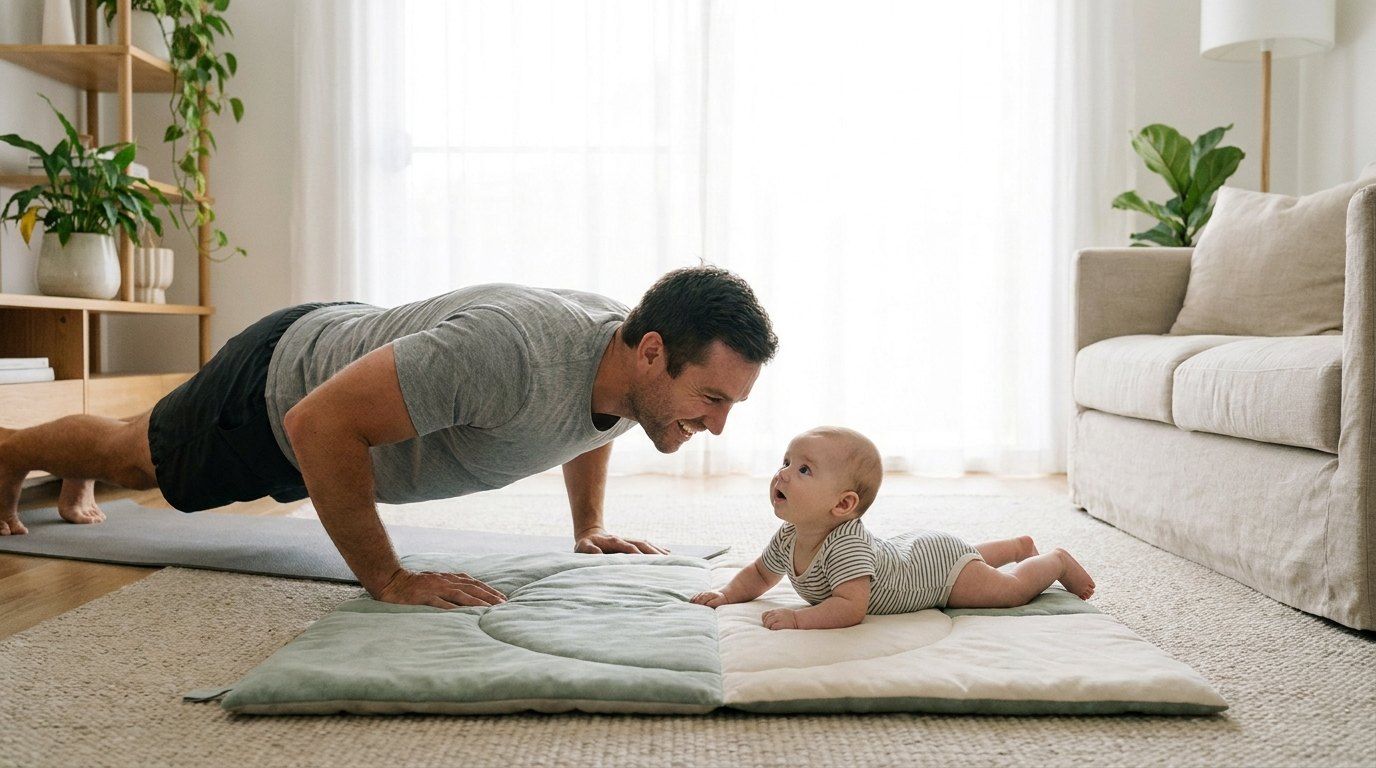
- Make tummy time your workout time. The American Academy of Pediatrics recommends tummy time for awake babies, with you watching closely, starting with a few short sessions a day. Get down on the floor with them and do your push-ups and planks face to face. Never leave the baby unattended.
- Walk with the stroller or carrier. Brisk walking is moderate activity. Use the stroller’s five-point harness on every ride, as the AAP recommends, and set the brake whenever you stop. For carriers, follow the TICKS rule in our guide to baby carriers for big and tall dads.
- Running waits. Jogging stroller makers set age minimums: BOB, for example, says running is only for children 8 months and older in the stroller seat. See the best strollers for tall dads.
- Keep the gear out of reach. Put weights and bands away after each session so a crawler can’t pull them down.
- Use the baby’s naps. Two strength sessions of 20 minutes fit in nap time.
Gear that earns its space
You don’t need any of this to start. If you want to add equipment, these three cover a lot of ground in a small apartment.
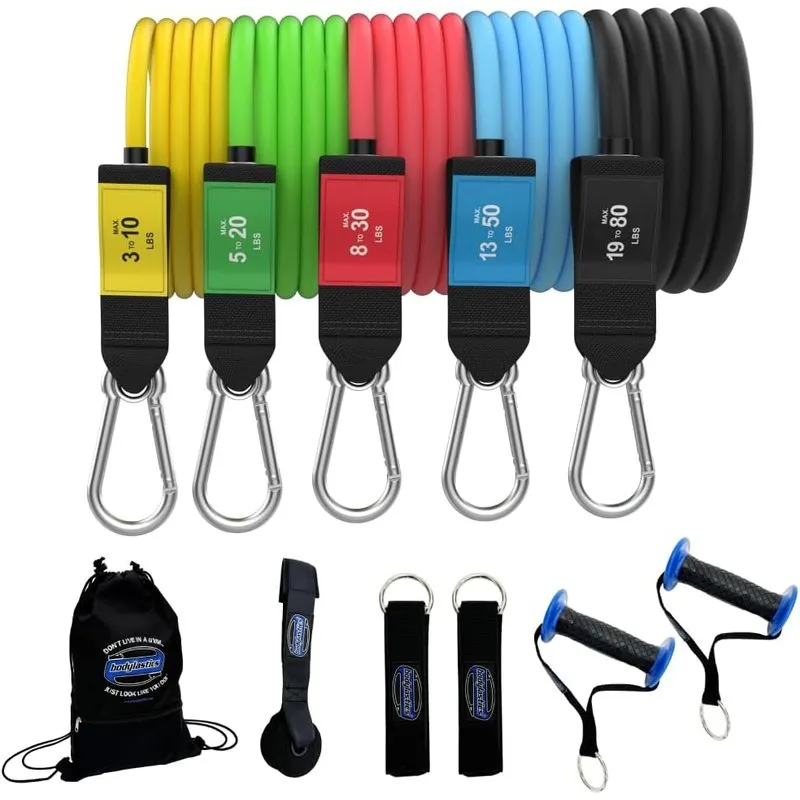
Bodylastics 5 Band Pro Series Set
Five stackable resistance bands, from 3 to 10 pounds up to 19 to 80 pounds, with handles, ankle straps, a door anchor and a carry bag. Bodylastics lists up to 190 pounds of combined resistance.
Pros
- Cheapest way to train every major muscle group at home
- Packs into a bag for travel
- Door anchor turns a doorway into a cable station
Cons
- Check bands for wear before each use
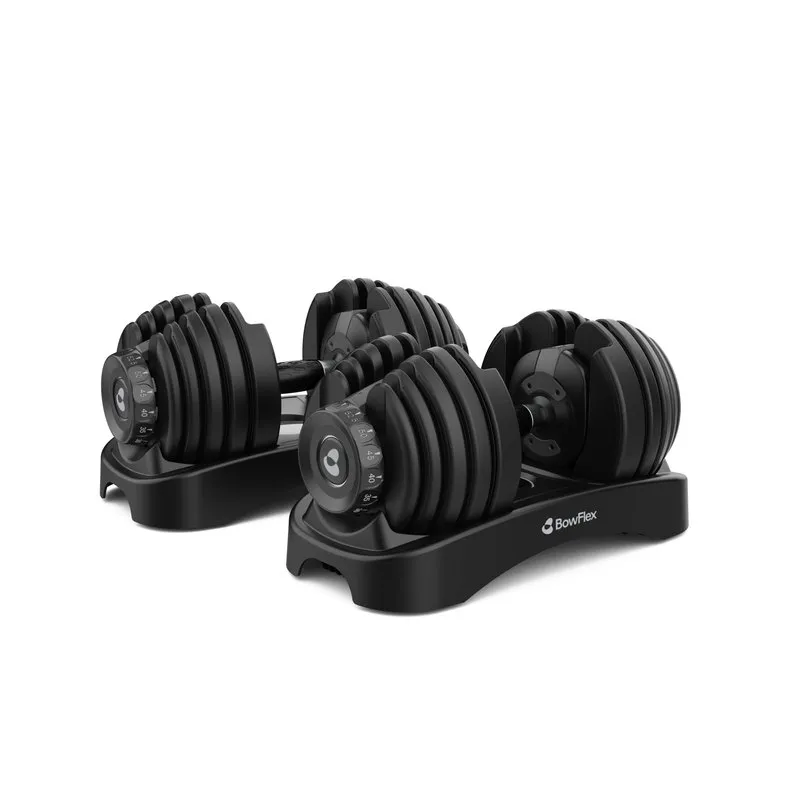
BowFlex Results Series 552 SelectTech Dumbbells
Adjustable dumbbells that go from 5 to 52.5 pounds each in 15 settings, replacing 15 sets of weights. Each dumbbell measures 16.9 by 8.3 by 9 inches, so a pair fits in a corner.
Pros
- A full rack of weights in a small footprint
- Quick dial to change weight between sets
- Room to progress for years
Cons
- Expensive
- Keep them stored in their trays, away from crawling kids
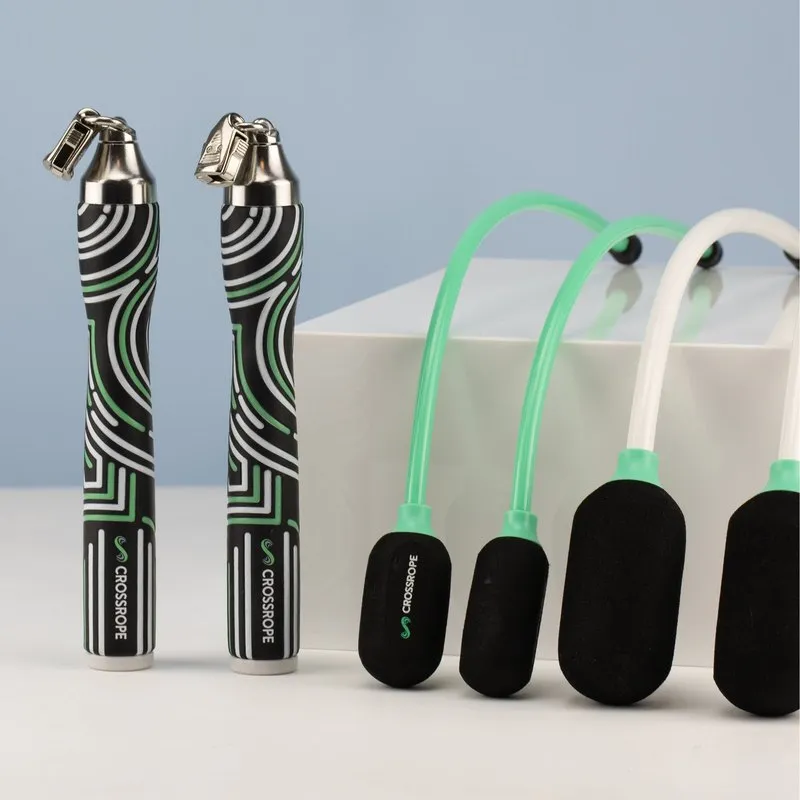
Crossrope Ropeless Get Lean Set
Jump rope handles with short weighted attachments instead of a rope (14 inches long), so you get the jump-rope motion with nothing swinging overhead. Crossrope pitches it for small spaces, low ceilings and quieter workouts.
Pros
- Works in a living room with low ceilings
- Quieter workouts, according to Crossrope
- Quick cardio in short bursts
Cons
- Pricey for a jump rope
If your weight has crept up since the baby came, see do new dads gain weight? for what the research shows and what helps.
FAQ
How much exercise does a dad need each week?
The Physical Activity Guidelines for Americans recommend at least 150 minutes a week of moderate activity, or 75 minutes of vigorous activity, plus muscle-strengthening on 2 or more days. That’s about 22 minutes a day of moderate activity.
Do short workouts count?
Yes. The 2018 guidelines removed the old 10-minute minimum and say bouts of any length contribute. A 5-minute walk or a few flights of stairs counts toward your weekly total.
What’s the best workout for a busy dad at home?
A 20-minute bodyweight circuit twice a week (squats, push-ups, lunges, band rows and planks) plus walking most days covers the guidelines. Add short, hard intervals when you only have 10 minutes.
Can I work out with my baby?
Yes, with care. Do floor exercises during your baby’s supervised tummy time, and walk with the stroller or carrier. Wait to run with a jogging stroller until the age its maker allows, often around 8 months.
Does exercise help with sleep and stress?
Yes. The federal guidelines say a single session can improve sleep and reduce anxiety that day, and regular activity improves sleep quality and reduces anxiety and depression.
Sources
- Physical Activity Guidelines for Americans, 2nd edition and Move Your Way: Adults fact sheet, U.S. Department of Health and Human Services
- Physical Activity Guidelines for Adults, Centers for Disease Control and Prevention
- Three Types of Exercise Can Improve Your Health and Physical Ability, National Institute on Aging
- Back to Sleep, Tummy to Play and How to Choose a Safe Baby Stroller, American Academy of Pediatrics (HealthyChildren.org)
- Cohabiting and becoming a parent: associations with changes in physical activity in the 1970 British cohort study, Werneck et al., BMC Public Health, 2020
- A birth of inactivity? A review of physical activity and parenthood, Bellows-Riecken and Rhodes, Preventive Medicine, 2008
- Effectiveness of physical activity interventions for improving depression, anxiety and distress: an overview of systematic reviews, Singh et al., British Journal of Sports Medicine, 2023
- Twelve weeks of sprint interval training improves indices of cardiometabolic health similar to traditional endurance training despite a five-fold lower exercise volume and time commitment, Gillen et al., PLoS One, 2016
- Revolution Flex 3.0, BOB Gear